Detailed Explanation of Tulip Planting Methods and Technical Key Points
Tulip (Tulipa gesneriana L.) is a perennial bulbous flower of the genus Tulipa in the family Liliaceae. Because of its elegant appearance and pure flower colors, it is deeply loved by people and is an important early-spring ornamental garden flower. It needs to go through a certain low-temperature stage and can only bloom normally after the flower stem has fully grown.
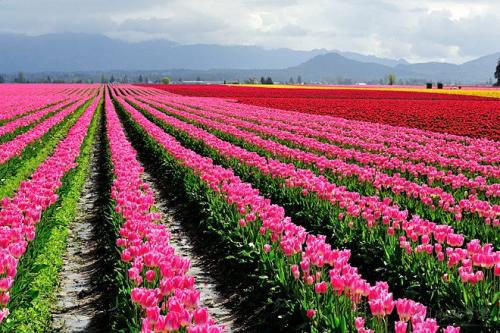
Tulip propagation method: bulb division propagation. In North China, planting is suitable from late September to late October; in East China, planting is suitable from September to October; in warmer regions, planting can be done from late October to early November. The temperature, light, moisture, soil conditions and other conditions of the planting site should match its optimal growth and development environment as much as possible; different varieties also have different requirements, which should be noted during large-scale propagation. Use fully decomposed pig, cattle, chicken manure, human feces and urine, etc., evenly turned into the soil at 105,000 kg/hm2, with a cultivation layer of more than 20 cm. It has a relatively wide adaptability and can grow in sandy loam and light clay soil with a pH of 6-7.5. Sandy loam with good drainage, high organic matter content, fertility, looseness, and good permeability is most suitable.
Tulip planting management: the plant and row spacing is 7 cm x 11 cm, and the soil covering thickness is 2.5-3 times the bulb diameter. Irrigate thoroughly immediately after planting; if the soil is relatively dry before winter, irrigate once more. After the soil thaws in early spring, the axillary buds sprout and emerge; apply fertilizer once every two weeks, using a 2%-3% liquid fertilizer of calcium nitrate or potassium nitrate combined with watering for root irrigation. Stop water and fertilizer 3 weeks before dormancy. Each irrigation and topdressing should avoid excessive moisture, otherwise the soil permeability will worsen, affecting normal growth and making diseases more likely. Cultivate daughter bulbs into new bulbs used for cut flowers. Generally, those with a circumference of about 3 cm need to be cultivated for 2 years, while those with a circumference of 5 cm can reach 12 cm after 1 year of cultivation and be used as bulbs for cut flower production. Harvest when the stems and leaves wither in summer; when digging out the bulbs, be careful not to damage them, remove the soil, disinfect, and store. Seed propagation is generally carried out in autumn, and seedlings usually need 5 years to bloom.
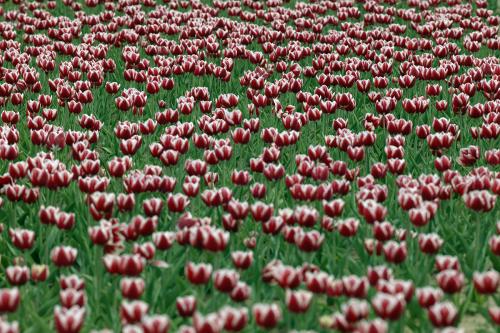
Tulip cultivation techniques: for the selection of seed bulbs, bulbs with a circumference of more than 12 cm can be used for cut flower cultivation. Bulbs of 9-11 cm can be used for potted flowers or open-field planting. The storage conditions and planting date of the bulbs directly affect the flowering time, quality, etc. Generally, after the bulbs are harvested, place them in a ventilated and dry place at a temperature of 25°C; in July-August, the storage temperature is 17-18°C. After this period of storage, the flower buds grow to 4 mm in length and differentiation is basically complete, but they still need low-temperature vernalization before they can bloom. At present, low-temperature treatment is commonly used to break dormancy. Tulips overwintering in the open field are planted in September and bloom in April of the following year; during this period they go through a natural vernalization stage, while forced cultivation requires artificial temperature control for vernalization treatment.
For flowering in December, in mid-to-late August treat the bulbs at a controlled temperature of 13°C for 3 weeks, then lower the temperature to 5°C for 9 weeks, and plant in mid-to-late October; or in mid-to-late August store the bulbs at 9°C for 6 weeks, then plant. For flowering in February, carry out 5°C treatment for 6 weeks in October and plant in early December. For flowering in March, this is semi-forced cultivation, also called late forced cultivation; plant in late January. After storage in the previous period and natural vernalization, artificial treatment may be omitted, or from July to early September keep them at 23°C, from September to early October at 20°C, and when planting from October to early November maintain 17°C. Before planting, peel off the bulb membrane, remove diseased bulbs, and soak in a 200-fold solution of Junduxiao or an 800-fold solution of chlorothalonil for 30 min; do not damage the bulbs during disinfection.
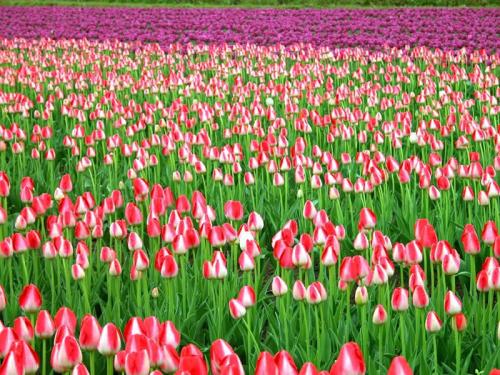
For tulip planting, apply fully decomposed organic fertilizer. In areas with heavy clay soil, also apply fermented fertilizer (human feces and urine) with furnace slag as the main body at 120,000 kg/hm2, or prepare a potting substrate. The potting substrate is prepared with furnace slag : sandy soil : decomposed manure at 1:3:1. For soil disinfection, spray and water the soil with a 500-fold solution of carbendazim and a 1000-fold solution of 75% phoxim emulsifiable concentrate. Make raised beds with a bed width of 120 cm, a planting layer thickness of 30 cm, and a working path width of 45 cm. The plant and row spacing is 10 cm x 12 cm. For potting, plant 3 bulbs in each pot with an inner diameter of 20 cm. The soil covering thickness is 1.5 times the bulb diameter; if the nose has already grown out, the tip of the nose can be level with the soil surface.