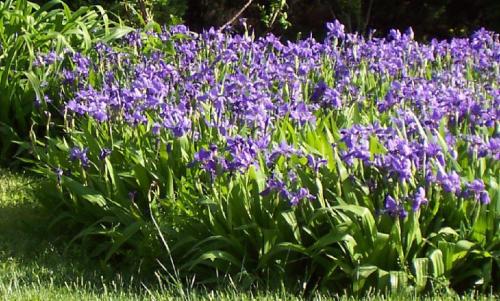
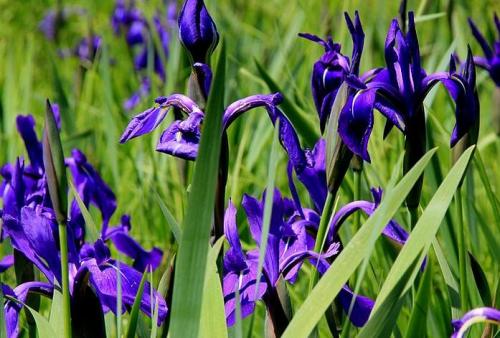
Iris (scientific name: Iris tectorum Maxim.), also known as blue butterfly, purple butterfly, flat bamboo flower, etc., belongs to the order Liliales, family Iridaceae, genus Iris, and is a perennial herb with a thick rhizome about 1cm in diameter, extending obliquely; leaves 15~50cm long, 1.5~3.5cm wide, flowers blue-purple, about 10cm in diameter; capsules oblong-elliptic or obovate, 4.5~6cm long, 2~2.5cm in diameter. It is native to central China and Japan, and is mainly distributed in south-central China. It can be used for ornamental purposes, its flowers have a delicate fragrance and can be used to make perfume, and its rhizome can be used as traditional Chinese medicine, harvestable year-round, with anti-inflammatory effects.
Cultivation Techniques
Soil Requirements
Iris can be planted not only in glass greenhouses or plastic film greenhouses, but also in open fields. Outdoor planting with temporary covers, or using movable houses, is feasible especially in spring and autumn.
For the production of cut iris flowers, planting can actually be carried out in any type of soil, as long as it drains well, has strong moisture retention, and does not become compacted (otherwise it will restrict plant growth). Good soil structure is a fundamental condition, which is very necessary for the frequent large-scale planting of short-growing-period iris.
In heavy loam, it is recommended to add materials such as peat, vermiculite or coarse sand and mix them into the soil to a depth of about 25cm to improve the soil. For soil that easily becomes compacted, after planting a layer of materials such as rice husks, straw, pine needles, black peat or similar materials can be spread on the soil surface to prevent compaction. This method can also be used to prevent the soil from drying out too quickly.
After planting, soil temperature is the most important factor, with a minimum temperature of 5~8°C and a maximum temperature of 20°C. The level of soil temperature directly affects the emergence rate. Too low a soil temperature will reduce flowering capacity, so the optimal soil temperature should be controlled between 16~18°C.
For producing iris in a greenhouse, the optimal temperature is 15°C. To shorten the growing period, newly harvested bulbs can be used at planting, with the greenhouse temperature maintained at 18°C for the first 4~3 weeks. This temperature can be maintained until January 1, but it will cause the plants to be weak and small. A temperature of 13°C or lower will prolong the growing period and at the same time increase plant weight, but the probability of flower withering increases.
In autumn, when the plants are growing, especially in temperate regions, when light is insufficient, the greenhouse temperature must be lowered to prevent flower withering. Generally controlled at 10~13°C, try to ensure plant growth; if at all stages the leaves appear excessive, then consider pruning off some leaves.
The average day and night temperature for production can be 20~23°C, with a minimum temperature of 5°C. In greenhouses with high temperatures and weak light, lack of light is the main cause of flower withering.
In areas where frost damage occurs frequently, production can only be carried out in greenhouses. Its suitable growth temperature should be arranged at night. Therefore, unheated greenhouses should be closed early to make the night temperature as suitable as possible. During the day, ventilation should be started early to avoid harm caused by the temperature rising above 18°C. Shading can also achieve the purpose of temperature control, but an appropriate light level still needs to be maintained.
The optimal temperature for open-field growth is 15~17°C, and continuous high temperatures during the day can be blocked with shade nets. It can not only reduce direct solar radiation, but also increase temperature.
Drainage system: In order to quickly remove excess water, a well-functioningdrainage system should be installed. This also makes it possible to use water to leach the greenhouse soil. This treatment can prevent the problem of salt accumulation caused by using less water when growing fertilizer-loving crops or during a certain planting stage.
Planting density: Planting density varies according to different varieties, bulb size, planting period, and planting location. To make the planting spacing appropriate, a planting net with 64 grids per square meter is usually used.
Fertilization points: Generally speaking, applying base fertilizer before planting is not advisable, as this will increase the salt concentration in the soil and delay the growth of the iris root system. Before planting, sample and test the soil to ensure that the soil contains the correct nutrients. Sampling must be done after soil treatment and leaching. In this way, the missing nutrients can be obtained by directly supplementing fertilizer into the soil later. Iris is sensitive to fluorine, so fluorine-containing fertilizers (phosphate fertilizers) and triphosphate fertilizers must not be used. Conversely, fertilizers such as diphosphate should be used.
Weed Control
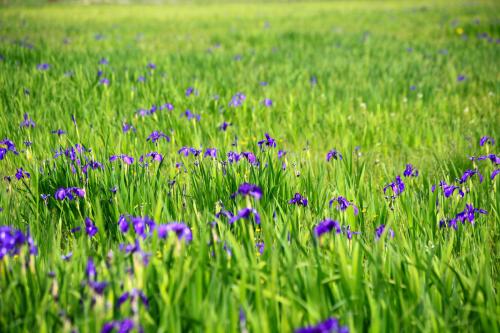
The growth process of iris only takes 8~12 weeks. In such a short growth time, if the soil has been treated by steaming, flooding, plowing, etc., then there is no need to consider the weed problem during plant growth. After the plants are planted, chemical herbicides are mainly used to remove weeds. However, when applying them, take care not to cause damage to the plants.
If weeds begin to grow in the field after the plants are planted, herbicides can only be applied when the bulbs are buried deep enough. Newly sprouted young shoots of the bulbs will not be harmed by herbicides only when they are at least 2 centimeters below the soil surface.
Before the plants unfold their leaves, small weeds in the greenhouse or open field can be controlled by spraying suitable herbicides. If ordinary herbicides cannot effectively control some annual grass weeds, then compound herbicides should be used instead. When applying, do so when it is nearly dark, spray onto the plants, and then spray enough water. Early the next morning, rinse thoroughly from the top of the plants. Because herbicides have residual effects, be sure to pay attention to the following points. The amount of herbicide applied in each field per year must be limited, preferably no more than 2 times; use herbicides only when absolutely necessary; do not plant varieties that are sensitive to herbicides.