Detailed Explanation of Chestnut Planting Techniques and Management Methods
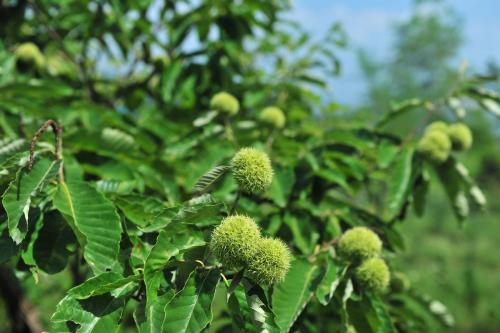
The chestnut, whose proper name is chestnut (Castanea mollissima Bl.), has rich variety in our country. Based on appearance, it is roughly classified into two types: one is the chinquapin, mainly produced in the mountainous areas north of Fujian. The flat, large one is the Chinese chestnut, mainly found in many provinces of northern China.
Cultivation Techniques
Orchard Site Selection
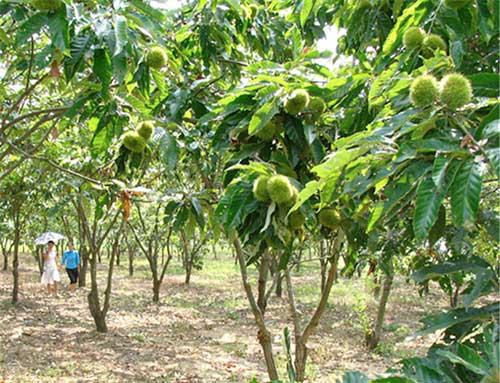
A chestnut orchard should be established on sandy loam soil with a low groundwater table and good drainage. Avoid planting in saline-alkaline soil, low-lying waterlogged areas, and windy locations. When opening up a chestnut orchard on hilly land, choose gentle terrain near mountains with deeper soil layers, and later gradually expand to areas with poorer conditions.
Variety Selection
Variety selection should focus on excellent varieties bred locally as the main cultivars, such as Paoche No. 2, Chenguo No. 1, etc., and appropriately introduce varieties such as Shifeng, Jinfeng, Haifeng, Qingmao Ruanci, and Chushu Hong. According to different edible requirements, roasting chestnut varieties should be the main focus, while appropriately developing excellent vegetable chestnut varieties, considering both foreign trade export and domestic market demand. At the same time, achieve a reasonable combination of early, mid, and late varieties.
Arranging Pollinator Trees
Chestnut trees mainly rely on wind to spread pollen, but because chestnut trees exhibit dichogamy of male and female flowers and self-pollination, a single variety often produces empty burs due to poor pollination. Therefore, a newly established chestnut orchard must include 10% pollinator trees. Practice has proven that using Chushu Hong as a pollinator tree in Xinyang City works well.
Reasonable Close Planting
Reasonable close planting is a basic measure to increase yield per unit area. For plains chestnut orchards, 30-40 trees per mu is appropriate; for mountain chestnut orchards, 40-60 trees per mu is appropriate. For planned close-planting chestnut orchards, 60-111 trees per mu can be planted, with gradual thinning by rows and by individual trees later.
Irrigation
Chestnut trees relatively prefer water. Generally, irrigate once before sprouting and once during the rapid fruit growth period, which helps the normal growth and development of the fruit trees and improves fruit quality.
Shaping and Pruning
Pruning chestnut trees is divided into winter pruning and summer pruning. Winter pruning is carried out from after leaf fall to before bud break the following spring, and it can promote the tree's vigor and female flower formation. The main methods include heading back, thinning branches, renewal pruning, delayed pruning, branch bending, and notching. Summer pruning mainly refers to bud removal, pinching, male flower removal, and branch thinning during the growing season, whose purpose is to promote branching, increase female flowers, and improve the fruit-setting rate and single-nut weight.
(1) Heading back: Cutting off part of a one-year-old branch. Heading back can promote branching, strengthen tree vigor, compact the canopy, reduce male flowers, and adjust the distribution of nutrients. For vigorous trees and vigorous branches, delayed pruning can be used, heading back after bud break.
(2) Renewal pruning: This is heading back perennial branches. It is mostly used for perennial branches that are weak in growth, whose fruiting部位 has moved outward, and whose inner canopy is severely bare.
(3) Branch thinning: Removing competing branches, shade-casting branches, and slender branches in the inner canopy from the base.
(4) Cap pruning: Winter heading back near the bud scale scars of new shoots that have been pinched different numbers of times. Leaving 2-4 small buds on the new shoot scale scar for heading back is called live-cap pruning; if handled properly, the small buds above the cap and the large buds below the scale scar can produce fruiting branches. Heading back on the new shoot scale scar without leaving buds is called dead-cap pruning, causing the large buds below the scale scar to produce fruiting branches. Generally, for branches with weak vigor, use dead-cap pruning; for branches with strong vigor, use live-cap pruning.
(5) Delayed pruning: Delayed pruning means not pruning. Its main effect is to disperse nutrients and moderate tree vigor. Vigorous trees mostly use delayed pruning.
(6) Branch bending and notching: For vigorous auxiliary branches in the canopy that have not been pinched, during the period from spring sap flow to bud break, bend them flat and make notches above each bud at the position where sprouting is desired, so they produce vigorous branches. At winter pruning, then cut the delayed and flattened branches back to the position where vigorous branches were produced.
(7) Pinching: When a new shoot grows to 30 cm, remove the tip of the new shoot. It is mainly used on vigorous branches to promote branching and early fruiting. Pinch 2-3 times each year. For trees beginning to bear fruit, the new shoots of fruiting branches are long and vigorous; after the pre-fruit shoot grows out, leave 3-5 buds and pinch. After pinching the pre-fruit shoot, about 3 robust branches can form, increasing the proportion of fruiting branches produced, while also slowing the outward movement of the fruiting部位.
(8) Male flower removal: Leave only a few male inflorescences on the branch and remove the rest. Its main effect is to regulate nutrients, promote female flower formation, and improve fruit-setting ability.
Flower and Fruit Thinning
Flower thinning can be done directly by hand by removing later small flowers and inferior flowers, keeping as many earlier large flowers and good flowers as possible. Generally, keeping 1-3 female flowers per fruiting branch is appropriate. For fruit thinning, it is best to use fruit-thinning shears, leaving 1 single bur per internode. When thinning flowers and fruits, grasp the principle of leaving more on the outer canopy and fewer in the inner canopy. For artificial supplementary pollination, choose varieties with excellent quality, large nuts, early ripening, and easily peeled astringent skin as pollinator trees. When the male inflorescences on a branch, or most of the flower clusters' anthers on the male inflorescence, have just changed from green to yellow, spread the collected male inflorescences on glass or clean white paper before 5 a.m., place in a dry, windless place, turn 2 times each day, and put the fallen pollen and anthers into a clean brown bottle for later use. When the multi-lobed stigmas of the 3 female flowers in one involucre are fully extended and curled back and turned yellow, use a brush or a pencil with a rubber tip to dip pollen and dab it on the curled-back stigmas. If the tree is tall and dipping is inconvenient, the gauze bag shaking method or powder spraying method can be used, prepared at a ratio of 1 part pollen to 5 parts taro powder filler.