Bougainvillea, also known as: Purple Bougainvillea, Purple Yalan, Bougainvillea; Latin scientific name: Bougainvillea glabra Choisy. A vine-like shrub of the Nyctaginaceae family, Bougainvillea genus. Stems are thick and sturdy, branches drooping, hairless or sparsely pubescent; thorns are axillary, 5-15 mm long. Leaves are papery, ovate or ovate-lanceolate. It prefers a warm, humid climate, is not cold-tolerant, and loves full sunlight. There are many varieties, and the plant has strong adaptability; it is not only widely distributed in southern regions but can also be cultivated in the cold north. Native to Brazil. In southern China it is planted in courtyards and parks, while in the north it is cultivated in greenhouses; it is a beautiful ornamental plant. The flowers are used medicinally to regulate qi and blood, treat leukorrhea, and regulate menstruation.
Planting Methods
Cuttage propagation is commonly used, and seedling cultivation is easy. In May and June, cut mature woody branches, 20 cm long, insert them into a sand pot, cover with glass, and keep moist; roots can form in about one month, and after two years of cultivation they can bloom. The whole plant's flowering period is very long, reaching three to four months. During the flowering period there is considerable fallen flower and leaf litter, which needs
to be removed promptly to keep things fresh and attractive. Bougainvillea glabra is vine-like and easy to propagate. Simply insert its stems into soil in early spring or late autumn, and roots will form in one month, with branches and leaves growing out. It can bloom the second year. Its flowering period is generally about one month; in the south the flowering period is generally from October of the current year to early June of the following year.
Choosing Potting Soil
It is not demanding about soil, but fears waterlogging and is not tolerant of waterlogging; therefore, a loose, well-drained potting soil must be chosen. Generally, a potting soil made of 4 parts humus soil, 4 parts garden soil, and 2 parts sand can be used, or sun-dried pond mud mixed with some coal cinder can be used as potting soil.
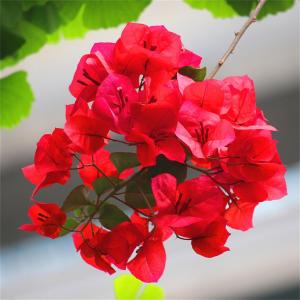
An evergreen small shrub, with bright red eye-catching flowers, relatively large flower shape; every 3 bracts gather into a small triangular flower, hence it is also called triangular flower. Bougainvillea glabra prefers warmth and sufficient light, is not cold-tolerant, and avoids waterlogging. It is suitable for growing in fertile, loose, well-drained sandy soil; in heavy, alkaline, low-lying, waterlogging-prone soil it not only grows poorly but also easily rots at the roots and dies. The potting soil should be prepared with 4 parts leaf mold, 2 parts garden soil, 1 part decomposed barnyard manure, 1 part sawdust, and 2 parts river sand; when potting, 30 g of decomposed cake fertilizer should also be mixed in as base fertilizer.
It needs a certain amount of nutrients; during the growing period, appropriate fertilization is required to meet its growth needs. Fertilizer should be decomposed, and fertilization should be applied in small amounts many times, with a light concentration; otherwise, it easily damages the root system and affects growth. Starting in May, apply a 10%-15% cake fertilizer solution once every half month to promote spring shoot growth; in the high-temperature season of July-August, to meet its growth needs, apply a 10% cake fertilizer solution and a small amount of superphosphate or a small amount of compound fertilizer solution once every 15-20 days; after September, less nitrogen fertilizer should be applied; wood ash and a small amount of superphosphate can be used to promote the bracts to open in a bright red and attractive color. Bougainvillea glabra needs less water than other flowers; during the growing period, it is enough that the potting soil is neither dry nor wet.
Reasonable Fertilization
To make it bloom, sufficient nutrients must be ensured, and fertilization must be timely and appropriate, used reasonably. Generally, from April to July during the vigorous growth period, apply liquid fertilizer once every 7-10 days to promote robust plant growth; the fertilizer can be 10%-20% decomposed soybean cake or rapeseed cake water or human manure water, etc. Starting in August, in order to promote flower bud formation, apply fertilizer mainly based on phosphorus fertilizer once every 10 days; 20% decomposed chicken, duck, and pigeon manure and fish scraps and other liquid fertilizers can be used. From October onward it enters the flowering period; from then until mid-November, a fertilizer mainly based on phosphorus fertilizer needs to be applied once every half month, with a fertilizer water concentration of 30%-40%. After that, each time after flowering, an additional topdressing should be applied once, so that the flowering period continuously receives nutrient supplementation.
Water Control Before Flowering
Usually, watering should follow the principle of "do not water if not dry, and water thoroughly when watering." But for neat and abundant flowering, water control must be carried out before flowering. Starting in September, control watering of Bougainvillea; each watering should wait until the potting soil is dry and the branches and leaves are soft and drooping before proceeding. Repeat this continuously for half a month, then after half a month resume normal watering as usual. During the water control period, absolutely do not fertilize, to avoid fertilizer burning the root system. In this way, about one month is enough for buds to appear and bloom, and the flowers will open neatly and abundantly.
Loosening Soil and Repotting
Due to long-term watering, fertilizing, and rain washing, the potting soil easily becomes compacted; therefore, the soil must be loosened regularly, and weeds in the pot should be removed at the same time, to benefit the growth of Bougainvillea. Otherwise, if the potting soil is compacted and water accumulates, it easily causes root rot or poor growth. In addition, Bougainvillea glabra grows relatively fast, has a developed root system, and very many fibrous roots, so it needs repotting once a year.
Field Management
Temperature
The suitable growth temperature is 15-30°C, of which May-September is 19-30°C, and October to the following April is 13-16°C. In summer it can tolerate high temperatures of 35°C; when the temperature exceeds 35°C, appropriate shading or measures such as spraying water and ventilation should be taken. In winter, the ambient temperature should be maintained no lower than 5°C; otherwise, when the temperature is below 5°C for a long time, it is prone to frost damage and leaf drop.
Flowering requires a temperature above 15°C; to extend the flowering period, it should be moved indoors promptly before the early winter cold wave arrives, placed in a sunny spot, and maintained at a relatively high ambient temperature (it can continue blooming between New Year's Day and the Spring Festival).
Light
It likes light and is a sun-loving flower; insufficient light during the growing season will lead to weak plant growth and affect bud formation and flowering. Therefore, throughout the year, except that newly potted small seedlings should first be placed in semi-shade. In winter it should be placed in front of a south-facing window, and the light duration must not be less than 8 hours; otherwise, a large amount of leaf drop easily occurs. It is a short-day flower; by controlling the daily light duration to about 9 hours, it can form buds and bloom after one and a half months.
Pruning
It grows rapidly; during the growing period, attention should be paid to shaping and pruning to promote side branch growth and produce more flowering branches. The number of prunings is generally 1-3 times, and it should not be too many; otherwise, it will affect the number of bloomings. After each flowering, promptly remove the remaining flowers to reduce nutrient consumption. After the flowering period, thin out overly dense branches, inner branches, leggy branches, and weak branches; generally do not prune other branches, or only lightly prune the branch tips. Heavy pruning is not suitable, so as to shorten the next growth period and promote earlier and multiple bloomings.
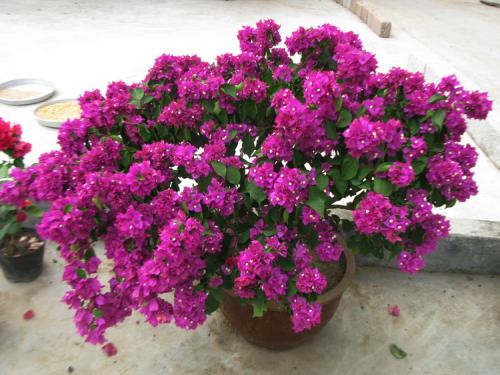
It has strong growth vigor, so it needs shaping and pruning every year, and once every 5 years it needs heavy pruning for renewal. The time can be in spring each year or after flowering; cut off overly dense branches, dry and withered branches, diseased and weak branches, crossing branches, etc., to promote new branches. After fallen leaves and flowers during the flowering period, they should be cleaned up promptly. After flowering, promptly remove the remaining flowers. During the growing period, promptly pinch the tips to promote side branches, help flower bud formation, and promote lush flowering. Old plants can be cut back somewhat. Bougainvillea has climbing characteristics, so this feature can be used for tying and shaping; it can be trained into shapes such as flower rings, flower baskets, and flower balls. When necessary, supports can also be set up to create various shapes, such as flower pillars.
Flowering Period Control
If you want to see Bougainvillea glabra on National Day, you can move the pot into a dark room in advance for light-avoidance treatment, because it is a short-day flower. Around early August, place the potted Bougainvillea in an environment that does not let light through; from 5 p.m. each day until 8 a.m. the next day, it should be completely without light. Maintain this for 50 days, spraying water daily to lower the temperature. Water normally, and once a week apply additional phosphorus and potassium liquid fertilizer or hoof piece fertilizer. In this way, brilliant Bougainvillea can be seen on National Day.
Precautions
In midsummer and winter, because the plant grows slowly or is dormant, fertilization should be stopped to avoid fertilizer damage.
Do not apply concentrated fertilizer or raw fertilizer (organic fertilizer that has not been fully decomposed), to prevent root damage, causing scorched and falling leaves, or even the death of the whole plant.
In severe cold it needs to be moved indoors; otherwise it will be frostbitten.