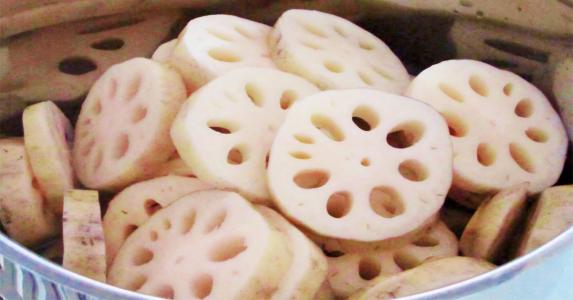
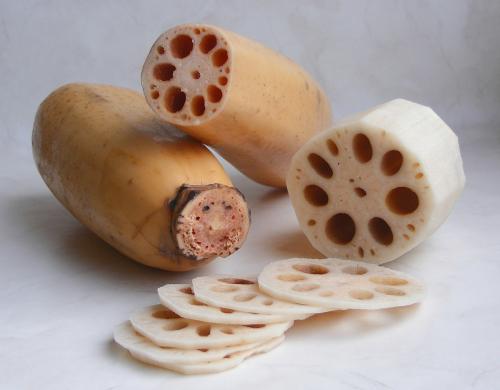
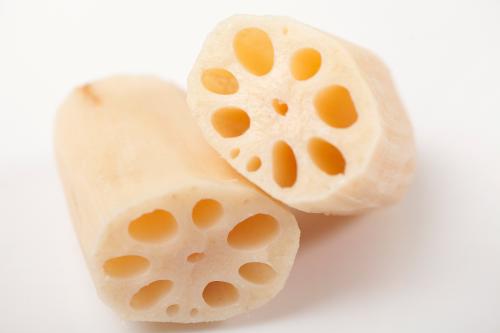
Lotus root originated in India and was introduced to China very early. Lotus root belongs to the subclass Magnoliidae, order Proteales. It likes warmth, is not tolerant of shade, and is not suited to lack of water or strong winds. Lotus root is slightly sweet and crisp; it can be eaten raw or cooked as a dish, and its medicinal value is quite high. Every root, leaf, flower stamen, and fruit is a treasure, and all can be used as nourishment and medicine. Lotus root made into powder can aid digestion and stop diarrhea, stimulate appetite and clear heat, nourish and strengthen the constitution, and prevent internal bleeding. It is an excellent liquid food and nourishing delicacy for women, children, the elderly, and those who are frail and frequently ill.
Growth Characteristics:
1. Germination and growth period: from the start of sprouting of the seed lotus root until the emergence of standing leaves, mid-to-late maturing varieties require 15-30d. In spring, when the temperature rises to about 15 degrees C, the seed lotus root in the soil begins to sprout and grow. Before the standing leaves emerge, nutrition mainly depends on the nutrients stored in the seed lotus root. If the seed lotus root is relatively plump, the soil is fertile, the water level is relatively shallow, and the soil temperature is relatively high, early emergence of standing leaves can be promoted, laying the foundation for vigorous growth.
2. Vigorous growth period: from the plant producing its first standing leaf until the appearance of the rear handle leaf, mid-to-late maturing varieties take 40-60d. As the temperature gradually rises, vegetative growth gradually accelerates. Generally after 2 standing leaves have grown, the main stem begins to branch, and roots, stems, leaves, and other organs grow vigorously in all respects. The standing leaves gradually become taller. After 6-7 standing leaves are produced on the main stem, flower buds begin to appear. In this period, vegetative growth reaches its peak; it is necessary both for the roots and lotus runners to grow vigorously and build a strong nutritional system, and also to prevent the plant from growing excessively and remaining vegetative, delaying lotus root formation.
3. Lotus root formation period: from the appearance of the rear handle leaf until the new lotus root fully expands, 50-90d are needed. The appearance of the rear handle leaf marks that the tip of the underground stem has begun to extend from horizontal to slanting downward, and the internodes shorten and expand segment by segment, accumulating nutrients and forming new lotus roots. Each lotus root takes about 30d from the beginning of expansion to the full expansion and final shaping of the whole root. However, at this time the new lotus root has a high water content and low dry matter content such as starch and protein. Generally, about another 30d are still needed for the water content in the new lotus root to gradually decrease and the dry matter content to increase, finally reaching internal fullness and entering dormancy for overwintering. The aboveground leaves also gradually turn yellow and all die after frost. While the underground main stem and branches form lotus roots one after another, the aboveground parts correspondingly bloom and bear fruit one after another. Each flower takes 30-40d from blooming, pollination, and fertilization to lotus seed maturity.
Artificial Cultivation:
Cultivated lotus root can be divided into three major categories: lotus root lotus, seed lotus, and flower lotus. Among them, flower lotus belongs to aquatic flowers, while lotus root lotus and seed lotus belong to aquatic vegetables. Lotus root lotus can be divided by cultivation water depth into shallow-water lotus root and deep-water lotus root.
1. Shallow-water lotus root (field lotus root)
Suitable for low-lying fields, ordinary paddy fields, or rice fields with a water depth of 10-30cm, with the deepest not exceeding 80cm; mostly early-maturing varieties. Such as Suzhou flower lotus root, Manhe (late lotus root), Wuzhi No. 2, Elian No. 1, Elian No. 3, Hubei Liuyuebao, Yangou No. 1, Kexuan No. 1, Da Zi Hong, Yu lotus root, Jiayu, Hangzhou white flower lotus root, Nanjing flower-fragrance lotus root, Queziyang lotus root, Jiangxi flowerless lotus root, etc.
2. Deep-water lotus root (pond lotus root)
Generally requires a water level of 30-60cm, with the deepest not exceeding 1m. During the summer flooding period, it can tolerate water 1.3-1.7m deep. It is suitable for cultivation in ponds, river bends, and lake shoals, and is generally a mid-to-late maturing variety. Such as Jiangsu Baoying Beauty Red, Xiao An Hong, Elian No. 2, Elian No. 4, Hunan Paozi, Wuhan Da Mao Jie, Guangzhou silk lotus root, Simiao, etc.
China was already cultivating it more than 3,000 years ago; carbonized ancient lotus seeds have been found in both Liaoning and Zhejiang, showing its long history.
[Water Management] Lotus root is an aquatic plant and cannot do without water throughout the entire growth period. Summer is the peak growth period for lotus root flowers (lotus flowers), and the demand for water is also greatest, so throughout summer attention must be paid to keeping water in the pond. Spraying new high-fat film on the leaf surface makes the branches and leaves emerald green and luxuriant, and enhances the accumulation of photosynthesis products and the ability for directional transport.
[Fertilizer Management] Lotus root likes fertilizer and also has a relatively high demand for fertilizer, but too much fertilizer can burn the seedlings, so fertilizer should be applied lightly and frequently. Spraying new high-fat film greatly improves the utilization rate of the effective components of the fertilizer, is not afraid of evaporation from sun exposure, and can regulate water absorption.
[Pest and Disease Control] There are aphids, cotton leafworms, slug moths, etc. They damage standing leaves and flower buds. Targeted pesticides sprayed on the plant surface plus new high-fat film can improve efficacy, effectively prevent leaf viral infection, and make the branches and leaves emerald green and luxuriant. Water maggots suck the sap of lotus root roots, stems, and leaves; lime can be applied to repel and kill them.
[Growth Period] The quality requirements for lotus root are very high. Spraying Diguo Zhuangtiling can promote thickening of the nutrient transport ducts of the underground fruit, improve the expansion vitality of the underground fruit, make the lotus root body plump, the flesh crisp and tender, with high water content and sweetness, high quality and high yield, and a delicate fragrance.
There are aphids, cotton leafworms, slug moths, etc. They damage standing leaves and flower buds. Spraying with 90% trichlorfon 800-1000 times solution or 40% dimethoate 2000 times solution can be used. Water maggots suck the sap of lotus root roots, stems, and leaves, causing lotus leaves to turn yellow. Once discovered, lime can be applied to repel and kill them, with a dosage of 10-15 kg per mu.
[Lotus Leaf Wilt Disease]
Affected lotus leaves become scorched yellow and withered, affecting lotus root growth and causing reduced yield. Control: Keep the lotus root field clean and prevent oil pollution from contaminating the lotus root field. Sewage and soapy water can also cause lotus leaves to wither and die. Lotus root is very sensitive to herbicides. Herbicides must absolutely not be applied in lotus root fields.
[Lotus Root Viral Disease]
After infection, symptoms can appear on both lotus leaves and underground rhizomes. Large polygonal to irregular light brown necrotic spots are produced on the leaves. Dark brown anthracnose streak spots are produced on the rhizome epidermis. Control: Select disease-resistant varieties and control aphids (the virus transmission vector) in a timely manner. At the early stage of disease, spray 1.5% Zhiblingling emulsion 1000 times solution.
[Lotus Root Black Spot Disease]
Lotus root black spot disease (also called brown streak disease or leaf spot disease) initially appears as needle-tip-sized yellowish-brown small spots, and later the whole leaf is covered with lesions with concentric rings, causing half a leaf or the whole leaf to dry up. Control: Increase phosphorus and potassium fertilizer and avoid partial application of nitrogen fertilizer. In winter, thoroughly remove diseased and residual leaves in the field and burn them in a centralized manner. At the early stage of disease, remove diseased leaves and spray for control. Commonly used are 70% thiophanate-methyl 1000 times solution or 65% zineb 600 times solution. Or 1:1:166-200 Bordeaux mixture, sprayed once every 10 days for a total of 2-3 sprayings.
[Lotus Root Rot Disease (Lotus Root Plague)]
In the early stage, the leaves are light green and begin to dry from the edges; later the whole leaf curls and dries, the top of the petiole bends and dries, and the whole field appears scorched yellow as if burned by fire. Control: Implement 2-3 year crop rotation in severely diseased fields. Commonly use 70% thiophanate-methyl 1000 times solution or 75% chlorothalonil 800 times solution to spray and seal the seeds, cover with agricultural film and seal for 24 hours, then dry and plant. Before planting in the lotus root field, deep plow and apply 100 kg of lime per mu. When disease occurs, 0.5 kg of 75% chlorothalonil plus 30 kg of dry soil can be mixed evenly and scattered into the shallow-water field. Because the pathogen of lotus root rot disease is in the soil portion of the stem, controlling this disease requires spraying the lower part of the stem, leaving only 3-5 cm of water depth, and carrying out continuous control twice over 3-5 days to achieve control.