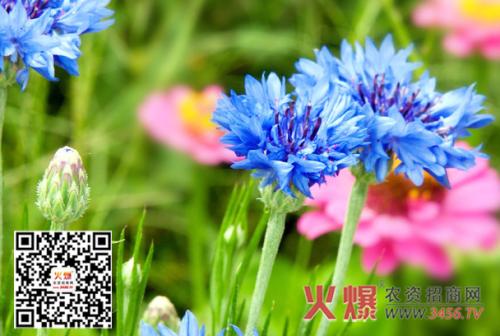
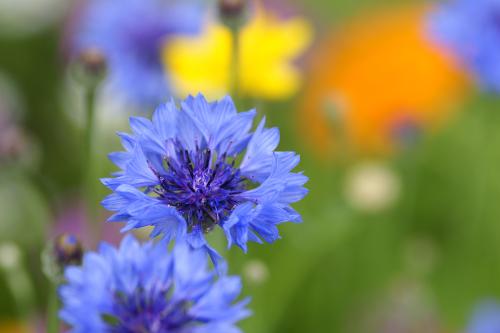
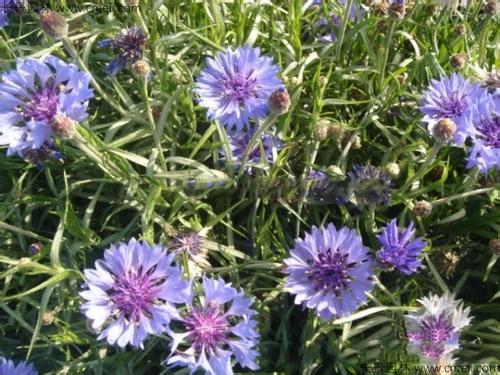
Cornflower (Latin scientific name: Centaurea cyanus L.) is an annual or biennial herbaceous plant of the genus Centaurea in the Asteraceae family. It can reach a height of 70 cm, is upright and branching, with grayish-white stems and branches, basal leaves, and flowers arranged at the top in corymbs or panicles. The involucre is elliptical, with disc florets in blue, white, red or purple; the achene is elliptical, and the flowering and fruiting period is from February to August.
The cornflower's homeland is Europe. It was originally a wild flower, and after many years of cultivation by people, its "wild" nature has diminished, the flowers have become larger, and the colors have multiplied, with varieties in purple, blue, light red, white and so on, among which purple and blue are the most prized. In Germany it can be found everywhere on hillsides, in fields, by the water, along roadsides, and in front of and behind houses. It is regarded as the national flower of Germany.
Cultivation Techniques
Key Points of Cultivation
Sowing can be done in both spring and autumn, with autumn sowing being preferable. Sow in mid-to-late September in a prepared seedbed, cover with soil just until the seeds are no longer visible, press down lightly, cover with straw, water thoroughly, keep the soil moist at all times, and remove the straw after germination. When the seedlings have 6-7 small leaves, they can be transplanted or planted out, with a plant spacing of about 30 cm. After the plants have established, apply diluted decomposed human manure liquid at 5 times the water ratio once every 10 days or half a month, and stop fertilizing in March of the following year to wait for flowering. If grown in pots, the potting soil should be loose and fertile; it is best to make a mixed soil from garden soil, leaf mold, plant ash and so on. When the seedlings have 6-7 leaves, carry out the first transplanting, moving the shorter seedlings into tall pots.
Cultivation Steps
Seedling raising: Choose loose, fertile soil to make the bed, cover with about 0.2 cm of soil. Cultivation: Transplant when the seedlings have grown 6-7 true leaves; for pot cultivation, plant one plant per 13-17 cm pot. After the seedlings have established following planting, pinch back once to encourage more branching and more flowers; conversely, if there is too much branching, some side buds should be removed when necessary to obtain larger flowers. Because it has a taproot, it is best to sow directly; for autumn sowing in the open ground, cover for overwintering, and it will bloom in early summer; if overwintered in a cold frame, it can bloom in late spring; spring sowing should be done as early as possible. It blooms in June.
Cultivation site: Because the cornflower is native to European fields, it can tolerate cold somewhat, and it likes cool places with plenty of sunlight.
Soil: It prefers loose, fertile, well-drained sandy loam. The cultivation soil should be made as well drained and well aerated as possible; if the soil is fairly clayey, 30-40 percent osmunda fiber or perlite can be mixed in to improve it.
Watering: In principle, watering once a day is already enough, but in drier summer weather, water once in the morning and once in the evening to keep the potting soil moist and lower the temperature of the pot, but avoid waterlogging.
Fertilizing: Cornflowers like plenty of fertilizer; during the growing period, apply a diluted liquid fertilizer of the three major elements once a month. If the leaves are too lush, reduce the proportion of nitrogen fertilizer; before flowering, it is best to apply more phosphorus and potassium fertilizer so as to obtain larger flowers with beautiful colors.
Management during the flowering period: Cornflowers naturally send out side branches; when there are many side branches, the flowers are smaller. When necessary, some side buds can be removed, leaving only the smaller branches, so that larger flowers can be obtained. The cornflower is a long-day plant; in winter, when daylight hours are shorter, using a plant light at night to supplement lighting can make it bloom earlier.
Management
Cornflowers like plenty of sunlight, a cool climate, and dislike summer heat; they prefer fertile, loose soil. Because of the taproot, direct sowing is best. For autumn sowing, to make it bloom earlier, it can be overwintered in a cold frame, and it can bloom in late spring. Because cornflowers do not tolerate transplanting well, they must be moved with a soil ball when transplanted, otherwise they do not recover easily. After the plants have established, apply diluted decomposed human manure liquid at 5 times the water ratio once every 10 days or a month, and stop fertilizing in March of the following year to wait for flowering.
If grown in pots, the potting soil should be loose and fertile; it is best to use a mixed soil of garden soil, leaf mold, plant ash and so on. When the seedlings have 6-7 leaves, carry out the first transplanting; as they grow thereafter, move them into at least a three-tube pot, because the cornflower has a taproot system and large seedlings do not tolerate transplanting. In winter it can be kept continuously buried in the soil to overwinter, then taken out in early March; fertilize frequently, and stop fertilizing when the flower buds appear.
It has strong cold resistance; in East China it can be planted in the open ground, while in North China it must be covered to overwinter; it likes fertile and loose soil; it likes plenty of sunlight; it can self-sow; it has strong adaptability and is easy to cultivate. When grown as a cut flower, greenhouses are usually used to force flowering: sow in August, plant out in September, and flowers can be produced in February of the following year. In the warm regions within the passes, sowing is generally done in August-September, with open-ground covering for overwintering, planting out in early spring of the second year, and flowering in early summer. In the Northeast region, spring sowing is done in greenhouses.
Because the cornflower's root is a taproot with very few lateral roots, transplanting must be done when the seedlings are small and with soil; once the seedlings are large, they do not survive easily, so it is often sown directly in spring. Cornflowers can also reproduce by self-sowing. In addition, cornflowers like dense planting; otherwise they actually grow poorly.
Extending the Flowering Period
Cornflowers have rich flower colors and a distinctive flower shape, and are good material for ground planting, pot planting and cut flowers. In order to extend the ornamental flowering period of cornflowers, in addition to autumn sowing, spring sowing and summer sowing can also be used. If sown in April-May, they can bloom in July-October of that year. If sown in July with seeds matured that year, they generally bloom after September, and those grown in the open ground can last until the Frost's Descent period. In mid-to-late October, transplant plants grown in the ground into flower pots and move them indoors to overwinter, or sow directly in pots in August and move them indoors before winter. In winter, as long as the room temperature is kept at 8-15 degrees C, with moderate watering and a small amount of dilute compound fertilizer, and placed in a sunny spot, cornflowers can also be made to bloom. This method of sowing in stages and batches can effectively extend the ornamental flowering period of cornflowers.
Points to Note
The cornflower is robust and fairly cold-tolerant, likes sunlight, and requires fertile, loose, well-drained soil. It is generally sown directly in the seedbed in September; south of Central China it can overwinter in the open ground, with no need for cold protection in winter, and is transplanted in November or early March of the following year. In North China, autumn-sown seedlings are transplanted once when they have grown 2-3 true leaves, moved into a sunny cold frame before winter, covered with cold-protection materials in winter, and planted out in the open ground in early spring of the following year. Base fertilizer should be applied before planting out. Because the cornflower has a taproot system and does not tolerate transplanting, a fairly large soil ball must be kept when transplanting.
Cornflower stems are slender and weak and tend to lodge, so the planting distance should not be too close; prevent overly dense growth and poor ventilation that cause lodging. During the seedling stage, pinch out the growing tips to encourage more branching and make the plants shorter, so that they bloom more and have a graceful shape. During the growing period, apply liquid fertilizer once every 20 days, but note that too much nitrogen fertilizer should not be applied; appropriately apply more phosphorus and potassium fertilizer to make the stems firm and the flower colors vivid. At the same time, watering should be moderate and not excessive; in the rainy season, be sure to drain promptly, otherwise root rot will occur and affect the plant's normal growth.
Collecting Flower Seeds
Seeds can be collected when the inflorescences have just turned yellow and withered. If the inflorescences are over-mature, the seeds scatter easily; generally, when the vast majority of inflorescences have turned yellow and withered, cut the whole plant, dry it, thresh the seeds, and store them in a cool, dry place. The seeds have the ability to self-sow.