Areca Palm Planting Methods and Care Points Explained in Detail
Areca palm (Latin scientific name: Chrysalidocarpuslutescens), also known as yellow coconut, purple palm, etc., is a clumping evergreen shrub or small tree. The stem is smooth, yellow-green, without prickles, covered with a waxy powder when young, and bears obvious leaf scars in a ringed pattern. The leaf surface is smooth and slender, with pinnate compound leaves, fully divided, 40-150cm long, the petiole slightly curved, the tip soft; the leaflets are linear-lanceolate, asymmetrical on the left and right sides, the middle leaflets about 50cm long, the top leaflets only 10cm, the apex long and tapering, often with 2 short divisions, the main vein on the back raised; the petiole, leaf rachis, and leaf sheath are all pale yellow-green; the leaf sheath is cylindrical and clasps the stem.
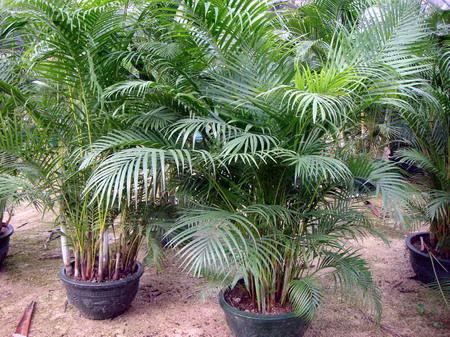
Pot planting method
1. The pot should be deep and large and the soil loose
Areca palm avoids heavy clay soil and saline-alkaline soil, and prefers slightly acidic sandy loam rich in humus, so when planting in pots you can mix leaf mold, peat soil, and vegetable garden topsoil, then add a small amount of perlite or sand as the growing medium. Before planting, first place a layer of crushed charcoal pieces or crushed hard plastic foam pieces at the bottom of the pot, which helps enhance air permeability and drainage and prevent root rot; at the same time, also add some decomposed organic fertilizer or nitrogen-phosphorus-potassium compound granular fertilizer to the growing medium as a base fertilizer. Areca palm produces suckers every year, and the young buds are often close to the upper part of the roots, so when planting it should not be too crowded, and gaps should be left for the growth of the Areca palm suckers, which helps the new buds take root better. Generally speaking, Areca palm is repotted and given fresh soil once every three years.
2. Likes moisture and fertilizer but avoids waterlogging
The vigorous growth period of Areca palm is from May to October, so during this period it needs frequent watering to keep the potting soil slightly on the moist side without waterlogging, and the stems and leaves should also be sprayed with water, which can both remove dust, keep the leaves fresh and beautiful, and raise the air humidity of the small environment. During the winter dormant period, the potting soil only needs to be slightly moist and not dry. In the north, when watering, often put a little ferrous sulfate in the water (500:1) to prevent long-term watering with alkaline water, alkalization of the potting soil, and yellowing of the plant. Areca palm likes fertilizer, so it needs light fertilizer applied frequently, about once every 15 days with nitrogen-phosphorus-potassium compound fertilizer or watering with a 0.2% potassium dihydrogen phosphate solution; for Areca palm bonsai placed outdoors, it is best to apply decomposed resistant liquid fertilizer. When fertilizing Areca palm, it is best not to apply nitrogen fertilizer alone, to prevent excessive vegetative growth and soft, unattractive stems and leaves.
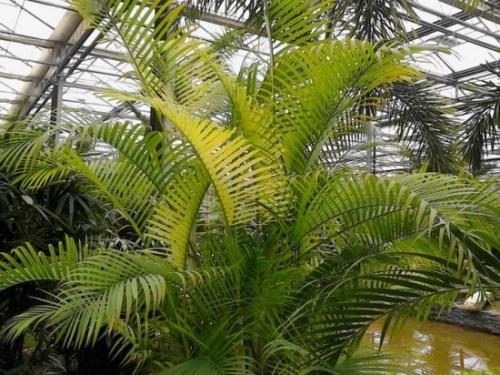
3. Likes light and warmth but fears exposure to the sun
Areca palm likes an environment with plenty of diffused light, but fears exposure to the sun, so after being placed in a dark room for a period of time, it needs to be moved to a place with plenty of diffused light for care for a period of time. For plants placed outdoors, from late spring to mid-autumn, 50% to 60% of the light must be shaded and direct sun exposure must be avoided. After being brought indoors in winter, it can receive light through glass. The most suitable growth temperature for Areca palm is 15-28°C; below 8°C in winter it is prone to cold damage, and below 5°C it may freeze to death. When cultivating Areca palm, poor ventilation can lead to scale insects, so attention should be paid to pruning old leaves and overly dense leaves; maintaining good ventilation of the plant clump can prevent this, and at the same time a 1000-fold dilution of 50% omethoate solution can also be sprayed on the stems and leaves for control.
4. Division propagation easily survives
Pot-grown Areca palm has not been seen setting seed, so propagation uses the division method; the best time for propagation is around Qingming, and watering is stopped 2-3 days before division planting, which helps with removing the plant from the pot. When division planting, use a sharp knife to cut the clumping plant into 2-3 clumps, each clump must have at least 2-3 plants, smear the cut surfaces with sulfur powder or plant ash for antisepsis, and then plant them separately in pots. Generally speaking, divide once every 3 years in combination with repotting and changing the soil; it cannot be divided every year, as this is not conducive to the growth of Areca palm.