How to Grow and Care for Snowdrops
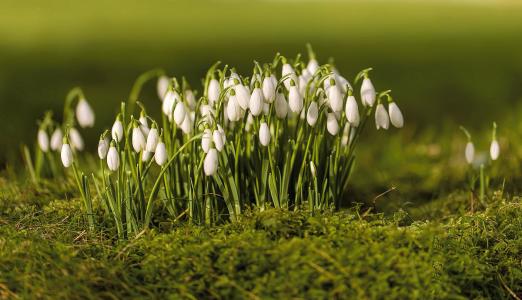
Snowdrops have bulbs. The leaves are linear. The flower stems are upright, with a single flower borne at the tip of each stem; the flower nods and is bell-shaped; the flowers are white, with six petals arranged in two layers, three petals in the inner layer and three in the outer layer, and the outer petals are longer and more convex than the inner ones. There are six anthers, which open by pores or short longitudinal slits. The ovary has three chambers, and the fruit is a capsule.

How to grow and propagate snowdrops
Snowdrops are propagated mainly by division. After the aboveground parts wither, the bulbs are dug up and divided. Commercial bulbs are graded into three sizes: 4-5 cm, 5-6 cm, and over 6 cm in circumference. To increase the propagation rate, in early summer the bulbs can be cross-cut 6-8 times from the base toward the top, disinfected with 0.1% mercuric chloride solution, and cultured on a propagation bed at 20°C; after 3 months, 1-2 small bulbs can form on each piece.
For sowing, the seeds are sown immediately after collection. The optimum germination temperature is 13-18°C. After emergence, shade the seedlings to keep them alive. This method is generally used in breeding.
Snowdrops are native to Europe and western Asia, growing on slopes at forest edges. They prefer cool, moist, semi-shaded conditions, tolerate severe cold down to -15°C, and dislike strong direct sunlight and drought. A humus-rich, loose, well-drained sandy loam is ideal.
When growing them in a courtyard, apply rotted farmyard manure before planting. Plant 50-60 bulbs of 4-5 cm circumference per sq m, at a depth of 5 cm. For pot culture, plant 3-5 bulbs in a 15 cm diameter pot at a depth of 3-4 cm.
For pot culture, apply monopotassium phosphate or Huiyou 15-50-30 special fertilizer for flowering pot plants once before flowering. For field planting, plant in September-October and they flower in February-March; generally no additional fertilizer is needed. For pot culture in November, place the pots outdoors after planting, and once they sprout and root, put them in a sunny spot; they will flower in 50 days. Store dormant bulbs at 15-17°C to promote flower bud differentiation.
Gray mold is the most serious disease of snowdrops, causing black rot of the flower stalks and flower bases. After the leaves emerge, it can be controlled with 75% carbendazim at 1000 times dilution. The most serious pest is the narcissus bulb fly, which can be treated by soaking in circulating hot water (40-45°C) for 3 hours, then drying before storage.
It has the effects of warming the kidney and supporting yang, dispelling wind and removing dampness, unblocking the meridians and activating collaterals, and regulating menstruation and relieving pain. It is mainly used to treat dysmenorrhea in women, irregular menstruation, cold and painful lower abdomen, as well as rheumatoid arthritis and rheumatoid arthritis; in addition, it can also be used to treat postpartum recovery, impotence in men, senile waist and leg pain and other conditions, and it has a significant effect in preserving youthful appearance, strengthening the body, and delaying aging.