Goldfish Weed Planting Methods and Technical Key Points
Goldfish weed (scientific name: Ceratophyllum demersum L.) is a perennial herbaceous submerged aquatic plant of the genus Ceratophyllum in the family Ceratophyllaceae, also known as fine grass, soft grass, and fish grass. The whole plant is dark green. The stems are slender and soft, with branches. The leaves are whorled, 6-8 leaves per whorl; sessile; the leaf blades are forked or finely divided, with linear lobes bearing small spiny teeth. The flowers are small, unisexual, monoecious or dioecious, axillary, without a perianth; the involucral bracts number 8-12, subulate; the male flowers have numerous stamens; the female flowers have 1 pistil, the ovary is long-ovate, superior, 1-loculed; the style is subulate. The nutlet is ovate and smooth. The style persists, with spines at the base.
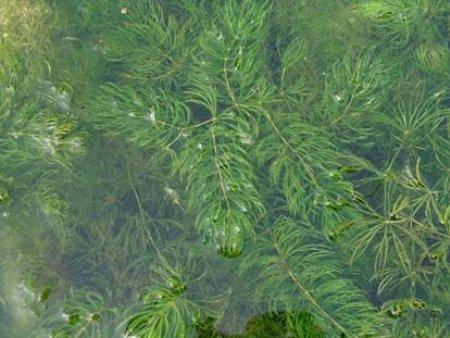
Growth Habits
Dormancy and germination:The seeds have a hard outer shell and a relatively long dormant period, which is broken by low winter temperatures. In early spring the seeds germinate in the mud and grow upward to reach the water surface. When the seeds germinate, the radicle does not elongate, so the plant has no roots; instead, it anchors the plant body with leaf-like branches that grow into the soil, while the basal lateral branches also develop very fine fully divided leaves, resembling white thread-like root-like branches, which both anchor the plant and absorb nutrients.
Overwintering terminal buds;In autumn, as the photoperiod gradually shortens and the temperature drops, the tips of the lateral branches stop growing, the leaves become densely clustered, the color turns dark green, the cuticle thickens, and nutrients such as starch accumulate, forming a special vegetative propagule, the dormant terminal bud. At this time the plant becomes brittle, and the terminal buds easily fall off and sink into the mud to overwinter in dormancy, germinating into new plants the following spring. In addition, during the growing season, broken plants can develop into new plants at any time.
Vegetative growth:Goldfish weed has no roots and the whole plant is submerged in water, so its growth is closely related to light. When the water is too turbid and less light penetrates the water, goldfish weed grows poorly, but once the water clears and sunlight penetrates, it can still resume growth. At 2%-3% light intensity, growth is slower. At 5%-10% light intensity, growth is rapid, but strong light can kill goldfish weed. Goldfish weed can grow normally in water with a pH of 7.1-9.2, but a pH of 7.6-8.8 is most suitable.
Flowering and fruiting:The flowering period is June-July, and the fruiting period is August-September. After the male flowers mature, the stamens detach from the parent plant, and the small float at the tip of the anther raises them to the water surface, where they split open and release pollen; the pollen has a relatively high specific gravity and slowly sinks to reach the stigma of the submerged female flowers, where pollination and fertilization occur, and this process only takes place in still water. After the fruit matures, it sinks to the mud bottom and overwinters in dormancy.
Harmful effects:Goldfish weed is distributed throughout the country, and is especially abundant and causes relatively serious harm in rice fields that are rich in organic matter, have deeper water layers, and are submerged for long periods. In addition, it is also distributed in still ponds, lakes, and ditches. Because goldfish weed has an extremely strong nitrogen-absorbing capacity and simultaneously lowers the water temperature, it seriously affects rice tillering and growth.
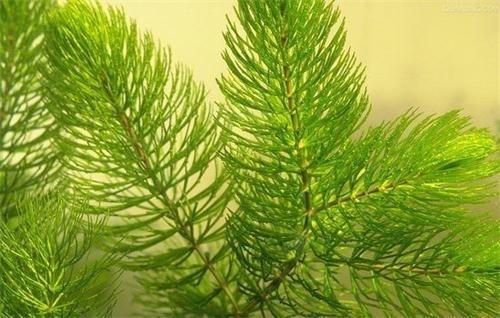
- Goldfish weed planting is suited to dense planting rather than sparse planting. If growers want to achieve high yields, insufficient basic seedlings will make it difficult to raise the yield. Generally speaking, when cultivating this aquatic plant, it is advisable to transplant 200 clumps per mu of water area.
- During cultivation, fertilizer should be sufficient rather than lean. If goldfish weed is to be planted in those barren water surfaces that cannot be used for raising fish or shrimp, these relatively poor-quality water areas should have the water moss and other weeds removed before planting, then 25 kg of superphosphate per mu of water surface should be applied as a base fertilizer, with little nitrogen fertilizer applied, to prevent green algae from taking over the water surface. Then plant the goldfish weed.
- The water area for planting goldfish weed should not be too deep; generally keeping it within a range of 1 m is most suitable. Because if the water is too deep, the stems will be coarse and the leaves will be few, greatly reducing the yield, and the utilization rate of the aquatic plant will also decrease, thereby reducing the commercial value of planting goldfish weed.