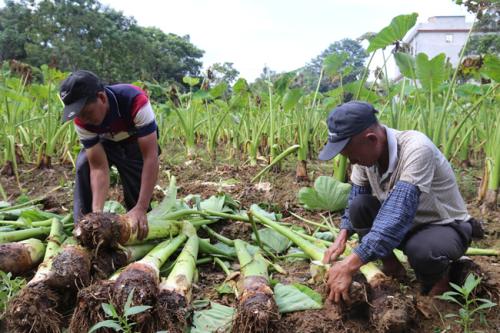
Taro, also known as yu or yunai, is the underground corm of a plant in the Araceae family; its shape and flesh vary by variety, and the small taro is the type usually eaten. It is a perennial tuber plant, often cultivated as an annual crop. The leaves are shield-shaped, and the leaf stalks are long and thick, green or purplish red; the base of the plant forms a shortened stem, which gradually accumulates nutrients and enlarges into a fleshy corm called the "taro" or "mother taro", which may be spherical, oval, elliptical or block-shaped. Each node of the mother taro has a bud, but the axillary buds at the middle and lower nodes are the most active, producing the first tillers, which form small corms called "daughter taros"; these in turn produce "granddaughter taros", and under suitable conditions can form great-granddaughter or great-great-granddaughter taros, and so on.
Planting Requirements
1. Temperature requirements:
Taro originated in hot, humid regions, and through long-term cultivation has developed cultivation types such as
water taro, dual-purpose water-dryland taro, and dryland taro. However, whether water taro or dryland taro, all require hot and humid environmental conditions. Taro corms begin to sprout at 13-15°C; the optimum growth temperature during the seedling stage is 20-25°C, and the optimum growth temperature during the vigorous growth stage is 20-30°C. A large day-night temperature difference favors corm formation, and during the corm formation stage the most suitable temperatures are 28-30°C during the day and 18-20°C at night.
2. Water requirements:
Whether water taro or dryland taro, both prefer moist natural environmental conditions. Dryland taro requires moist soil during the growing period, especially during the vigorous leaf growth stage and the corm formation stage, when water demand is high, requiring increased watering or shallow water in the furrows. At the same time, note that in the early stage of corm formation, spraying
Diguo Zhuangdiling can thicken the nutrient transport ducts of the underground fruit, increase the swelling vigor of the underground fruit, make the fruit surface smooth, the fruit shape robust, and improve quality, achieving high yield. Water taro requires a certain water layer during the growing period; during the seedling stage the water layer should be 3-5 cm. During the vigorous leaf growth stage, a water depth of 5-7 cm is best. Watering and irrigation should be controlled 6-7 days before harvest to prevent the corms from containing too much water and being unsuitable for storage.
3. Light requirements:
Taro is relatively tolerant of weak light and is not very strict about light intensity. It grows well under
diffused light, and corm formation and enlargement require short-day conditions.
4. Soil requirements:
Water taro is suited to growing in water and requires selection of paddy fields, low-lying land or water furrows for cultivation. Although dryland taro can grow on dry land, it still retains the ecotype of a swamp plant, so moist areas are preferable for planting. Taro is a fertilizer-loving crop, and its corms form in the underground soil layer, so loam or clay loam rich in organic matter with deep soil should be selected, with a pH of 5.5-7 being most suitable.
Nutritional Analysis
1. Taro is rich in protein, calcium, phosphorus, iron, potassium, magnesium, sodium, carotene, niacin, vitamin C, B vitamins,
saponin and many other components; among the minerals it contains, fluorine content is relatively high, giving it a role in cleaning teeth, preventing dental caries and protecting teeth;
2. Its rich nutritional value can strengthen the human body's immune function, and it can serve as a common medicinal-diet staple for preventing and treating cancer. During cancer surgery or postoperative radiotherapy, chemotherapy and rehabilitation, it has an auxiliary therapeutic effect;
3. Taro contains a mucilaginous protein that, after being absorbed by the human body, can produce immunoglobulin, also called antibody globulin, which can improve the body's resistance. Therefore, traditional Chinese medicine believes that yunai can detoxify and has an inhibitory and resolving effect on painful swellings and toxicities in the human body, including cancer toxins, and can be used to prevent and treat tumors and
scrofula and other conditions;
4. Taro is an
alkaline food that can neutralize acidic substances accumulated in the body, regulate the body's acid-base balance, produce beauty-enhancing and hair-darkening effects, and can also be used to prevent and treat hyperacidity;
5. Taro is rich in mucilaginous saponin and various trace elements, which can help the body correct physiological abnormalities caused by trace element deficiency, while also increasing appetite and aiding digestion; therefore, traditional Chinese medicine believes that yunai can tonify the middle and benefit qi.
Taro is nutritious, containing large amounts of starch, minerals and vitamins; it is both a vegetable and a food grain, and can be eaten cooked, dried or made into flour. Taro has a fine, soft texture, is sticky, tender and refreshing, and is rich in nutrients; it can be made into dishes and also into all kinds of snacks, crisp and tasty,
There are approximately 100 different kinds of taro; some are oval and resemble
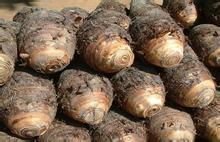
sweet potato, while most others are round. Taro has fewer strange shapes compared with other tuber plants. Taro can grow to 6 feet tall and has broad leaves; however, the young shoots can be eaten after being blanched in boiling water. The leaves and young shoots are less used in Western markets. The tuber part is dark brown, and the outer skin is ringed and quite rough, with hairs on it. The flesh may be white, off-white or purplish gray, and some have pink or brown streaks.