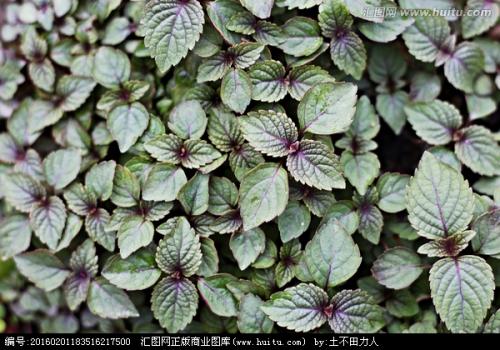
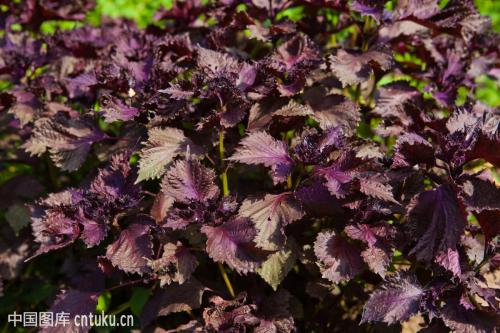
Perilla (scientific name: Perilla frutescens (L.) Britt.), also known as guiren, white perilla, red perilla, etc.; it is an annual herbaceous plant of the Lamiaceae family. It has a distinctive aroma. The leaves are mostly shrunken and curled; when flattened, intact leaves are ovate, 4 to 11 cm long and 2.5 to 9 cm wide, with a long-tapered or acute apex, a rounded or broadly cuneate base, and rounded serrate margins. Both surfaces are purple, or the upper surface is green, while the lower surface has numerous sunken glandular scales. The petiole is 2 to 5 cm long, purple or purple-green, and brittle. The young branches are purple-green, with pith in the center of the cross-section, a fresh fragrance, and a slightly pungent taste.
Cultivation Techniques
Site Selection and Land Preparation
Perilla is highly adaptable to climate and soil. It is best to choose sunny, well-drained, loose and fertile sandy loam or loam; growth is poorer in heavy clay. For land preparation, plow the soil to a depth of 15 cm and rake it level. Work it fine and make beds; the beds and furrows are 200 cm wide, and the furrows are 15-20 cm deep.
Before the plants grow to close the rows, weed frequently. In direct-seeded areas, pay attention to thinning and weeding. In drilled areas, when the seedlings are 15 cm tall, thin to a spacing of 30 cm; use the extra seedlings for transplanting. Plants in direct-seeded land grow quickly. If the density is high, the plants become leggy, with no branching or very little branching. Although the plant height can still be reached, there are fewer leaves on the lower part of the plant, and they drop due to poor light penetration and air movement, affecting leaf yield and perilla oil yield. At the same time, more stems and fewer leaves also affect the grade of the whole herb, so do not thin too early. In seedling beds, from transplanting until the rows close, loosen the soil and weed 2 times.
Requirements for environmental conditions: Perilla prefers a warm and humid climate. The seeds can germinate when the soil temperature is above 5°C, and the suitable germination temperature is 18-23°C. During the seedling stage, it can tolerate low temperatures of 1-2°C. The plants grow slowly at lower temperatures. Growth is vigorous in summer. The suitable temperature during the flowering period is 22-28°C, with a relative humidity of 75%-80%. It is relatively tolerant of moisture and has strong waterlogging tolerance, but is not drought-tolerant, especially during the formation period of the product organs. If the air is too dry, the stems and leaves become coarse and hard, with more fiber and poor quality. It has a wide adaptability to soil and can also grow in relatively shady places.
Perilla has a relatively short growing period. The whole herb can be harvested 2 and a half months after transplanting, and since the whole herb is used as medicine, nitrogen fertilizer is the main type. Apply fertilizer intensively before the rows close.
For direct-seeded and seedling-raised land, apply topdressing when the seedlings are 30 cm tall. Open furrows between the rows and apply 15000-22500 kg of human manure and urine per hectare, or 112.5 kg of ammonium sulfate and 150 kg of superphosphate. Loosen the soil and earth up to bury the fertilizer well. Apply fertilizer once more before the rows close, using the same method as above. However, be careful not to let the fertilizer touch the leaves this time.
Irrigation
After sowing or transplanting, if it does not rain for several days, water promptly. During the rainy season, pay attention to drainage and clear the working paths to prevent water accumulation that causes root rot and leaf drop.
Harvesting and Processing
When harvesting perilla, choose a sunny day to cut it, as the aroma is stronger and drying is easier. For perilla leaves used as medicine, harvest should be carried out from late July to early August, before perilla blooms.
Perilla stems: Harvest in early September before flowering, when the inflorescence has just emerged. Cut the plants from the base with a sickle, hang them upside down in a ventilated, shaded place to dry, and after drying, beat off the leaves for medicinal use.
Perilla seeds: Harvest from late September to mid-October, when the seeds and fruits are ripe. Cut off the fruit spikes or the whole plant, tie them into small bundles, dry them in the sun for several days, then thresh out the seeds and dry them in the sun. The yield is 1125-1500 kg per hectare.
While collecting seeds, also pay attention to selecting and retaining good seeds. Choose robust plants with high yield, wait until the seeds are fully mature before harvesting, dry them in the sun and thresh them for use as seed.