How to Grow Echeveria chihuahuensis: Methods and Key Techniques
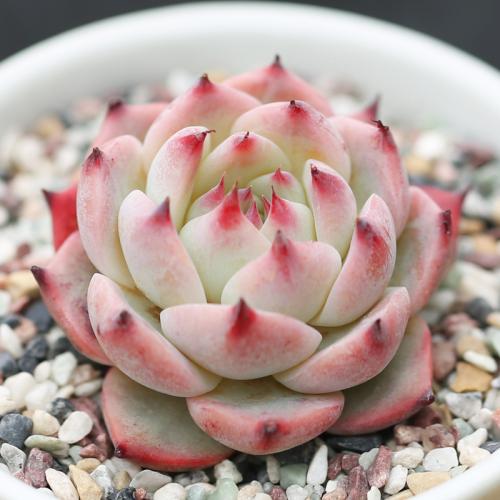
Echeveria chihuahuensis, of the Crassulaceae family and the genus Echeveria, also known as Jiwa lotus (because it is often confused with a dog's name, in most cases it is simply called Jiwa lotus). It is native to Chihuahua, Mexico, and grows on hillsides with good air circulation and plenty of sunlight. Echeveria chihuahuensis is a small plant with a stemless rosette of very compact leaves. The ovate leaves are rather thick, with a small tip, blue-green and covered with a thick white powder, and the leaf margins are a beautiful deep pink. The tip of the inflorescence is curved, bell-shaped and red. Cultivation is not too difficult, but in summer it must not be watered too much. The red leaf tips are especially beautiful, making it a highly ornamental succulent.
Growing methods:
Temperature. The succulent Echeveria chihuahuensis prefers large day-night temperature differences and fairly warm weather. The minimum temperature should be kept above 7°C. When winter temperatures are relatively low, it is better to keep it indoors.
Watering. The succulent Echeveria chihuahuensis is a drought-tolerant plant and should not be watered much, so the amount of water must be well controlled; too much water easily causes waterlogging and leads to root rot. In summer, water only after the soil has dried completely, and in winter the potting soil should be kept dry.
Soil. For the succulent Echeveria chihuahuensis, the growing soil can generally be a mix of peat and perlite or a sandy soil with good air permeability, with some bone meal, a calcium-containing material, mixed in.
Propagation. Early spring is a good time to propagate the succulent Echeveria chihuahuensis; relatively plump leaves can be removed and laid flat, and they will quickly produce small shoots, then simply wait for them to slowly grow into independent plants.
Light. The succulent Echeveria chihuahuensis prefers sunlight, so in summer just place it somewhere with good ventilation and plenty of sunlight, such as a windowsill or similar spot.
Fertilizing. The succulent Echeveria chihuahuensis grows relatively slowly, so it does not need much fertilizer; generally once about every 20 days is enough.