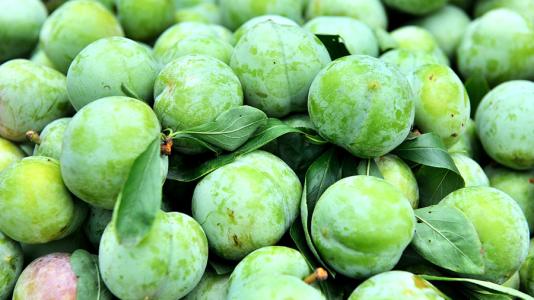
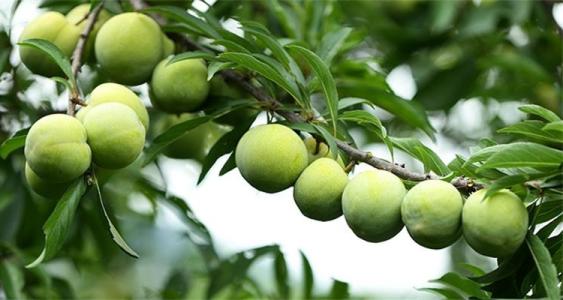
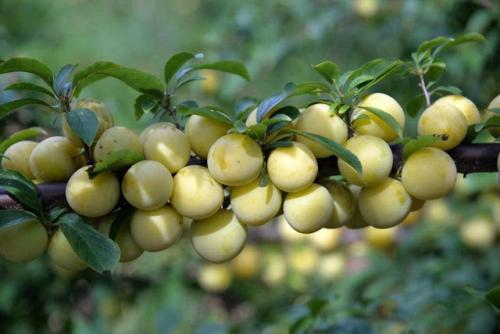
The plum (Prunus salicina Lindl.) is a plant of the genus Prunus in the Rosaceae family, also known as Jiaqingzi, Bulin, plum, Yuhuang plum, and mountain plum. Its fruit ripens between July and August; plump and round, delicate and translucent, beautiful in form and sweet in taste, it is one of people's favorite fruits. It is widely cultivated throughout the world.
Cultivation Techniques
Selection of Rootstock and Varieties
Choose a dwarfing rootstock for the rootstock, one with strong affinity for the variety being grafted; it is best to choose varieties with bright fruit color, high yield, and slightly weaker growth vigor. Plum varieties are very rich; China's traditional fine varieties include "Furen Li, Jiaqing Li, Xieli, Hongxiang Li, Yuhuang Li, Mi Li, Wuyue Li" and others. At present, the domestic and introduced foreign plum varieties promoted and applied in production mainly include: Dashi Zaosheng, Japanese Liwang, Misili, Rose Queen, Black Gem, American Dali, Changle Niuxin Li, Xianfeng Li, and others.
Potting Soil Preparation
Because the container of a plum bonsai is limited, the limited potting soil must contain sufficient fertility to maintain the needs of plum growth and fruiting. Generally, mix 4 parts rotted leaves, 2 parts decomposed barnyard manure and crushed bone, and 4 parts garden soil, and appropriately mix in a small amount of superphosphate, diammonium phosphate, etc., to increase soil fertility. Mix the potting soil thoroughly and evenly, crush it fine and sift it. Before use, the culture soil should be sprinkled with 1.5% formalin solution for disinfection. When planting, let the root system spread out, firm the soil by pressing, follow the practice of "three buryings, two treadings, one lifting of the seedling," water thoroughly with bottom water, and place in a shady spot to recover.
Soil Replacement and Repotting
The nutrients in the potting soil are gradually leached away by frequent watering. After 2 to 3 years, the fertility in the potting soil is insufficient and the physical structure deteriorates, so the pot must be turned out promptly and new culture soil added. Stop watering before turning out the pot, so the soil shrinks and separates from the pot wall, making it easier to remove the potting soil. After the soil ball is turned out upside down, cut away the old roots 2 to 3 cm thick around the potting soil, mix organic fertilizer with the soil thoroughly, sift it, and fill the bottom. Then replant with the soil ball, add fertile soil around to fill, and water thoroughly once. Because the root system of a plum bonsai grows quickly, after 1 to 2 years the roots grow curled along the pot wall, tangled and intertwined, with old roots densely packed, affecting the growth of new roots. Therefore, when repotting, cut off the curled root system and thin out the old roots that are crowded and too dense, which benefits new root growth and improves the ability to absorb water and nutrients.
Shaping and Pruning
The tree form of a plum bonsai should not only favor fruiting but also have an aesthetic effect and enhance its ornamental value. It is usually mainly the natural round-headed form and the pagoda form, and can also be shaped according to personal preference into favored tree forms such as the cascade style and twisted-trunk style. After potting, in 1 to 2 years, make full use of measures such as propping, pulling, and bending to open the angle of the branches, so as to bear fruit earlier.
When pruning, focus on moderately shortening one-year-old branches to stimulate branch sprouting and form a compact small-canopy tree form for fruiting. For young plum trees, while selecting, retaining, and cultivating the main and lateral branches and completing the shaping task, balance the tree vigor well and maintain the principal-subordinate relationship of the scaffold branches at all levels; appropriately prune scaffold branches that are too vigorous. For trees that have just begun fruiting, fruiting is mainly on short fruit branches and bouquet spur branches. After entering the fruiting stage, according to the strength of their growth, cut back heavily leaving 2 to 3 plump buds at the base. For overly long branches, they can be reduced to the two-year-old branch position, so that the medium and small branch groups within the whole canopy are distributed compactly.
Overwintering and Cold Protection
When no freezing damage occurs in winter, it is generally not advisable to overwinter indoors; let it overwinter and go dormant naturally outdoors, to improve the tree's ability to resist various natural disasters. To prevent freezing damage, choose clear weather and water thoroughly once before the soil freezes; after the water seeps down, wrap the entire container with straw bags and tie tightly with rope, or dig a trench in a wind-sheltered, sunny spot and bury it.
Field Management
Expand the pits and improve the soil, and deep-plow and apply heavy fertilizer. Topdressing should follow the principle of frequent light applications, with more applications during the shoot period. Fertilizer should first be dilute and then concentrated, and the amount should increase as the tree body expands. Pay attention to shaping and controlling shoots, and cultivate a high-yield tree form. Summer pruning mainly involves pinching or lightly pruning water sprouts, and thinning out water sprouts sprouting from the trunk and main branches. Winter pruning mainly involves cutting off dead branches, diseased and pest-infested branches, and drooping branches that drag on the ground.
Fertilizer and Water Management
After the planted seedlings survive, open shallow trenches 20 cm wide and 5 cm deep between the rows to make raised beds; the raised-bed trenches are used for summer drainage, irrigation, and fertilization. In the early growth stage, topdress once every 10 days. From bud break to the flowering stage, apply 25 kg each of ammonium bicarbonate, potassium dihydrogen phosphate, etc. per mu. From the young fruit stage to the ripening stage, apply 25 kg each of urea, diammonium phosphate, and potassium sulfate per mu. After fruit harvest, during the vegetative growth period, promptly apply fertilizer underground, applying 100 kg of ammonium bicarbonate or 50 kg of urea per mu. Each September, apply organic fertilizer in trenches or spread it on the tree; mainly use decomposed chicken manure and barnyard manure, applying 3000 kg of high-quality coarse fertilizer, 30 kg of diammonium phosphate, 30 kg of potassium sulfate, and 30 kg of urea per mu. After each fertilization, irrigate once. Throughout the entire production process, in addition to watering after fertilization, irrigate another 1 to 2 times according to soil moisture conditions, and carry out intertillage and loosening of the soil promptly after watering.
Temperature and Humidity Regulation
1. Temperature regulation. The dormancy period of the plum is 40 days to 50 days, requiring 1000 hours to 1500 hours of low temperatures of 0°C to 7°C. After the plum leaves fall in early November, forced dormancy is carried out, and once its chilling requirement is met, the temperature is raised. After the temperature is raised, temperature regulation is achieved by opening and closing ventilation openings and adjusting the size of the ventilation belt. The temperature regulation indicators for each phenological period of the plum growing season in the facility are: from the start of heating to the early flowering stage, daytime temperature 13°C to 15°C, nighttime 3°C to 5°C; during the flowering stage, daytime temperature regulated to 18°C to 20°C, not exceeding 22°C at the highest, nighttime 6°C to 8°C; during the fruit growth stage, daytime temperature 25°C to 28°C, nighttime temperature 10°C to 12°C; during the fruit coloring stage, the daytime maximum does not exceed 30°C, nighttime 10°C to 15°C. When the outside temperature at night is 10°C to 12°C, the greenhouse film can be removed.
2. Humidity regulation. From film covering to before germination, the relative air humidity is about 70%; during the flowering stage, the relative humidity is 50%; during the fruit swelling stage, the humidity is 60% to 70%; during the fruit coloring stage, the humidity is 50%. Humidity regulation can be adjusted by irrigation.
Pest and Disease Control
Anthracnose, which damages the leaves: spray 5-degree lime sulfur mixture before germination in early spring, or spray 1:1:100 Bordeaux mixture. Gummosis, which damages the bark of trunks and branches: in summer and autumn, spray affected trees with 800-fold Ambam or 800-fold Topsin, and scrape off the diseased parts. Aphids, which damage new shoots: use tobacco leaf soaking liquid, spray continuously 2-3 times, spraying once every 7-10 d.
The main pests and diseases of plum are fruit borers, red spider mites, leaf rollers, stinging moths, etc. For pest outbreaks, spray 1000-fold fenitrothion solution or 1500-fold 40% dimethoate solution for control. The main diseases are bacterial shot hole disease, ring spot disease, brown spot disease, and powdery mildew. For diseases, use 0.5% lime double-dose Bordeaux mixture, spray once in late April or early May, and then spray 2 to 3 more times every half month. For bacterial shot hole disease, spray leaves with 3000-fold 72% agricultural streptomycin soluble powder solution.