A Detailed Guide to Cymbidium Orchid Cultivation Methods and Key Techniques
The cymbidium orchid (scientific name: Cymbidium hybridum) is an evergreen perennial epiphytic herb in the orchid family, Orchidaceae. Its pseudobulbs are thick and sturdy, with latent buds at every node. The size of the buds varies with node position; the leaves are long and lanceolate, and leaf color is greatly affected by light intensity. The root system is well developed, with roots mostly cylindrical, fleshy, thick and plump. The inflorescence is fairly long, with more than 10 florets; the flowers are large, and flower colors include white, yellow, green, purplish red, or with purplish brown markings.
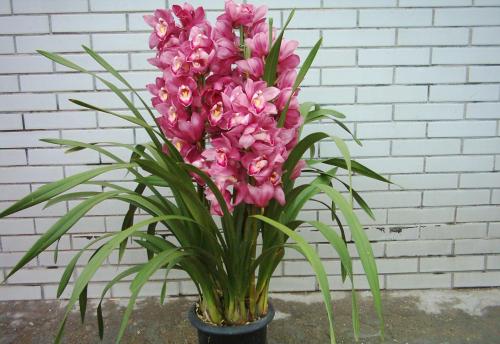
Cultivation methods for cymbidium orchids:
1. During the Spring Festival period, temperatures are relatively low, so the cymbidium orchid must be placed in a warm and well-ventilated spot to ensure normal growth. The normal growing temperature for cymbidium orchids is around 15°C, so the temperature also needs to be regulated properly.
2. Watering. Cymbidium orchids need sufficient moisture to grow well, so they should be watered and misted regularly.
3. When the flowers begin to fade, the flower stalk can be cut off from the base, which reduces the consumption of nutrients.
4. When the cymbidium orchid has grown to a certain point, be sure to repot it. When repotting, cut away rotten roots and dead leaves, and use a pot with several drainage holes at the bottom for better growth.
5. Fertilization of cymbidium orchids must be done well; mainly apply foliar fertilizer. During the growing season, apply a dilute compound liquid fertilizer once every half month or so, which promotes better growth of the cymbidium orchid.
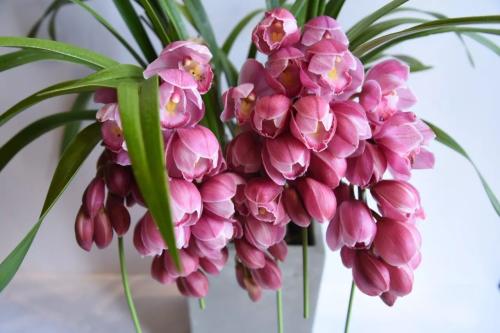
Cultivation methods and precautions for cymbidium orchids:
1. Propagation: The division method is commonly used. Division is usually carried out after the plant flowers and before the new shoots have grown large, during this brief dormant period. Before dividing, the plant should be dried appropriately, and the operation should be done when the roots are slightly white and soft. Vigorous plants are usually divided once every 2-3 years, and each divided clump of orchid seedlings should carry 2-3 pseudobulbs, one of which must be newly formed in the previous year.
2. Temperature: It likes strong light, and the suitable growing temperature is 10°C-25°C. In winter it should be moved into a low-temperature greenhouse for cultivation.
3. Humidity: It is very fond of moisture, but ventilation must be ensured, otherwise it is prone to anthracnose. Humidity for small seedlings should be 80%-90%, and for medium and large seedlings 60% to 85%.
4. Fertilization: During the growing period, the ratio of nitrogen, phosphorus and potassium is 1:1:1; during the flowering-forcing period, the ratio is 1:2:2 to 3. A fertilizer solution pH of 5.8-6.2 is suitable.
5. Watering: In production, sprinkler irrigation is usually used. Water once a day in May and September, twice a day in July-August, and once every 2 to 3 days from October to April of the following year. The frequency of watering should be adjusted at any time according to the size of the seedlings and weather conditions.