Detailed Explanation of Ginkgo Planting Methods and Technical Key Points
Ginkgo (scientific name: Ginkgo biloba L.), a deciduous tree of the Ginkgoaceae family, genus Ginkgo. Ginkgo is a large deciduous tree, with a diameter at breast height reaching up to 4 m. The bark of young trees is nearly smooth and light gray, while the bark of mature trees is grayish brown, irregularly longitudinally fissured, and rough; it has long shoots and slow-growing spur shoots. The crown of young and mature trees is conical, becoming broadly ovate when old; the branches are nearly whorled and extend obliquely upward (the large branches of female trees are often more spreading than those of male trees).
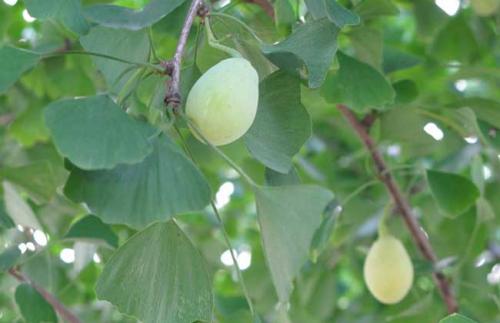
Cultivation Techniques
Seed propagation is mostly used for large-scale landscaping seedlings or for making clump-style bonsai. After harvesting the seeds in autumn, remove the outer seed coat and dry them in the sun; they can be sown in winter of the same year or in spring of the following year. If sown in spring, they must first undergo mixed-sand stratification to promote germination.
When sowing, place the seed embryo horizontally in the sowing furrow, cover with 3 cm-4 cm of soil after sowing and firm it down; the seedlings can grow to 15 cm~25 cm tall in the same year. After the Quanhong poplar drops its leaves in autumn, it can be transplanted. However, note that the seedbed should be chosen in a well-drained area to prevent waterlogging from rotting the part of the seedling near the ground.
Site Selection
Planting
- Reasonable arrangement of pollinator trees: Ginkgo is a dioecious plant. To achieve high yields, pollinator trees should be reasonably arranged. Select male trees with the same variety and flowering period as the female trees; the ratio of female to male trees is 25-50:1. The arrangement method uses a 5-tree or 7-tree square-center pattern, or corner arrangement.
- Seedling specifications: Good varieties and strong seedlings are the material basis for early fruiting and high yield in ginkgo. Seedlings with a height-to-diameter ratio of 50:1 or more, a main root length of 30 cm, uniform lateral roots, and current-year shoot growth of 30 cm or more should be selected for planting. In addition, the seedlings must have strong terminal buds, plump and full lateral buds, and no pests or diseases.
- Reasonable close planting: Ginkgo grows relatively slowly in the early stage. Close planting can improve land utilization and increase yield per unit area. Generally, a spacing of 2.5 x 3 m or 3 x 3.5 m between plants and rows is used, with 88 or 63 plants planted per mu. After the canopy closes, transplanting is carried out, first removing every other row from the plant spacing, changing it to a 5 x 3 m or 6 x 3 m plant-row spacing, with 44 or 31 plants per mu. After a few years, transplant another row from the original row spacing, forming a 5 x 6 m or 6 x 7 m plant-row spacing, with 22 or 16 plants planted per mu.
- Planting time: Ginkgo is mainly planted in autumn with leaves on, and in spring before leafing out. Autumn planting is carried out in October-November, which allows the seedling roots a longer recovery period and prepares for aboveground sprouting the following spring. When planted before sprouting in spring, because the aboveground part sprouts quickly and the roots do not have enough time to recover, growth is not as good as with autumn planting.
- When planting ginkgo, dig planting holes according to the designed plant-row spacing, with a size of 0.5-0.8 x 0.6-0.8 m. After digging the holes, backfill with topsoil and apply fermented fertilizer containing calcium superphosphate. When planting, spread the seedling roots out naturally, align them with the front, back, left, and right seedlings, then firm the soil while filling it in. The planting depth should be such that soil is mounded to 2~3 cm above the original soil mark on the seedling; do not bury the seedling too deeply. After planting, water thoroughly with settling water in time to improve the survival rate.