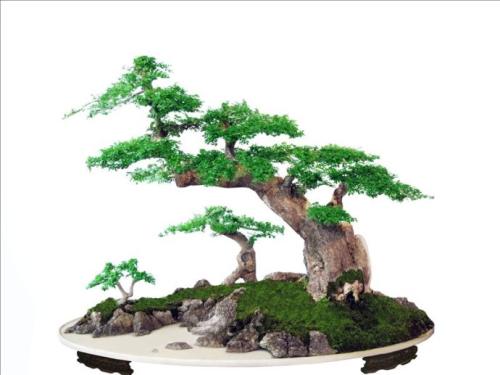
Fraxinus hupehensis belongs to the Oleaceae family, genus Fraxinus. It is native to Zhongxiang and Jingshan in Hubei, and is a deciduous tree reaching up to more than 30 m tall. The bark of young and middle-aged trees is smooth and light grayish green, while the bark of middle-aged and old trees has longitudinal dark gray fissures. The branches have strong sprouting ability and tolerate pruning. The tree is drought-tolerant, moisture-tolerant, and high-temperature-tolerant, and likes fertilizer, water, and sunlight. It can be cultivated in the open field anywhere south of the Beijing area.
Cultivation methods:
1. Shallow planting
The planting depth for Fraxinus hupehensis should be such that the root collar is level with or slightly higher than the ground surface of the planting site. Before transplanting, observe whether the root collar is on the upper surface of the root ball. If not, it means the original planting site had soil buried too deep. Extra care should be taken to locate the position of the main surface roots, and the planting depth should be determined accordingly. That is, measure the root ball height from the root collar position, or measure the root ball thickness from the position of the main roots and add 3 cm to 5 cm to obtain the burial depth data. In short, the planting depth must ensure that the root collar position is relatively consistent with the ground elevation of the planting site, to avoid slow rooting due to low ground temperature in the early stage from planting too deep, easy root rot when watering slightly too much, and in the later stage roots growing upward in search of oxygen, becoming shallower as the tree grows and resulting in declining vigor.
2. Providing nutrients
After transplanting Fraxinus hupehensis, the soil environment of the tree must be optimized. This is an important means of promoting survival. One-third by volume of the planting hole can be mixed evenly with peat or other organic soil amendments and backfill soil, then used to fill around the tree roots. When transplanting acid-loving plants in the north, ferrous sulfate or sulfur powder can be applied appropriately; if the soil is too acidic, lime powder can be applied to create a suitable environment for root growth. After backfilling, the backfill soil should not be tamped too firmly; instead, water it thoroughly so that its structure settles naturally. In addition, tree rooting agents can be sprayed onto the root system after the root ball is placed in the hole, or after backfilling, a small weir can be made in the planting hole at the outer edge of the root ball and the rooting agent poured onto the root ball. The solution can then seep down directly from the root ball, or it can be poured down along the side of the root ball to the surrounding roots, achieving the purpose of preventing root rot and promoting root growth.
3. Preventing sunscald
After transplanting, Fraxinus hupehensis requires necessary tree protection, especially when the planting site is surrounded by hard paving, such as plazas and garden paths. The strong ground radiation from such hard paving combined with solar radiation can easily cause sunscald on the trunk or even large branches of newly planted trees, thereby affecting tree survival. Generally, trees with a trunk diameter below 10 cm should be tightly wrapped with one layer of straw rope; trees with a trunk diameter of 10 cm to 20 cm should be tightly wrapped with two layers of straw rope; and trees with a trunk diameter of 20 cm should have a layer of film added between the two layers of straw rope to improve moisture retention. Note that the trunk must not be directly wrapped with film, to avoid serious damage to the tree from high temperatures under direct sunlight.
4. Stable support
Landscape greening transplanted trees are generally planted with the full crown, so whether the support is firm is also key to tree survival. The support point for Fraxinus hupehensis should be selected at more than 1/3 of the tree's total height. The angle between the support pole and the ground should be as close to 45 degrees as possible, and must not exceed 60 degrees. The strength of the support pole must be selected according to the local maximum wind force; it should not be too thin, which could cause the pole to break and the tree to topple. In addition, when fixing the support, protect the tree body. The lower end of the support pole should be buried 20 cm outside the tree hole and 30 cm below the ground, with flat large bricks or stones placed underneath. Generally, for single-trunk trees, the support poles can be directly attached to the trunk, while multi-trunk trees are suitable for first using a "#"-shaped frame on the trunk and then carrying out the support work. Note that each support should be fixed separately to avoid tree displacement.
5. Thorough watering
On the basis of digging a large hole, achieve thorough watering with one watering. That is, make a water-retaining weir with a height of more than 15 cm at 20 cm outside the planting hole. When watering, attach an 80 cm rigid water pipe to the outlet. After water comes out of the pipe, insert it into the backfill soil. Use the bottom watering method so that water overflows upward from the bottom of the hole. When the backfill soil clearly subsides, move the watering position to the opposite side and water from below. Alternate this way until the water-retaining weir is full, so that the backfill soil is evenly settled and the uprightness of the tree body is ensured.
6. Slurry planting
This method is especially suitable when the tree root ball has cracks or even scattered soil. Place the root system of Fraxinus hupehensis into the planting hole, backfill soil to 2/3 of the position, secure the support frame, make the water-retaining weir, add rooting agent, and stir while pouring in clear water until the water fills the weir. After the water seeps down for 2 to 3 hours, stir and add water again. While watering, add the remaining 1/3 of fine soil, and fill with water until the weir is full. This can ensure close contact between the root system and the soil, greatly improving the survival rate.
7. Thick moisture conservation
After the first thorough bottom watering seeps down, cover the water-retaining weir of the planting hole with more than 10 cm of organic matter or about 10 cm of inorganic matter (such as sand, small pebbles, broken bricks, etc.). This can ensure that no further watering is needed for 30 days after one thorough watering. If large-sized Fraxinus hupehensis is transplanted and the planting hole is large enough, natural precipitation can meet the tree's survival and growth requirements, but according to the actual ground soil conditions, do not water when not dry, and water thoroughly when dry, to avoid excessive watering affecting root healing and growth and causing root rot.
Cold protection measures
Fraxinus hupehensis is a
landscape greening tree species with strong vitality and adaptability. It shows no adverse reaction at an extreme minimum temperature of -20.3 degrees C and a maximum temperature of 42.3 degrees C. When planted in the south, it can overwinter without any freeze protection measures, but in northern regions, where the climate is cold and the north wind is bitter, newly transplanted large Fraxinus hupehensis trees and stump bonsai must be protected from freezing, wind, and cold in the same year. Freeze and cold protection generally begins on November 10 of the same year and ends before November 20. Specific measures generally include:
1. Apply winter fertilizer. It needs hole application (that is, dig trenches, apply fertilizer, then cover with soil), which is beneficial to the release of the fertilizer. Apply 1 kg of imported compound fertilizer per large tree, and 0.5 kg per small tree. Fertilization should be even, about 50 cm from the trunk.
2. Watering. Before the winter
cold wave arrives, water thoroughly once with antifreeze water.
Watering should be done in the morning, not in the evening, to prevent lowering the soil temperature and affecting plant root activity.
3. Plastic film insulation. Cover the ground around the tree with plastic film, and cover the film with soil to fix it, so as to achieve freeze protection.
4. Wind protection. Wrap the trunk with straw rope. On the northwest side of the seedling, beyond the height of the tree, use thickened non-woven fabric, chemical fiber tarpaulin, or striped cloth to set up a cold protection shed, make a triangular windbreak wall, and secure it with guy wires for reinforcement. In addition, before spring arrives, water thoroughly and replenish moisture on the trunk and leaves early, which is also beneficial for wind protection.
5. Trunk wrapping. Wrap straw rope around the outside of the main trunk up to the branches. Then cover the outside with a layer of plastic film.
Winter pruning and shaping
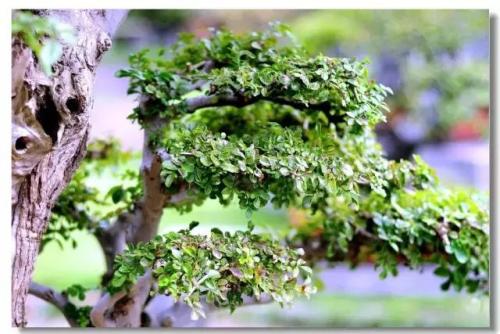
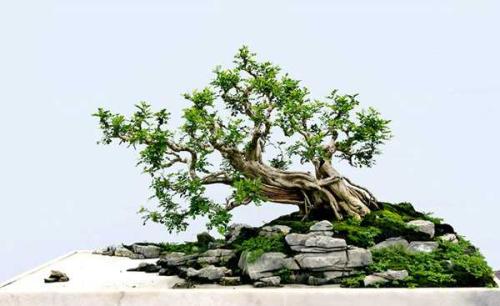
For Fraxinus hupehensis, after frost in autumn, the leaves wither after frost and the branch structure is exposed, which is very favorable for observing the direction of branches (pads), their front-to-back interweaving, high-low staggering, and positional form. At this time, a careful round of pruning and tying can be carried out on the branch form. What can be pruned into place can be bent and pulled into place with aluminum wire. If some branches (pads) are too ostentatious or their direction and position are not ideal, use aluminum wire or rope to pull them into place. For Fraxinus hupehensis, special attention should be paid to its opposite branches and frog-leg branches. On the trunk, when setting branches, and on first- and second-level branches, cut out growing branches in a staggered way. Frog-leg branches can be allowed to grow long on one side, while shortened on the other, or changed into a downward-bent branch.
Pest and disease control
Fraxinus hupehensis rarely has insect pests.
Aphids,
mites,
nematodes,
red spider mites, and others do not affect it. When tender buds first emerge, the bud tips may sometimes be affected by pests and diseases, but after a few days, when the bud leaves age, the damage disappears on its own. Powdery mildew,
damping-off, and others do not cause harm to it.