How to Grow Pothos (Devil's Ivy): Methods and Key Techniques
Pothos (scientific name: Epipremnum aureum) belongs to the genus Epipremnum. It is a large evergreen vine that grows in tropical regions, often climbing over rocks and tree trunks in rainforests. It has strong twining ability and well-developed aerial roots, and can be grown hydroponically.
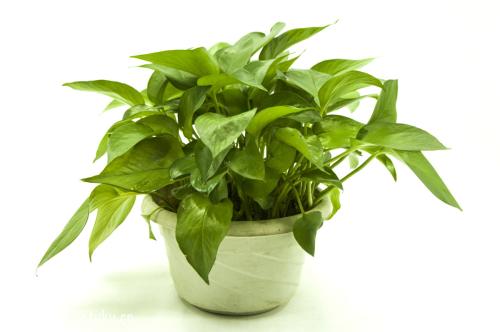
Growing Methods
1. Light
The original growing environment of pothos is among towering trees in forests where it is shaded, so its demand for sunlight is not strong. However, in the north during autumn and winter, to compensate for the lack of temperature and photosynthesis, its light exposure should be increased. Pothos can be placed in the ***best spot for indoor light, or moved to a sealed balcony to bask in the sun at noon. At the same time, when the temperature is low, open windows as little as possible, because leaves can be frostbitten in an extremely short time.
For indoor cultivation, it can be placed beside a window, but direct sunlight should be avoided. Too strong sunlight will scorch the leaves of pothos, while too much shade will cause the beautiful markings on the leaf surface to disappear. Generally, receiving four hours of diffused light is ***best for the growth and development of pothos. Therefore, pothos can be placed year-round in a sunny spot indoors. In dimmer indoor conditions, it should be moved every half month to a brighter environment for a period of recovery; otherwise, the internodes tend to lengthen and the leaves become smaller.
In spring, summer and autumn, pothos can be placed near an east- or north-facing windowsill, while in winter it can be placed at a south-facing window. If it is kept for a long time in an environment that is too dark, it will not only cause the trailing stems to grow excessively, the internodes to lengthen and the plant shape to become sparse, but the yellow-white streaks on the leaf surface will also become smaller and paler, and the markings may even disappear completely and fade to green. If grown outdoors, attention should be paid to shading, and especially in summer, strong direct sunlight must be prevented; otherwise, new leaves will become smaller, the leaf color dull, and the leaf margins will easily be scorched.
2. Temperature: In the north, pothos can safely overwinter when the room temperature is above 10°C, and it can grow normally when the room temperature is above 20°C. Generally, households have little problem reaching this temperature, but care should be taken to avoid excessive temperature differences, and also to keep the leaves away from heating equipment.
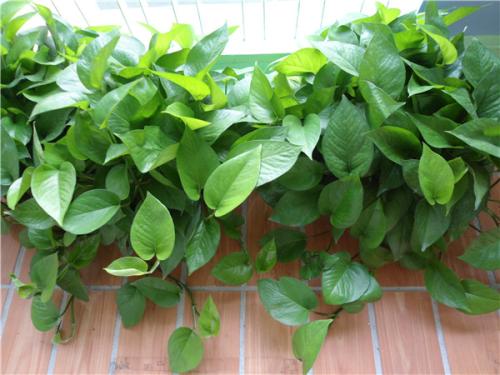
3. Humidity: Humidity refers to the water content of the air in the plant's growing environment. Under the condition of maintaining normal temperature, increasing humidity is extremely beneficial to plant growth. The following methods can be used to increase humidity. Place the plant near a humidifier, with the humidifier running for more than 5 hours a day, so the plant can enjoy the mist sprayed out by the humidifier; use a sprayer adjusted to the mist setting to spray water on the leaves, stems and aerial roots of the plant several times a day; keep an appropriate amount of water in the saucer to increase the local humidity around the plant through evaporation; gently wipe the leaf surface with a cold wet towel or toilet paper, or lightly apply it to the leaf surface for a short time (1-2 hours per day); cover the plant with a transparent plastic film to create the effect of a small greenhouse, supplementing the plant's water through evaporation of moisture from the soil, for no more than 2 hours a day, as too long a time will affect the plant's ventilation and photosynthesis.
4. Water: In autumn and winter, the amount of watering should be strictly controlled according to room temperature. Before heating begins, when the temperature is lower, the soil of the plant evaporates more slowly, so watering should be reduced, and the amount should be controlled at between 1/4 and 1/2 of the original. Even after heating begins, watering should not be too frequent; when watering, pour less into the pot and allow water to seep through the coir. In addition, water should also be sprayed at the places where aerial roots grow on the coir pole, to reduce insufficient root water uptake caused by overly rapid evaporation. For winter watering, water that has been left to stand for a day is better, as water that is too cold easily damages the roots. When growing in water, the water amount must not be too much; just enough to submerge the roots is fine, as too much water easily causes the stems and leaves to rot.
5. Soil: In winter, it can grow well under bright diffused light indoors, with sturdy stem nodes and brilliant leaf color. During the growing period, it has relatively high water requirements. In addition to normally replenishing water to the potting soil, the leaf surface should also be sprayed with water frequently. For column-and-vine cultivation, more water should also be sprayed on the coir-covered column so that the coir fully absorbs water for uptake by the aerial roots twining around the stem. A nitrogen-phosphorus-potassium compound fertilizer can be applied once every 2 weeks, or a 0.2% potassium dihydrogen phosphate solution can be sprayed weekly, to make the leaves emerald green and the markings more vivid. Pothos likes moisture. During the growing season, watering should keep the potting soil moist at all times; never let the potting soil dry out, otherwise it easily causes yellow leaves and a poor plant shape. If too much watering causes waterlogging in the potting soil, it easily causes root rot and withered leaves, and especially when the winter room temperature is low, watering must be controlled even more carefully. In summer, while watering thoroughly, also pay attention to spraying water on the leaf surface frequently. In winter, when the climate is dry, the leaves also need to be spray-washed once every 4-5 days with warm water to wash away dust on the leaf surface, which helps keep the leaves glossy and emerald green.
6. Fertilizing: In the autumn and winter seasons in the north, most plants grow slowly or even stop growing, so fertilizing should be reduced. Before winter begins, mainly apply liquid inorganic fertilizer by watering or spraying, about once every 15 days. After winter begins, fertilizing should mainly be foliar spraying, applied mainly through the stomata on the leaf surface; the fertilizer is absorbed through the stomata on the leaf surface, and the fertilizer effect can act directly on the leaf surface. Special-purpose fertilizer should be used for foliar fertilizer, as ordinary inorganic fertilizer is not easily absorbed by the leaf surface. Beida Huhuashen series and Japan-produced Hanakao, etc. can all be used as foliar fertilizer.
7. Shaping: Plant or directly insert 4-5 plants per pot, and set up a coir pole in the middle of the pot to make it easier for pothos to twine upward as it grows. Shaping and pruning are carried out in spring. When the stems have climbed all over the coir pole and the tips have exceeded the coir pole by about 20 cm, cut off 40 cm of the stem tips of 2-3 of the plants. After new buds and new leaves sprout following the shortening, then cut off the stem tips of the remaining plants. For potted plants that have lost leaves on the whole plant or the lower half due to winter frost damage or other reasons, half of the stems can be shortened by 1/2, and the other half by 2/3 or 3/4, so that the cut heights are staggered; in this way, the new leaves growing below the cuts can quickly cover the coir pole.