Detailed Explanation of Rose Planting Methods and Technical Points
The Chinese rose (scientific name: Rosa chinensis Jacq.): known as the queen of flowers, also called "monthly red", is an evergreen or semi-evergreen low shrub that blooms in all four seasons, generally red, or pink, occasionally white and yellow, and can be used as an ornamental plant or a medicinal plant, also known as Chinese rose. There are three natural varieties, and modern Chinese roses have diverse flower forms, including single-petaled and double-petaled, as well as elegant flower forms such as high-centered with rolled edges; their colors are brilliant and rich, not only solid colors such as red, pink-yellow, and white, but also mixed colors, silver edges and other varieties; most varieties are fragrant. There are many varieties of Chinese roses, with nearly ten thousand in the world, and China also has more than a thousand.
Morphological Characteristics
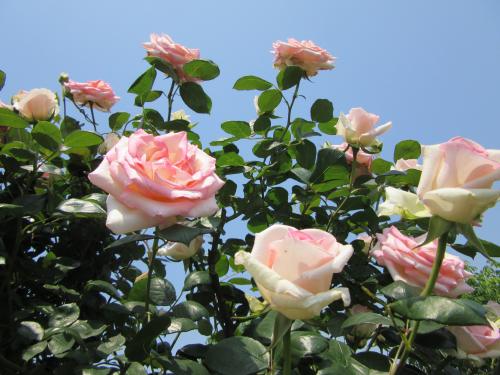
The Chinese rose is an upright shrub, 1-2 m tall; branchlets stout, cylindrical, nearly hairless, with short thick hooked prickles. Leaflets 3-5, rarely 7, together with petiole 5-11 cm long, leaflets broadly ovate to ovate-oblong, 2.5-6 cm long, 1-3 cm wide, apex long acuminate or acuminate, base nearly rounded or broadly cuneate, margin sharply serrate, both surfaces nearly hairless, upper surface dark green, often glossy, lower surface lighter in color, terminal leaflet stalked, lateral leaflets nearly sessile, total petiole relatively long, with scattered prickles and glandular hairs; stipules mostly adnate to the petiole, only the free part at the apex ear-shaped, margin often with glandular hairs. Flowers several clustered, rarely solitary, 4-5 cm in diameter; pedicel 2.5-6 cm long, nearly hairless or with glandular hairs, sepals ovate, apex caudate-acuminate, sometimes leaf-like, margin often with pinnate lobes, rarely entire, outer surface hairless, inner surface densely covered with long soft hairs; petals double to semi-double, red, pink to white, obovate, apex emarginate, base cuneate; styles free
, extending out of the mouth of the hypanthium, about as long as the stamens. Fruit ovoid or pear-shaped, 1-2 cm long, red, sepals deciduous. Flowering period April-September, fruiting period June-November.
Cultivation Techniques
After flowering, dry and withered flower buds should be cut off. When the Chinese rose first shows flower buds, pick a well-shaped flower bud. The purpose is to keep only one flower bud per branch, so that in the future the flowers will bloom full and gorgeous, with large flowers and a rich fragrance. After each season's flowering period ends, comprehensive pruning must be carried out. Generally, light pruning is suitable, promptly cutting off spent flowers and thin, weak, crossing, and overlapping branches, keeping thick, young branches with only 3-6 cm from the base, keeping outward-facing buds, and pruning into a natural open-center shape to make the plant shape beautiful and prolong the flowering period. In addition, potted Chinese roses should choose dwarf, multi-flowered varieties with a rich fragrance. Summer pruning mainly consists of cutting off the sprouting branches and flowers of the grafted rootstock, cutting off spent flowers with leaves after flowering, and thinning out excess flower buds, reducing nutrient consumption to create good conditions for the next flowering period. To make the plant shape beautiful, long branches can be cut back by 1/3 or half, medium branches by 1/3, cutting at a slant 1 cm above the leaf. If pruning is too light, the plant will grow taller and taller, the branches longer and thinner, and the flowers smaller and smaller. Winter pruning depends on the variety and cultivation purpose. When pruning, branches should be retained, and attention should be paid to the overall shape of the plant. Large-flowered varieties should retain 4-6 branches 30-45 cm long, select a strong lateral bud on one side, and cut off the upper part of the branch. For trailing or climbing varieties, the main focus is thinning out old branches, cutting off weak branches and diseased branches, and cultivating the main trunk.
Chinese roses love light, and during the growing season there must be sufficient sunlight, at least more than 6 hours of light per day; otherwise, they will only grow leaves and not bloom, and even if flower buds form, after blooming the flower color will not be brilliant and not fragrant. For open-field cultivation, choose a site with higher terrain, sufficient sunlight, air circulation, and slightly acidic soil. When planting, deep plow the land and apply organic fertilizer as base fertilizer. Potted Chinese roses should use fertile sandy soil rich in humus and slightly acidic, and alkaline soil should not be used. Before new buds sprout each spring, the pot soil should be changed once. Chinese roses can be grown by flat planting, and clay pots naturally also enter a semi-dormant state, and are most afraid of drying out and dehydration. Water once each morning and evening, avoiding direct sunlight. When watering at high temperatures, each watering should have a small amount of water seeping from the bottom of the pot, indicating thorough watering. When watering, do not splash water on the leaves to prevent disease.
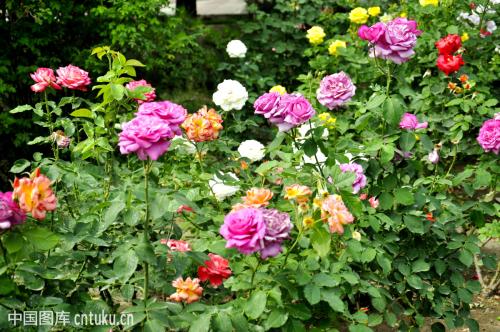
Chinese roses prefer a cool and warm climate environment, and are afraid of high temperatures. The most suitable temperature is 18-28C. When the temperature exceeds 32C, flower bud differentiation will be inhibited. Therefore, in the hotter midsummer, Chinese roses usually do not bloom, and even if there are a small number of flowers, they are much inferior to those at normal temperatures. At high temperatures, the flower pot can be moved to a shady environment for care. Open-field planted Chinese roses have well-developed root systems, rapid growth, robust plants, slightly larger flowers, and high ornamental value. During management, cultivation measures should be selected according to different types, growth habits, and geographical conditions. The planting density for upright varieties is 75 cm x 75 cm, for spreading varieties the plant-row spacing is 100 cm x 100 cm, for columnar varieties the plant-row spacing is 40 cm x 50 cm, and for climbing varieties the plant-row spacing is 200 cm x 200 cm. The plant spacing for open-field planted Chinese roses is 50-100 cm, depending on the size of the seedlings and the need. In winter, if there are warming conditions at home, the room temperature should preferably be kept above 18C, and there should be more than 6 hours of light per day. If there are no warming measures, then let them enter natural dormancy. At the Start of Winter, after the leaves fall, keep only 5 cm of each branch, cut off all branches above 5 cm, then place the flower pot in a cool place at around 0C for storage. The pot soil should be on the dry side, but not excessively dry, to prevent death from drying. Whether cultivated in a courtyard or on a balcony, attention must be paid to ventilation. With good ventilation, it is possible to reduce the occurrence of pests and diseases in Chinese roses. When preparing nutrient soil, attention should be paid to drainage, ventilation, and the combination of various nutrients. The ratio is garden soil: leaf mold: chaff ash = 5:3:2. Before and after overwintering each year, it is suitable to repot, trim roots, and change soil, gradually increasing the pot diameter year by year, with clay pots being the best.
Chinese roses love fertilizer. Potted Chinese roses should be fertilized frequently. During the growing season, apply dilute fertilizer water once every ten days. No matter which fertilizer is used, remember not to apply excessively, to prevent fertilizer burn and damage to the seedlings. However, no fertilizer should be applied during winter dormancy. Chinese roses love fertilizer; base fertilizer should mainly be slow-release organic fertilizer such as decomposed cow dung, chicken manure, soybean cake, oil residue, etc. Add liquid fertilizer water once every half month, which can keep the leaves thick, dark green, and glossy. Before sprouting in early spring, apply a relatively concentrated liquid fertilizer once. During the flowering period, be careful not to fertilize. After the flowers fade in June, apply liquid fertilizer once more. In September, when the fourth or fifth axillary buds are about to sprout, apply a medium-concentration liquid fertilizer once more. In December during the dormant period, apply decomposed organic fertilizer for overwintering. Winter plowing can apply human manure or spread decomposed organic fertilizer, then turn it into the soil. During the growing season, fertilize frequently. After the flowers fade, apply top dressing of quick-acting fertilizer 1-2 times. In high temperature and drought, apply thin fertilizer. Apply the last fertilizer before entering winter. Before fertilizing, attention should also be paid to promptly removing weeds. Watering Chinese roses has its particularities: it should be done by the principle of seeing dry and seeing wet, not watering when not dry, and watering thoroughly when watering. Chinese roses are afraid of waterlogging, and there should be no standing water in the pot; too much water easily causes root rot. In midsummer, water once a day, and water when the surface of the pot soil turns white. During winter dormancy, watering must be reduced, keeping it semi-moist. Watering Chinese roses varies with the season. In winter, keep the soil moist, and it is enough that it does not dry out completely.
Growth Habits
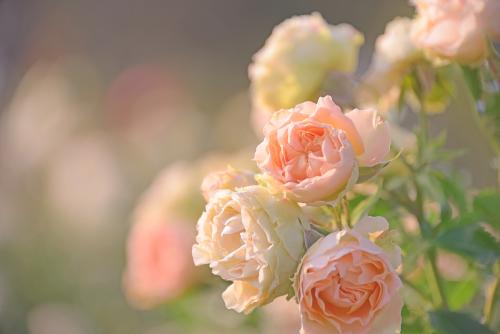
Although Chinese roses are not strict about climate and soil requirements, loose, fertile, organic-rich, slightly acidic, well-drained loam soil is more suitable. They prefer a warm, sunny, and airy environment. For most varieties, the optimal temperature is 15-26C during the day and 10-15C at night. When the winter temperature is below 5C, they enter dormancy. Some varieties can tolerate low temperatures of -15C and high temperatures of 35C; when the summer temperature remains above 30C, they enter semi-dormancy, and the plants grow poorly. Although they can still form buds, the flowers are small, have few petals, and are dull in color without luster, losing their ornamental value.
Propagation Methods
Division propagation is mostly carried out in early spring or late autumn. The method is to dig out the entire rose plant with soil and divide it, with each division having 1 to 2 branches and a few fibrous roots, and planting it in a pot or in the open field; it can bloom in the same year. Generally carried out in summer, the method is to bend a rose branch down from the parent plant and press it into the soil. At the middle part of the buried branch, remove the bark in a half-ring from the lower part, expose the branch end, and after this branch produces adventitious roots and grows new leaves, cut it off from the parent plant. Grafting commonly uses wild rose as rootstock, divided into bud grafting and stem grafting. Bud grafting has a relatively high survival rate, generally carried out from August to September, and the grafting site should be as close to the ground as possible. The specific method is: on one side of the rootstock stem, use a budding knife to make a "T"-shaped cut in the bark, then select a bud from the middle part of a well-grown current-year branch of the rose. Insert the bud into the "T"-shaped cut, tie it with a plastic bag, and provide appropriate shade. In this way, after about two weeks it can generally... [take] Usually when the rose is dormant in early spring or late autumn, cut mature branches with 3 to 4 buds for cuttings. If using softwood cuttings, provide appropriate shade and keep the seedbed moist. After cutting, roots generally form in 30 days, with a survival rate of 70% to 80%. If rooting powder is used to dip the cuttings, the survival rate is higher. That is, spring sowing propagation. It can be sown in holes or in furrows, and usually germinates and emerges in early to mid-April. Transplanting time is divided into spring planting and autumn planting, generally before the end of autumn after leaf fall or in early spring before sap flow begins.