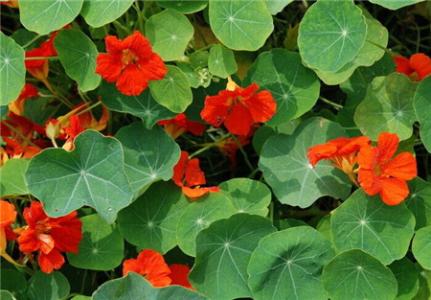
Nasturtium (Tropaeolum majus) is a plant of the class Dicotyledoneae, family Tropaeolaceae, genus Tropaeolum, and is a perennial semi-trailing or prostrate plant. The plant height is 30cm-70cm. The basal leaves have long petioles, and the leaf blades are pentagonal, ternately parted, with the secondary segments bearing a few small lobes and sharp teeth. The flowers are solitary or 2-3 in cymes, with five petals and 8-19 sepals, yellow, elliptic-obovate or obovate; the petals are equal in length to the sepals, narrowly linear.
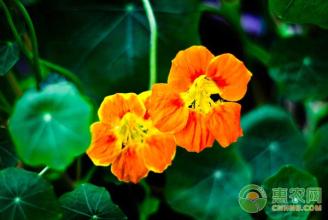
Propagation Methods
Seed Propagation
Generally, the sowing period is March to June, called spring sowing. The flowering period is August to December. Sowing in late August or early September in autumn is also possible, called autumn sowing. In this way, nasturtium will bloom around New Year's Day and during the Spring Festival.
Sowing and seedling raising: the suitable germination temperature is 18-20 degrees. Sow in individual spots, cover with about 1 cm of soil, water thoroughly and keep moist, and germination occurs in 7 days. When there are 2-3 true leaves, pinch out the growing tips and pot up; properly arrange the leaves and branches to aid ventilation and make the flowers show.
Cuttings are taken from April to June; select tender stems as cuttings, remove the lower leaves, shade after inserting, keep humid, and roots can form in 2-3 weeks. As the stems and vines grow, support frames should be set up promptly with bamboo strips, and the branches and vines tied up. Apply topdressing once every 10-15 days, and keep sufficient moisture and relatively high air humidity throughout the whole growth period.
Each flower has 8 stamens and one pistil, and among them the 8 stamens do not mature at the same time. And only after all the pollen has been dispersed does that pistil mature and extend to the trumpet-shaped opening of the flower.
Cultivation Techniques
Basic Management
For nasturtium cultivation, sandy loam rich in organic matter should be used, with a pH value of 5-6. Generally, during the growing period, fertilize once every 3-4 weeks, and after each fertilization, loosen the soil promptly to improve aeration and favor root development. Nasturtium likes moisture and fears waterlogging; keep soil moisture at about 50%. During the growing period, watering should be done little and often; in spring and autumn, water once every 2-3 days, and in summer water every day, and spray water on the leaf surfaces in the evening to maintain relatively high humidity.
After flowering, reduce watering to prevent excessive branch growth. If watering is excessive or drainage is poor, the roots are prone to rot from dampness; in mild cases the leaves turn yellow and fall, and in severe cases the whole plant wilts and dies. Nasturtium likes full sunlight and does not tolerate shade. In spring and autumn it should be placed in a sunny spot for cultivation, in summer it should be appropriately shaded, and in midsummer placed in a cool, ventilated place. In the north, move it indoors in mid-October and keep it in a sunny place, maintaining room temperature at 10--15°C, and appropriately control fertilizer and water. At the same time, the flowers and leaves of nasturtium are strongly phototropic, so when cultivating or viewing it, the position should often be changed to make it grow evenly.
The stems of nasturtium are trailing, so support must generally be set up to reinforce it. If allowed to grow naturally, the stems and vines will inevitably become too long, affecting the ornamental effect. In order to control the endless growth of its stems and vines, when nasturtium enters the initial flowering stage and its stems and vines have grown to 30-40 cm, spray the leaves with a 100PPM paclobutrazol solution to promote dwarfing. The effect can be seen three days after spraying: the main vine thickens, the extension of the top vine slows down, and the flowers on the side vines open one after another, which is quite beautiful.
Since nasturtium is a twining, semi-trailing flower with a strong apical growth advantage, if you want it to have abundant flowers and lush leaves, you should pinch the tops when it is a seedling to make it produce side branches. After pinching the tops, give fertilizer and water; generally the new branches that emerge in about 10 days can reach several centimeters in length. When the plant grows 15~20 cm above the pot surface, a support frame needs to be set up, the vine stems evenly tied to the frame, and the leaves made to face one direction. The size of the frame should be such that the vines and leaves can fill the frame in the later growth stage; generally it is about 20 cm above the pot surface. Tie promptly as the stems grow, and pay attention to distributing the vine stems evenly on the frame. When tying, pinch the shoot tips to encourage more branching, so as to achieve a beautiful shape with abundant flowers and lush leaves.
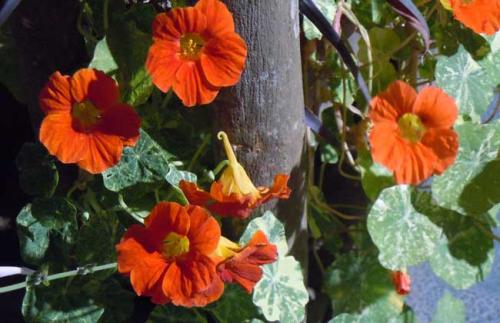
To grow potted nasturtium well, first choose a reasonably prepared growing medium; second, strengthen fertilizer and water management during the growth period; third, ensure relatively sufficient sunlight.
① The growing medium should be a loam mixed with 4 parts leaf mold, 4 parts garden soil, 1 part compost soil, and 1 part sand.
② During the growth period of nasturtium, improper fertilizer and water management often causes long internodes and yellow leaves, thin stems and small leaves, or luxuriant branches and leaves but sparse flowers. During growth, generally apply once a month a 20% concentration of decomposed soybean cake water; during flowering, stop applying nitrogen fertilizer and instead apply 0.5% superphosphate or decomposed chicken and duck manure water once every half month; after the flowers fade, apply topdressing once with 30% decomposed soybean cake water to replenish the nutrients consumed by flowering. Stop fertilizing in the hot summer weather. At the end of autumn, apply one more compound overwintering fertilizer to enhance the plant's cold resistance. Watering is a routine management task; the number of waterings and the amount of water should be determined according to the weather and the plant's growth. In spring and autumn, generally water once every other day, and in summer water once a day, to maintain relatively high air humidity. When flower buds appear, the number of waterings should be appropriately reduced, but the amount of water each time should be increased, so that the potting soil alternates between dry and moist. After flowering, watering should be reduced.
③ Nasturtium likes sunlight; in spring and autumn it should be placed in a sunny spot, in summer it needs appropriate shading, and in winter keep the room temperature at about 15°C; with sufficient sunlight, it can continue to grow and develop.
Autumn Sowing and Winter Blooming
Sow in late August or early September in autumn. When the seedlings grow 2-3 true leaves, transplant them into medium-sized flower pots, place them in a sunny spot outdoors, and carry out ordinary watering management. After "Frost's Descent" (Shuangjiang), move it indoors, place it in a sunny spot, and keep the temperature at 15°C-25°C, never lower than 8°C. Usually pay attention to turning the pot to make the plant full and attractive. Watering should be moderate; if too dry the leaves turn yellow, and if too wet they tend to rot. Apply a 0.5% potassium dihydrogen phosphate solution once every 10 days; do not apply too much nitrogen fertilizer to avoid spindly growth.