Hollyhock Planting Methods and Care Tips Explained
Hollyhock (scientific name: Althaea rosea (Linn.) Cavan.), also known as yizhanghong, dashuji, and rongkui. It is a biennial upright herbaceous plant, growing up to 2 m tall, with stems and branches densely covered in bristles. The flowers are borne in terminal racemes, single or double, in colors such as purple, pink, red, and white; the flowering period is from June to August, and the fruit is a capsule, with flat, round, kidney-shaped seeds. It prefers full sunlight and tolerates partial shade, but dislikes waterlogging.

Hollyhock planting methods:
Hollyhock is usually propagated by sowing, and can also be propagated by division and cuttings. Division propagation is carried out in spring, and cuttings are used only to propagate certain superior cultivars. In production, sowing is mostly used as the main method of propagation, and in North China spring sowing is the main approach.
Sowing: In North China, it is generally sown in the same year and blooms in the same year. The seeds germinate after about one week, and when 2 to 3 true leaves have grown, transplant once. Hollyhock seedlings are prone to damping-off, so the seedbed soil should be managed carefully; use leaf mold and field soil and disinfect the soil, or mix in medicated soil when sowing.
Division: Division propagation can be carried out from August to September. Dig up the old plants, divide the stem buds with fibrous roots, and replant them for renewal. After planting, water thoroughly immediately, and they can bloom the following year.
Cuttings: For cuttings in spring, it is advisable to use stem sections from basal suckers as cuttings. The cuttings are 7 to 8 cm long, with sandy soil as the substrate, and after cutting they should be shaded until they root.
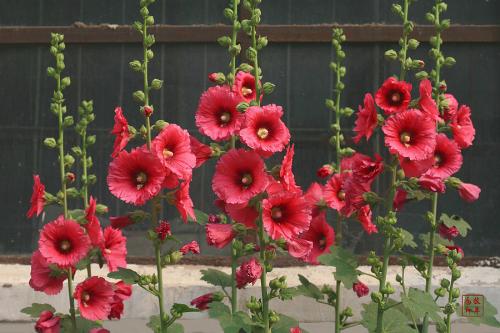
Hollyhock growing methods:
1. Soil: Hollyhock has strong saline-alkali tolerance and can still grow in soil containing 0.6% salt. It grows well in loose, fertile, well-drained sandy soil rich in organic matter.
2. Watering: During the flowering period, hollyhock should be watered appropriately so that the flowering period is long and the flowers bloom well, continuing all the way to the top of the stems.
3. Temperature: The growing temperature for Abelmoschus manihot is 25-30 degrees Celsius, and the *** optimum temperature during the flowering period is 26-28 degrees Celsius. An average monthly temperature below 17 degrees Celsius affects flowering, and growth is poor when the nighttime temperature is below 14 degrees Celsius.
4. Fertilizing: During the seedling growth period, attention should be paid to fertilizing, weeding, and loosening the soil so that the plants grow robustly. After flower buds form in the leaf axils, additional phosphorus and potassium fertilizer should be applied, and a few leaves at the base should be trimmed off.
5. Other: To keep the plants short and prevent lodging, in June the roots around the plant can be cut off in a cone shape with a spade, cutting the roots once every 2-3 weeks, then watering immediately for care. When the fruit turns yellow and ripe, it should be harvested immediately to prevent the seeds from scattering. After the flowering period ends, the aboveground part of the plant can be cut off, and when new shoots sprout, a clustered plant can form. Hollyhock is prone to aging, and should be renewed after 2-3 years of cultivation.