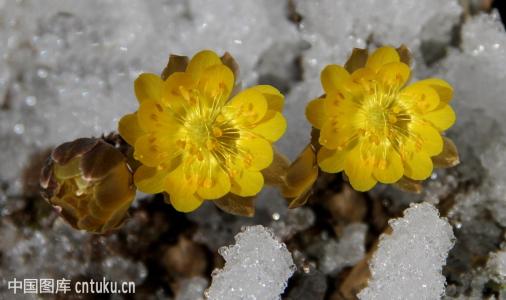
Ice Amur Adonis, scientific name: Amur Adonis (AdonisamurensisRegeletRadde), Ranunculaceae family (Ranunculaceae), Adonis genus (Adonis), a perennial understory plant. Also known as Jinzhanhua, Jinzhonghua, Binglehua, Binglinghua, Binglianghua, Binglihua, Bingliuhua and Fus Hou Cao (Longevity Grass), etc. In the Liaoning region it is called Snow Lotus. It is distributed in the various provinces of Northeast China, Japan, Korea, Russia and Europe.

Cultivation Techniques
The resources of Ice Amur Adonis are limited. According to forestry experts from Northeast Forestry University, under natural conditions, Ice Amur Adonis takes many years from seed falling to the ground, germination and growth to flowering. Therefore, while developing and utilizing it in a planned way, on the one hand attention should be paid to protecting the resources, and on the other hand research on its artificial cultivation should be accelerated, so that the understory rare plant Ice Amur Adonis resource can be protected and better benefit mankind.
This plant has the characteristic of flowering early. In the Zhangguangcai Ridge forest area of Mudanjiang, the Wandashan and the Xiaoxing'anling Qing'an forest areas, it usually germinates in mid-to-late March, at the end of winter and beginning of spring when the ice and snow have not yet melted, and its flower stem is 1.5-4cm. The flowering time can last until early May. This flowering time can last until early May.
Planting Management
For pot cultivation, it is suitable to plant in clumps and densely. Generally, it is potted in late autumn, and the potting soil needs to be mixed with a relatively large amount of humus. When planting, the dormant bud should be level with the soil surface. After planting, place it underground in a cool outdoor spot, and place sawdust or broken buds around the flower pot so that it can be taken out at any time. If you want to enjoy the flowers in winter, you can move the flower pot to a cold room at 00C-50C for 1 day-2 days, then move it to a room at 15°C-20°C, place it in a place with sufficient light, and in about 10 days-12 days it will germinate, form buds and bloom.
Site Selection and Fertilization
A method for cultivating Amur Adonis, characterized in that: the selected plot is sandy loam soil with PH=(7-8) and organic matter content greater than 2%; the base fertilizer is a compound fertilizer or a mixture of potassium sulfate fertilizer and diammonium sulfate; 3% Miral granular agent (1.5-1.7)kg is broadcast per mu; the cultivation mode can adopt direct seeding in the field or seedling transplanting; the sowing depth for direct seeding in the field is (0.5-1)cm; when using seedling cultivation, 1 mu of land requires a seedbed area of 100 square meters; when the first pair of true leaves grows, spray with azoxystrobin fungicide, and thereafter every 15 days alternately use a mixture of prochloraz and cyproconazole and azoxystrobin for 2-3 times; transplant when the seedlings grow (1-10) pairs of true leaves; when the seedlings grow to 8 leaves, apply (4-5)Kg urea per mu; for weeding, manual weeding or chemical weeding can be selected.
Medicinal Value and Effects
The whole plant of Ice Amur Adonis contains a variety of medicinal components including cardiac glycosides and non-cardiac glycosides, and it is commonly found in the pharmacopoeias of many countries. In traditional Chinese medicine, our country calls Ice Amur Adonis Fu Shou Cao (Longevity Grass). It has the functions of strengthening the heart, promoting diuresis, calming and slowing the heart rate; it can reduce the excitability of the nervous system and hyperfunction of spinal reflexes, and is used for acute and chronic cardiac insufficiency. It mainly treats congestive heart failure, cardiac edema and atrial fibrillation; a combination with silver bromide can strengthen the therapeutic effect on epilepsy. In the past there were many preparations of both Chinese and Western medicine, but nowadays they are very hard to find on the market.
Effects
Because of its unique living habits, it has very good ornamental value in the late winter and early spring in the north. As early as several thousand years ago in the Zhou Dynasty of our country, the Xishen people, an ethnic minority living in the Heilongjiang River basin, used "Binglehua" as a rare flower and exotic plant to pay tribute to the central regime and the Zhou Son of Heaven. In Beijing and Harbin in the 1950s-1960s, some people used it for outdoor flower exhibitions in early spring, which caused quite a sensation.
The blooming time of Amur Adonis is exactly the extremely cold season at the end of winter and beginning of spring when the ice and snow have not yet melted. In the northern regions, when no other plants are sprouting, how precious it is for it to bloom alone. Therefore, it has very good ornamental value in the north at this time. It can be used as configuration material for flower beds, flower paths, grass edges or rock gardens, and can also be cultivated in pots for viewing.