Detailed Guide to the Planting Methods and Techniques of Mimosa
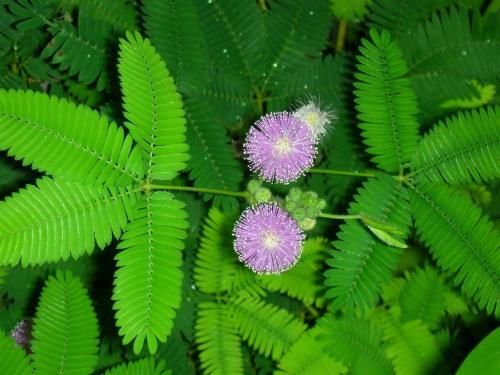
Planting methods
Generally propagated by sowing, sown from late March to early April. Scatter the seeds evenly on fine soil, cover with about 1.5 cm of soil, and at a temperature of about 18°C, seedlings can emerge in about 10 days (generally they grow once in the soil and do not require special effort in management). Seedlings grow relatively slowly, and can be planted out when they are 7-8 cm tall.
Field management: when planted in fields, the plant spacing is 25-30 cm; loosen the soil, hoe weeds, and water in a timely manner. For indoor pot cultivation, water once a day in summer. Fertilize once a month; if you do not want the plant shape to become too large, reduce the amount of fertilizer, or even do not fertilize. 3. Pest and disease control: basically no pests or diseases. If there are slugs, they can be controlled with fresh lime powder in the morning.
It likes moisture; water once a day during the summer growing period. During the seedling stage, apply a topdressing once every half month. If you do not want the plant shape to become too large, reduce the amount of fertilizer. Soil: requires deep, fertile, moist soil. It is not cold-tolerant and likes a warm climate; in winter the plant dies back on its own. It likes sufficient light and is slightly tolerant of partial shade. Propagated by sowing. Sow from late March to early April; seedlings grow relatively slowly, and can be planted out when the seedlings are 7-8 cm tall. 4
Why mimosa does not bloom The main reason mimosa does not bloom is unsuitable light. The photoperiod required for a plant to bloom is closely related to its place of origin. Mimosa originated in tropical and subtropical regions and is a short-day plant. It needs short-day light conditions to make it bloom. To make mimosa bloom in the same year it is introduced, one option is to introduce it in regions of similar latitude, and the other is that in regions with very different latitudes, artificial 8-hour short-day treatment must be carried out. 5
Mimosa likes a warm, humid environment with ample sunlight, and is suitable for growing in well-drained sandy loam rich in organic matter. It grows quickly and has strong adaptability. During the plant's growth period, together with watering, apply diluted decomposed liquid fertilizer about every 10 days (3-4 times in total). When grown as a potted ornamental, it should be moved indoors to a sunny place in winter, and maintaining a room temperature of 10-12°C is enough for it to overwinter safely. 6
Mimosa is an annual herb; it blooms with purplish-red flowers and dies after setting fruit. It belongs to the Fabaceae, so it forms pods. After flowering, when the seeds mature, they break off and fall from the joints. They can be collected at this time. When you see the pods (things like bean pods), you can collect them when they are about to fall. After disinfecting and air-drying the seeds, wrap them in paper and place them in a dry, low-temperature place, and that is fine. 7
Mimosa is relatively easy to propagate. Generally, the sowing method is used, and it can be done all year round, but indoor pot sowing in early spring in February is best. Before sowing, soak the seeds in 30°C warm water for 1 day and then sow, which can speed up germination. After sowing, place the pot in an environment of 15-20°C, and seedlings can emerge in about 10 days. When the seedlings grow to 5-6 cm tall, divide and transplant them with a soil ball, and when they grow to 10 cm, plant them out into larger pots.
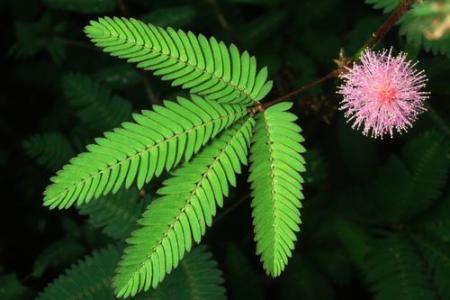
The flowers, leaves, and pods of mimosa all have fairly good ornamental value, and it is relatively easy to keep alive. It is suitable as a potted flower on balconies and indoors (people eating it or coming into excessive contact with mimosa can also cause hair loss). It can also be grown in courtyards and other places. Mimosa differs from ordinary plants in that when touched by people, its leaf stalks droop and its leaflets close, so people interpret this as "shyness", hence it is calledSensitive Plant, Hehu Grass, Mimosa, Zhixiu Grass, and Pa Chou Grass (Cantonese). It is native to the tropical regions of South America, likes warmth and humidity, and has ordinary soil requirements.