A Detailed Explanation of Fennel Planting Methods and Key Technical Points
Fennel was first recorded in the Tang Bencao. Su Song said that northerners call it huixiang, and the sound is close to huaixiang. Tao Hongjing said: when boiling rank meat, add a little, and there is no rank odor; even when put into stinky sauce as powder it is fragrant, hence it is called huixiang. Li Shizhen said that common people often chew it held in their bosoms, so perhaps the name huaixiang comes from this. The fruit (xiaohuixiang) is used as a spice and also for medicinal purposes; the roots, leaves and whole plant can also be used as medicine.
Fennel Planting Techniques
1. Requirements for the environment
Fennel grows well under mild climate conditions, but it is relatively strong in both cold and heat tolerance. In areas where winters are not too cold, it can be grown as a perennial. In the northern Liaoning region, the main planting seasons are spring and autumn. It has no strict requirements for soil conditions, but to ensure high yield and good quality, fertile plots should be selected for planting.
2. Land preparation and fertilization
After deep plowing the planting land, apply sufficient organic base fertilizer, about 2500 kg of fully decomposed organic fertilizer per 667 sq m, and 20-30 kg of compound fertilizer. Fennel has difficulty emerging, so land preparation and bed making must be meticulous, and the bed surface must be level to facilitate watering and ensure full stands.
3. Planting methods
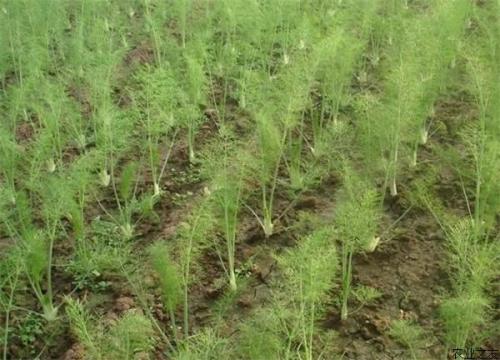
Fennel can be direct-seeded in the open field or transplanted after raising seedlings. Bed planting is the main method, with row and plant spacing of 15 cm x 15 cm. Open-field direct seeding: spring fennel can be sown in early April, and autumn fennel can be sown in July-August. Seedling raising and transplanting: mainly for spring fennel, generally seedlings are raised in a greenhouse or small arched shed in late March. Seed soaking and pregermination are best carried out, and the following steps should especially be followed:
(1) Seed treatment: For spring fennel, soak the seeds in warm water at about 40°C for 24 h, then place them at 15-20°C for pregermination. After the seeds show bud eyes, sow on a warm day using the wet sowing method, with a seeding rate of 2.5-3.0 kg per 667 sq m. For seedling raising and transplanting, evenly scatter the treated seeds on a seedling tray or on the bed surface in the greenhouse, and cover with 0.5-1.0 cm of soil. When sowing autumn fennel, because the temperature is relatively high, emergence is slow and uneven, so low-temperature seed soaking and pregermination should be carried out before sowing, using the same method as for spring fennel, or soak the seeds in 5 x 10⁻⁶ gibberellin solution for about 12 h, which can replace low-temperature soaking and pregermination. Sow when 80% of the seeds show bud eyes.
(2) Strengthen post-sowing management: After sowing, avoid dryness and keep the soil moist. Wheat straw, rice straw and the like can be spread over the bed surface to form light shade so as to preserve moisture, preserve heat and prevent rain damage. When using the wet sowing method, lightly sprinkle water once when the sprouts push through the soil, and remove the covering after the seedlings emerge completely in 1-2 days. Seedling raising and transplanting: in early to mid-May, when the seedlings are 35-45 days old, transplant them into the open field.
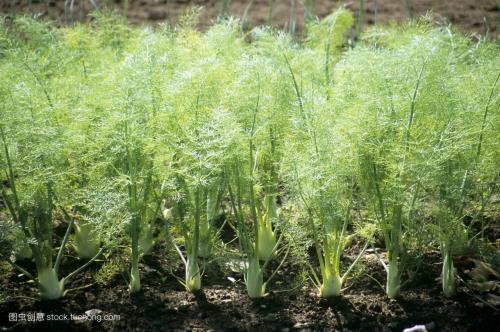
4. Field management
Open-field direct seeding: after the seedlings emerge completely, thinning should be carried out, combined with 1-2 times of intertillage thinning. For flat-bed planting, generally 2-3 plants per hole, or single-plant planting. Seedlings grow slowly, so attention should be paid to weed control. Do not water too much during the seedling stage; appropriately restrain growth. After the seedlings reach 10-12 cm in height, watering should be frequent, and a small amount of quick-acting nitrogen fertilizer should be applied together with watering. When the plant height reaches 30 cm, they can be harvested, generally yielding 1500-2000 kg per 667 sq m.