Detailed Guide to Night-blooming Jasmine Planting Methods and Techniques
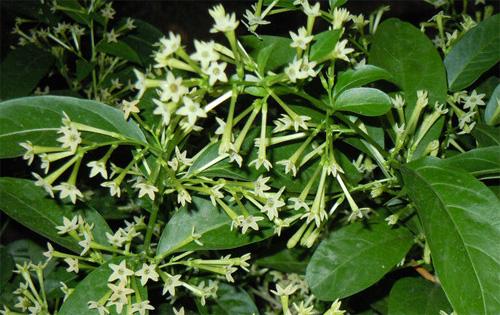
Night-blooming jasmine (scientific name: Telosma cordata (Burm. f.) Merr.): a slender twining shrub; branchlets pubescent, yellow-green, older branches grayish-brown, gradually becoming glabrous, slightly lenticellate. Leaves membranous, ovate-oblong to broadly ovate, veins slightly pubescent. Umbel-like cymes axillary, bearing up to 30 flowers; flowers fragrant, more so at night; corolla yellow-green, salverform, corolla tube cylindrical, throat villous, lobes oblong, ciliate, not wrinkled when dry, dextrorse; corona of 5 lobes, membranous, borne on the gynostegium, style short-columnar, stigma capitate, base five-angled. Follicles lanceolate, exocarp thick, glabrous; seeds broadly ovate, apex with white silky coma. Flowering period May-August, rarely fruiting.
Propagation Methods
- Selecting cuttings. Choose healthy, pest- and disease-free branches; on the same plant, select current-year middle-to-upper sun-facing branches, requiring shorter internodes, thick and strong stems and leaves, and plump buds; avoid branches about to flower and leggy shoots.
- Selecting the medium. Mix peat soil, leaf mold and sand at a ratio of 3:3:4 respectively; the bed soil prepared this way has the characteristics of raising bed temperature, retaining water, providing aeration, being fertile and slightly acidic, and is suitable for cuttings to take root and sprout.
- Before cutting, treat the cuttings with agents such as ABT rooting powder to promote rooting. Cut the cuttings into sections of 8 cm to 12 cm, each bearing 2 to 3 buds; the lower cut should preferably be 0.5 cm below a node, the cut should be smooth, remove the lower leaves, keeping only 2 to 3 leaves at the top; insert to a depth of generally about 3 cm.
- Creating conditions for rooting. The suitable rooting temperature is 20°C to 24°C; generally a soil temperature 3°C to 5°C higher than the air temperature is favourable for rooting. The relative air humidity of the cutting bed should be 80% to 90%, which favours rooting, and light should be about 30%. Moisture should be appropriate: slightly more water in the early cutting stage, slightly drier later. The suitable period for open-field cuttings locally is from early May to mid-June, when the climate is relatively good and can better meet the temperature and humidity conditions required for cuttings to root.
-
Strengthen post-cutting management. After cutting, water thoroughly, cover with plastic film, place in a relatively shaded spot, or scatter straw over the film to prevent direct sunlight, and increase light at night to help the cuttings survive. Ventilate 1 to 2 times a day to replenish the oxygen needed and prevent disease. Spray water frequently to keep the cutting bed moderately moist, but do not spray excessively, otherwise the bed becomes too wet, which often affects callus formation and rooting of the cuttings. When the new roots of the cuttings grow to 2 cm to 3 cm, they can be transplanted into pots at the appropriate time. After flowering, in the Nanjing area, plants should be moved indoors for winter care.
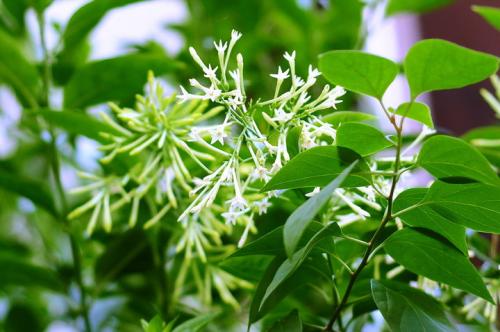
Potting soil: Night-blooming jasmine prefers loose, well-drained, organic-rich, slightly acidic soil. Its potting soil is generally made up of 3 parts peat soil or leaf mold plus 2 parts coarse river mud and a small amount of farmyard manure; when potting, fill about 1/5 of the depth at the bottom with granular crushed brick pieces to facilitate pot drainage, and use the prepared potting soil for the upper part.
Light: Potted night-blooming jasmine requires well-ventilated environmental conditions; from early May to the end of September, it should be placed in a sunny spot in the courtyard or on a balcony for care. Although it likes ample sunlight, intense sun exposure at midday in summer should be avoided.
Fertilizing: During its growth process, apply liquid fertilizer once every 10 to 15 days; from late April, apply a dilute liquid fertilizer once every half month; from mid-May, continuous flowering can be ensured. If high-efficiency humic acid liquid fertilizers such as Chunquan 883 or Huimanfeng are applied, the effect is even better.
Water regulation: Summer is the peak growth season; besides applying sufficient fertilizer, the potting soil must be kept regularly moist, and if necessary, water once a day. For seedlings, spray water on the leaf surface 1 to 2 times a day.
Suitable temperature: Every year in mid-to-late October, it should be moved into a greenhouse or indoor room, and the greenhouse or room temperature should be maintained at 8°C to 12°C; if the temperature is below 5°C, the leaves will turn yellow and drop until the plant dies.
Repotting: Repotting should preferably be done in early April in spring before the plant is moved outdoors; when repotting, remove part of the old soil and old roots, replace with new culture soil, and carry out heavy pruning to promote new branch growth. After repotting, keep the potting soil moist, but there must be no standing water in the pot; if the young leaves are found to droop slightly after repotting, water promptly.
Plant training: In cultivation management, a trellis needs to be set up; after the plant reaches the trellis, pinch the tips promptly to encourage more branching; after flowering, promptly cut off the withered flower stalks and apply additional fertilizer; after the flowers fade, cut off dead and dried branches and leaves and overly dense branches, and shorten leggy shoots. Pruning: Night-blooming jasmine branches grow relatively fast; if allowed to grow naturally, they can grow about 1 m in a year, so annual pruning is needed to sprout more side branches and produce more flowers. Pruning is generally carried out in autumn, keeping each side branch 10-12 cm long. After the flowers fade, cut off dead and dried branches and overly dense branches.
Harvesting: When 40%-50% of the small flowers are in bud and about to open and a few flowers have opened, pick the entire inflorescence. Generally pick once a day; opened flowers should be removed so as not to affect other flower buds and lose commercial value.