Calla Lily Planting Methods and Key Technical Points
Calla lily, (scientific name: Zantedeschia aethiopica (L.) Spreng.), is a perennial robust herb in the monocotyledon class, Araceae family, and Zantedeschia genus. It has tubers and readily tillers to form clumping plants. The leaves are basal, with sheaths on the lower part; the leaf blades are relatively thick, green, heart-shaped-arrow-shaped or arrow-shaped, with a sharp-pointed, gradually pointed, or tail-like pointed tip, and a heart-shaped or halberd-shaped base. It prefers loose, fertile clay loam rich in humus.
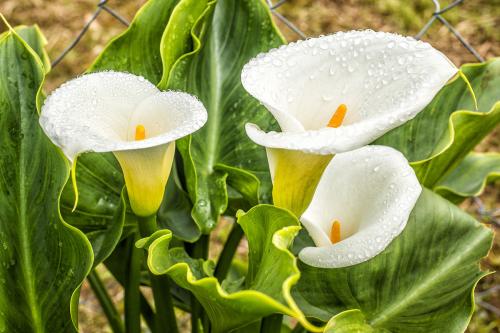
Pot planting methods
1 Calla lilies are best planted in relatively deep clay ceramic pots or purple clay pots with a diameter of 30-40 cm. They like to grow in deep, fertile, loose, slightly acidic sandy loam. You can mix leaf mold, garden soil, and fine sand in a 6:3:1 ratio to make the potting soil.
2 Calla lilies like fertilizer. From leaf growth to before the calla lily blooms, apply light fertilizer frequently, applying a nitrogen, phosphorus, and potassium compound liquid or granular fertilizer about once every 10 days. When fertilizing, be careful not to drip liquid fertilizer on the leaf surface, as this may cause rot; do not apply nitrogen fertilizer alone, to prevent excessive leaves and few or no flowers. Top-dressing with ferrous sulfate can make the leaves larger, thicker, greener, smooth, and glossy, and the leaf stalks less likely to grow, thereby ensuring the leaves look attractive; at the same time, it can promote flower bud formation and extend the flowering period. The specific method is: dilute ferrous sulfate into a 7% solution and apply it once every 1 month, watering thoroughly each time.
3 Calla lilies like moisture. After leaf growth, from mid-autumn to the following spring, water frequently, keeping the potting soil on the moist side without becoming waterlogged, and often spray water on the leaf surface and sprinkle water on the nearby ground to increase air humidity and benefit their growth. However, whether spraying or sprinkling water, avoid spraying water on the flowers and prevent water from flowing into the leaf center, otherwise it may easily cause leaf soft rot. In winter, use water close to room temperature for watering and spraying. In late May, the amount of watering should be reduced to promote dormancy. After the leaves turn yellow, stop watering and place the calla lily in a cool, ventilated place where it will not be exposed to rain.
4 The suitable growth temperature for calla lilies is 15-25°C. Below 10°C, the flowering period is delayed; below 5°C, growth stops; at 0°C, it may cause death. In spring, it is best to take them out of the shed when the lowest temperature is stable at 10°C.
5 Calla lilies like sunlight and long light, but dislike strong light. From leaf growth in mid-autumn until flowering in winter and spring, they should receive plenty of sunlight. Especially after being moved into the shed in winter, give full light and keep the temperature above 10°C. Buds begin to emerge from New Year's Day to before Spring Festival, and the full flowering period is reached in March to April. In winter, if there is insufficient light, the flowering period is delayed, or only buds emerge without flowering, and the buds may even gradually turn green and shrivel. In late May, move them to a ventilated, cool place. The high-temperature period in summer is their dormant period; reduce watering and fertilizing, and provide appropriate shading when the sunlight is strong.
6 Potting or repotting and changing soil should preferably be done from mid-August to mid-September after the Beginning of Autumn. If too early, the dormant period is short, and the small tillered tubers are not yet plump, which affects growth; if too late, the flowering period is delayed and shortened. When potting, it is best to place a layer of broken hard plastic foam blocks at the bottom of the pot to enhance air permeability and drainage, prevent root rot, and add some bone meal and nitrogen, phosphorus, and potassium compound fertilizer to the potting soil. When planting, select robust tubers with buds, plant 4-5 buds per pot, and cut off the aged part at the bottom of the bulb and the small sprouts germinating around it. Plant 3-5 plants per pot, with the buds facing upright, and cover with slightly thicker soil. Then water, place in a shady place, and after leaf buds grow, move to a place with sufficient sunlight.
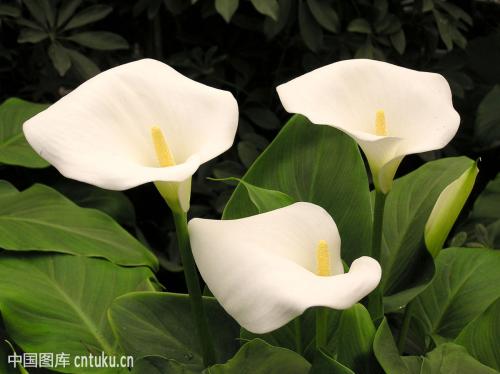
What points should be noted when planting calla lilies?
(1) Calla lilies are afraid of smoke. In winter, if they are placed in a room where coal fire is used for cooking and heating and are exposed to smoke for a long time, a large amount of smoke covering the leaves will cause yellow leaves or flower drop. Therefore, care should be taken to place the flower pot in a place with air circulation and no smoke to prevent exposure to smoke.
(2) For dwarf cultivation of calla lilies, paclobutrazol treatment can be used to make them noticeably dwarfed and increase ornamental value. Usually, after entering dormancy in summer, in combination with repotting and changing pots and division propagation, mix paclobutrazol with a small amount of fine soil and sprinkle it around the plant, with 10-15 grams per pot, depending on the size of the pot. Then water thoroughly and place in a moist, shaded, well-ventilated place for cultivation. At the same time, control fertilization; applying fermented liquid fertilizer once every 3-4 weeks is sufficient.
(3) Be careful not to pour fertilizer water on the leaves. After fertilizing, rinse immediately with clear water to avoid rot of branches and leaves. When the branches and leaves are lush, remove the outer old leaves to facilitate the emergence of flower stalks. February to April is the full flowering period. After May, when the weather is hot, yellowing begins. You can stop watering, lay the pot on its side, let it dry, and promote dormancy. After all the leaves have yellowed, take out the tubers, dry them, store them, and plant again in autumn.
(4) In winter, if the temperature is around 5°C, do not water too much; it is appropriate to keep the potting soil moist but leaning dry. If the temperature is above 10°C, the potting soil can be kept moist. For colored calla lilies placed indoors, throughout the entire growing season, spray frequently on their leaves and around them to increase air humidity.