A Detailed Guide to Orange Planting Methods and Key Technical Points
The orange (scientific name: Citrus sinensis; English: orange) is the fruit of the orange tree, a plant in the genus Citrus of the family Rutaceae. It is also known as huangguo, ganzi, jinhuan and liuding. The orange is a type of hesperidium and has high edible and medicinal value.
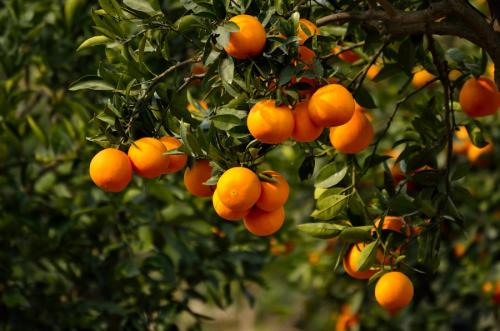
Planting and Management of Orange Trees
Soil Management
Deep plowing and hole expansion should be done well to mature the soil. It is forbidden to plant tall-stemmed plants such as corn and wheat in the orchard. Good work should be done on rational intercropping in the orchard and on cultivating and weeding.
Fertilizer and Water Management
(1) Fertilization principles: The needs of the orange for various nutrient elements should be fully met, and it is advocated to apply more organic fertilizer and to apply inorganic fertilizer and formula fertilizer rationally. Fertilization should also be guided by leaf analysis results, orchard soil analysis results, and the phenological period of blood oranges.
(2) Fertilization methods: Soil fertilization is the main method, combined with foliar fertilization. Methods such as ring trench application, strip trench application, hole application and broadcasting fertilizer on the soil surface are used.
(3) Fertilization for young trees: Apply frequently and lightly, mainly with nitrogen fertilizer, combined with phosphorus and potassium fertilizers. Fertilize 5-6 times during the spring, summer and autumn shoot flushing periods (March, May, June, July, September and December, applying 0.4 jin of ammonium bicarbonate or 0.2 jin of urea per plant each time. For 1-3 year old young trees, apply 100-400g of pure nitrogen per plant per year, and the ratio of nitrogen, phosphorus and potassium should preferably be 1.0:(0.4-0.5):1.0. For mature trees, apply four good fertilizations, namely the sprouting fertilizer, fruit-setting fertilizer, fruit-swelling fertilizer and post-harvest fertilizer. The application amounts are generally 2-3 jin of chemical fertilizer and one load of manure water for the sprouting fertilizer; 1-2 jin of phosphorus and potassium fertilizer + 1 jin of chemical fertilizer for the fruit-setting fertilizer; 1-2 jin of chemical fertilizer + 1-2 jin of phosphorus and potassium fertilizer for the fruit-swelling fertilizer; and for the post-harvest fertilizer (base fertilizer), mainly organic fertilizer, applying 50-100 jin of organic fertilizer + 1-2 jin of chemical fertilizer per plant.
(4) Water: Irrigate when the soil is dry, and drain when there is standing water. Training and pruning 1. Principles. Adjust measures to local conditions, prune according to the tree, promote and suppress appropriately, ensure ventilation and light transmission, and achieve three-dimensional fruiting. 2. Training (natural open-center shape). Trunk height 20-40cm, main branches (3-4 branches) distributed in a well-arranged and staggered manner on the trunk, branch angle of the main trunk 30°-50°, with 2-3 secondary main branches retained on each main branch. Generally, after the third main branch is formed, the quasi-central leader is cut off and twisted to one side to serve as a fruiting branch group.
3. Pruning. (1) Young trees: Light pruning is the main approach. After selecting the quasi-central extension branch and the extension branches of each main branch and secondary main branch, carry out moderate or even heavy heading-back on them, and regulate the growth balance among the main branches through the degree of heading-back and the direction of the pruning cut bud. Apart from appropriately thinning overly dense branch groups, the inner branches and the weaker shoots in the middle and lower parts of the canopy should generally be retained.
(2) Initial fruiting stage: Continue to select and heading-back the extension branches at all levels of the framework, remove summer shoots, and promote the growth of robust autumn shoots. In autumn, promote flowering measures such as ringing, root pruning and water control should be used for vigorously growing trees.
(3) Full fruiting stage: Timely retract fruiting branch groups, flower-dropping fruiting branch groups and declining branch groups, and prune out light-blocking branches, dead branches and diseased and pest-infested branches.