A Detailed Guide to Hawthorn Planting Techniques and Management Methods
Hawthorn (Crataegus pinnatifida Bunge), also known as mountain hawthorn and mountain red, belongs to the genus Crataegus in the Rosaceae family. It is a deciduous tree that can reach a height of 6 m. It is a drupe-type fruit with a hard stone, thin flesh and a slightly sour and astringent taste. The fruit can be eaten fresh or made into preserved fruit and fruit cakes, and after drying it can be used as medicine. It is a tree species unique to China that serves as both medicine and fruit, with effects such as lowering blood lipids and blood pressure, strengthening the heart and resisting arrhythmia. It is also a good medicine for strengthening the spleen and opening the appetite, promoting digestion and relieving stagnation, and activating blood and resolving phlegm, and it has a very good therapeutic effect on conditions such as chest and diaphragm distension, hernia, blood stasis and amenorrhea. Vitexin, a flavonoid compound in hawthorn, is a drug with relatively strong anticancer activity, and its extract has a certain effect on inhibiting the growth, proliferation, invasion and metastasis of cancer cells in the body.
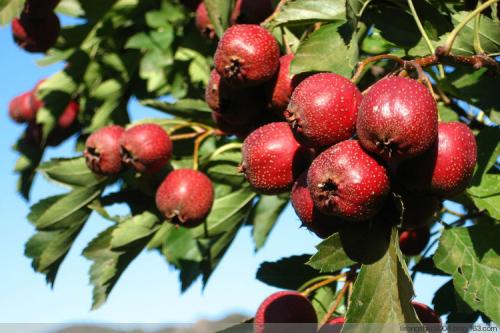
What are the planting methods for hawthorn
1. Hawthorn trees can be grown from seed. Usually wild hawthorn is used (harvested early; after extracting the seeds, they are immediately treated by scalding with water and sun-drying. The method: first wash the seeds clean, put them into water at 60 degrees Celsius and scald them for half an hour, stirring at all times during this period so that the seeds are heated evenly. Then take out the scalded seeds and soak them in cold water for 5 days, then take them out and sun-dry them until they crack.
2. If purchased seeds are used, they should be soaked in water for 24 hours, rubbed and washed, and then put into water at 60 degrees Celsius for scalding. During the day, spread the seeds on a cement yard or stone slab to sun-dry them, and at night soak them in water again. Repeat this until more than 50% of the seeds have cracked, then carry out sand storage stratification.
3. The temperature for sand storage is 0-5 degrees Celsius. After 80 days of stratification, the seeds can be germinated and sown in the field to cultivate rootstock seedlings. Then plant them separately in the nursery according to seedling size. Before planting seedlings, the land should be ploughed and turned, organic fertilizer applied, and beds made to retain soil moisture. After planting, water promptly and strengthen management.
4. After hawthorn saplings are planted, rooting in the same year occurs relatively late. Therefore, in the year of planting, aboveground growth is relatively weak. After the second year, once the seedlings have recovered, growth becomes vigorous, and afterward it becomes more vigorous year by year. However, when pruning, one must not make large cuts and leave large growth unchecked just because growth is vigorous, or even fail to prune the extension shoots, as this will affect the tree structure and the firmness of the framework, and affect the reasonable distribution of fruiting branches. Although it may bear fruit earlier, the fruiting area will be small and the yield low.
6. Hawthorn trees have strong adaptability; even on thin mountain land, their growth and development are better than those of other fruit trees. In hawthorn orchards with better fertilizer and water conditions, it is easy to obtain high yields year after year, and alternate bearing is also unlikely to occur. After hawthorn saplings are planted, they can produce a high yield in 5 years. The phenomenon of failing to bear fruit at the appropriate age, as with apple trees, is relatively rare.
Because hawthorn trees flower easily and bear fruit early, during the young tree period, if there is excessive fruiting, alternate bearing is likely to occur. For mature large trees, because the tree body stores more nutrients, as long as fruiting is not excessive, alternate bearing generally does not occur.