Detailed Explanation of American Ginseng Planting Methods and Technical Key Points
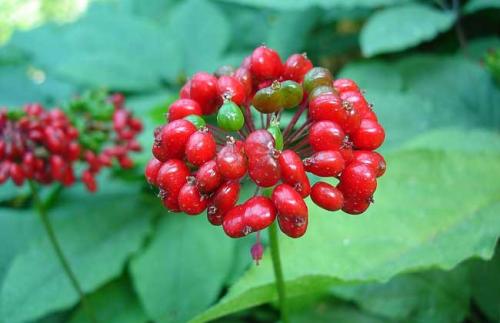
Araliaceae, genus Panax (Panax quinquefolium L.), the root is used as medicine. Perennial herbaceous plant with persistent roots.
Growth Habits
- Attention should be paid to cleaning the ginseng garden: pile the raked-up material to one side to dry, then burn it to make fertilizer.
- Before the overwintering buds emerge from the soil, the bed surface, working paths, shed frames and so on should all be sprayed once with 1% copper sulfate to kill pathogenic bacteria.
- During drought, leaves should be placed on the working paths between the beds, and watering should be done frequently.
- Attention should be paid to loosening the soil and weeding, keeping the soil loose to favor ventilation, light penetration and moisture retention. After the cold-protection material is removed, the compacted soil should be shallow-hoed to loosen it and increase soil permeability, so as to help seedlings emerge. Once the seedlings are uniform, root-protection mulch should be applied, and weeding and soil loosening should also be carried out. Thereafter, whenever weeds appear, they should be hoed or pulled at once.
- Attention should be paid to doing a good job of hanging curtains to block the sun. American ginseng likes sunlight but fears strong direct radiation, and above all fears the attack of cold wind and rain. The method of hanging face curtains on the front and rear eaves is adopted to prevent this, which both blocks wind and rain and prevents strong light from scorching the seedlings to death, and also prevents drought and reduces water evaporation. This should be done persistently every day, putting the curtains down early and rolling them up late, right through to the Beginning of Autumn.
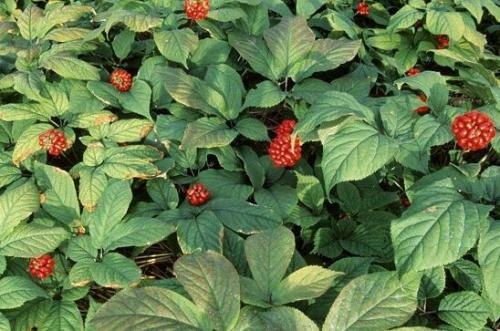
- Attention should be paid to bud removal. American ginseng flowers and sets fruit in 3 years, and in 2 years a few plants also bolt and flower. Bud removal should be carried out in time, removing the flowers in the central part, which can increase seed plumpness and enhance disease resistance.
-
Fertilization: June to August is the period of vigorous growth for American ginseng. A 2% calcium superphosphate solution, or a 0.3% potassium dihydrogen phosphate solution, or a 0.3% urea liquid fertilizer is applied as a foliar topdressing before 10 a.m. or after 3 p.m., with a marked yield-increasing effect. Apply once each month in June, July and August; the above 3 liquid fertilizers can be used alternately. Each year in October-November, when the stems and leaves above ground wither, shallow furrows are opened between the plants and a heavy winter fertilizer is applied. For each square meter, apply 2.5 kg of decomposed barnyard manure, 0.5 kg of bone meal, and 0.05 kg of compound fertilizer, mixed evenly together, scatter into the furrows, and after application cover the fertilizer with fine soil. This winter fertilizer can be applied together with the covering of cold-protection soil.
Field Management
- Attention should be paid to cleaning the ginseng garden: pile the raked-up material to one side to dry, then burn it to make fertilizer.
- Before the overwintering buds emerge from the soil, the bed surface, working paths, shed frames and so on should all be sprayed once with 1% copper sulfate to kill pathogenic bacteria.
- During drought, leaves should be placed on the working paths between the beds, and watering should be done frequently.
- Attention should be paid to loosening the soil and weeding, keeping the soil loose to favor ventilation, light penetration and moisture retention. After the cold-protection material is removed, the compacted soil should be shallow-hoed to loosen it and increase soil permeability, so as to help seedlings emerge. Once the seedlings are uniform, root-protection mulch should be applied, and weeding and soil loosening should also be carried out. Thereafter, whenever weeds appear, they should be hoed or pulled at once.
- Attention should be paid to doing a good job of hanging curtains to block the sun. American ginseng likes sunlight but fears strong direct radiation, and above all fears the attack of cold wind and rain. The method of hanging face curtains on the front and rear eaves is adopted to prevent this, which both blocks wind and rain and prevents strong light from scorching the seedlings to death, and also prevents drought and reduces water evaporation. This should be done persistently every day, putting the curtains down early and rolling them up late, right through to the Beginning of Autumn.
- Attention should be paid to bud removal. American ginseng flowers and sets fruit in 3 years, and in 2 years a few plants also bolt and flower. Bud removal should be carried out in time, removing the flowers in the central part, which can increase seed plumpness and enhance disease resistance.
- Fertilization: June to August is the period of vigorous growth for American ginseng. A 2% calcium superphosphate solution, or a 0.3% potassium dihydrogen phosphate solution, or a 0.3% urea liquid fertilizer is applied as a foliar topdressing before 10 a.m. or after 3 p.m., with a marked yield-increasing effect. Apply once each month in June, July and August; the above 3 liquid fertilizers can be used alternately. Each year in October-November, when the stems and leaves above ground wither, shallow furrows are opened between the plants and a heavy winter fertilizer is applied. For each square meter, apply 2.5 kg of decomposed barnyard manure, 0.5 kg of bone meal, and 0.05 kg of compound fertilizer, mixed evenly together, scatter into the furrows, and after application cover the fertilizer with fine soil. This winter fertilizer can be applied together with the covering of cold-protection soil.