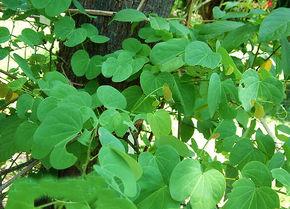
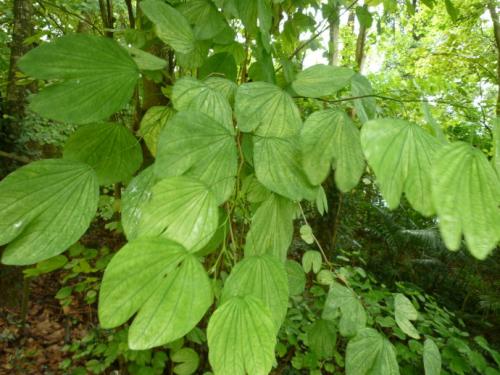
Bauhinia purpurea (scientific name: Bauhinia purpurea Linn.): a tree or erect shrub, 7-10 m tall; bark thick, nearly smooth, gray to dark brown; leaves stiffly papery, suborbicular, apex cleft to 1/3-1/2 of the leaf length, lobes rounded-obtuse or nearly acute at the apex, both surfaces glabrous or thinly puberulent beneath.
Racemes lateral or terminal, few-flowered, 6-12 cm long;
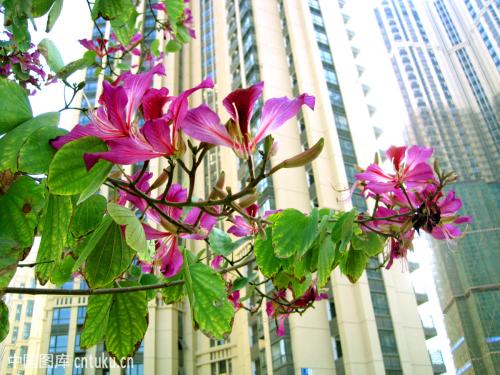
flower buds more or less fusiform, with 4-5 angles or narrow wings, obtuse at the apex; petals pinkish red, oblanceolate, 4-5 cm long, with veins and a long claw.
Pods strap-shaped, flat, slightly curved sickle-like, dehiscing at maturity; seeds suborbicular, flat, seed coat dark brown. Flowering period September-November; fruiting period February-March.
Widely cultivated in subtropical regions of the world in gardens for ornament and as street trees; the bark, flowers and roots are used medicinally, as a wash for burns and purulent sores, and the juice or powder of young leaves can treat cough, but the root bark is highly toxic and must not be taken internally. Distributed in China, Indochina, India and Sri Lanka.
Sowing
Collect mature pods in September-October, take out the seeds, and bury them in dry sand in a cool place to overwinter. Sow from late March to early April; treat the seeds before sowing so as to achieve uniform and strong seedlings. Soak the seeds in 60°C
warm water, and after the water cools continue soaking for 3-5 days; change the cool water once a day; after the seeds swell from absorbing water, place them at 15°C to germinate, drenching with warm water 1-2 times a day; after the radicles emerge, sow them in the seedbed; seedlings can be complete in 2 weeks, and after emergence thin them appropriately. When there are 4 true leaves, they can be transplanted to the
nursery; the beds should preferably be loose, fertile loam; for ease of management, plant in wide and narrow rows, with wide rows 60 cm, narrow rows 40 cm, and plant spacing 30-40 cm. The seedling stage is not cold-tolerant, and in winter a plastic arch shed is needed to protect them through the winter.
Key Care Points
Soil
The soil for growing Bauhinia purpurea is best chosen as fertile soil, preferably sandy soil with strong drainage; growing in such soil, its natural regeneration capacity will be very strong, and it can reproduce by self-sowing. In the southern regions of our country, it can generally be cultivated and grown outdoors, but in other regions it needs pot cultivation, and especially note that during the seedling stage it needs to be placed in a nutrient bag in time for growing, which can greatly increase the survival rate of Bauhinia purpurea!
Temperature
Bauhinia purpurea likes a warm climate, preferably an environment with plenty of sunlight and slightly humid conditions; it cannot withstand particularly low temperatures, and in winter it is best to move it back indoors for growing.
Watering
Bauhinia purpurea likes moist locations, and when growing it, watering must be frequent, generally once every one or two days, and each watering should be thorough. If it is grown in a pot, it is even more important to ensure good drainage at the bottom of the flowerpot, with no standing water, otherwise the roots will rot; mainly ensuring the soil is moist is enough.
Fertilizing
During the growing period, Bauhinia purpurea must be fertilized; liquid fertilizer is the most suitable choice, and applying it once or twice is enough. When it reaches the dormant period, its growth becomes especially slow, and at this time it does not need much fertilizer; it is best not to apply any fertilizer, otherwise it is very easy to cause its roots to be burned, or even the entire plant to be burned to death.
Propagation
The most important propagation method for Bauhinia purpurea is cuttings, followed by grafting, so if you want the Bauhinia purpurea you grow to multiply more and grow more vigorously, you can choose these two methods to achieve it; the time for cuttings is chosen in March and April, and the time for grafting can be spring in April and May, or autumn in August and September.
Pest and Disease Control
Fusarium Wilt
Symptoms: Leaves mostly begin to
turn yellow and
drop from the tips of diseased branches, generally starting from individual branches and then gradually developing until the whole clump dies. Peeling back the bark, yellowish-brown longitudinal streaks can be seen in the xylem, and yellowish-brown concentric-ring-shaped necrotic spots can be seen in the cross section.
Disease pattern: This disease invades the plant roots through underground wounds, destroying the plant's vascular bundle tissue and causing the plant to wither and die. This disease is caused by infection by Fusarium fungi. The pathogen can overwinter in the soil or on diseased plant residues and survives for a relatively long time. It is mainly spread through soil, underground pests and irrigation water. It generally occurs more severely in June-July.
Control: Strengthen care management, enhance
tree vigor, and improve the plant's disease resistance. In nursery land, pay attention to crop rotation, avoid continuous cropping, or before sowing apply 70% pentachloronitrobenzene powder at 3-5 jin/mu in furrows. Promptly prune out dead diseased branches and diseased plants, burn them in a centralized manner, and disinfect with 70%
pentachloronitrobenzene or 3%
ferrous sulfate. You can use 50% thiram wettable powder at 200 times, or 50% carbendazim wettable powder at 400 times, or antimycin 120 aqueous solution at 100 ppm to drench the roots.
Angular Leaf Spot
Symptoms: It mainly occurs on leaves; the lesions are polygonal, yellow-brown to dark reddish-brown, and later bear small dark brown mold spots. In severe cases, the leaves are covered with lesions, which often join together into patches, causing the leaves to wither and drop.
Disease pattern: It is a fungal disease, and the pathogens are two species, Cercospora and Cercosporidium. This disease generally occurs from July to September. It mostly infects the lower leaves first and gradually spreads upward. When the plant grows poorly, the disease is severe in rainy seasons, and the pathogen overwinters on diseased leaves and residues.
Control: In autumn, clear away diseased fallen leaves and burn them in a centralized manner to reduce the source of infection. When the disease occurs, spray 50% carbendazim wettable powder at 700-1000 times, or 70%
mancozeb wettable powder at 800-1000 times, or 80% zineb at 500 times. Spraying once every 10 days for 3-4 consecutive sprays has a relatively good control effect.