Detailed Guide to Freesia Planting Methods and Care Techniques
Freesia, belonging to the Iridaceae family, is a perennial bulbous herbaceous flower of the genus Freesia. The corm is narrowly ovate or ovate, the leaves are sword-shaped or linear, the flower stem is erect, the flowers are erect and sessile, pale yellow or yellow-green, fragrant, the bracts are broadly ovate or ovate, the perianth tube is trumpet-shaped, the perianth lobes are ovate or elliptical, and the capsule is nearly ovate. It blooms from April to May and fruits from June to September. Main varieties include the light purple 'Blue Lady', the bright yellow 'Cream Cup', the red 'Rapid Red', the white 'Elegance' and the orange 'Spring Day', among others.
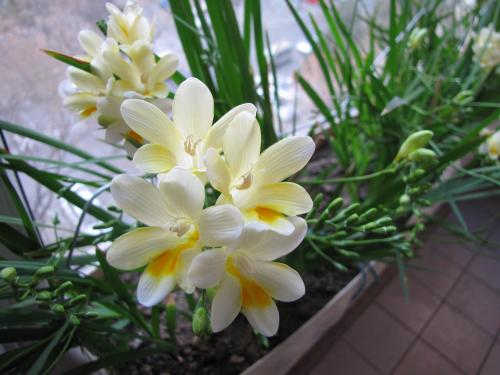
Freesia Planting Methods
1. Soil preparation: Freesia prefers sandy loam rich in organic matter, with strong water retention and good drainage, pH 6~7.2. Before planting, the soil can be sterilized per square meter with 6~10g of quintozene, 50~70g of methyl bromide, or 8~12g of carbofuran. After applying the chemicals, plow and rake the soil level, and sowing can be done after 5~7 days. The ridge height of the planting bed should be about 5cm in arid areas; for beds with high soil moisture that drain poorly, the ridge surface should be 20~25cm.
2. Bulb preparation: The natural dormancy period of Freesia bulbs is very long, about 50~60 days. Generally, after the bulbs are dug up, they are stored at 28~31°C and sprout after 2~3 months, while at a low temperature of 13°C, dormancy can last about 8 months. Therefore, before planting Freesia, dormancy must be broken through a high-temperature treatment followed by a low-temperature treatment.
(1) Bulb selection: For cultivation, bulbs with a diameter of 1cm or more should be selected. To reduce viral infection, virus-free tissue-cultured bulbs must be used, or new bulbs grown from seeds or daughter bulbs. Generally, tissue-cultured plantlets or seed sowing are used, and after 1~2 years of cultivation, small bulbs can be grown into high-quality planting bulbs.
(2) Bulb pretreatment: Before planting, the bulbs need pretreatment such as disinfection, breaking dormancy, and promoting root development. For bulb disinfection, fungicides such as carbendazim or thiophanate-methyl at 500~800 times dilution can be used to soak the corms for 1~2h (hours), then remove and dry in the shade. Root-promoting treatment should be done by planting after roots have emerged; root forcing should not be too long, otherwise the root system is easily damaged during planting.
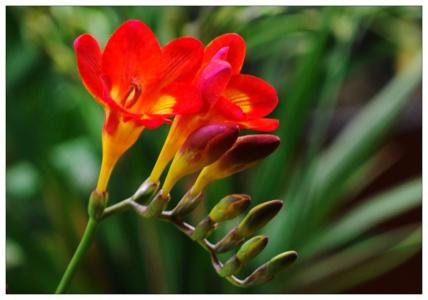
3. Planting: For ordinary cultivation, the planting period is from September to October, overwintering under protective facilities, with the main flowering period from March to April. When planting, if sowing is properly staggered and both forcing cultivation and delayed cultivation are adopted, Freesia can be supplied with flowers year-round. The planting distance varies depending on the variety, corm size, and cultivation season. Generally, the plant and row spacing is 8cm-10~14)cm, and the planting density is 80~110 plants per square meter.
Narrow-leaved varieties are planted more densely than broad-leaved varieties, winter cultivation is denser than summer planting, and small bulbs are denser than large bulbs. When planting, soil is usually covered to a depth of 2~3cm; avoid covering too thickly. After planting, the soil surface is often covered with a thin layer of peat soil, pine needles, straw, or sawdust to keep the soil moist.
4. Temperature management: Temperature management is very important for cut flower production of Freesia. Generally, about 6 weeks after planting, the inflorescence has fully differentiated, and smaller corms may be delayed by 2~3 weeks. During the flower bud differentiation stage, avoid high temperatures above 25°C and low temperatures below 10°C. From the 4-leaf stage onward, ensure that a temperature of 13~14°C is maintained for more than 4 weeks, so as to smoothly induce flower primordium differentiation during the 4~6 leaf stage, which helps improve cut flower yield and quality.
After flower buds appear, appropriately raise the ambient temperature to promote flowering; however, to prolong the flowering period, after the first flower opens, the temperature can be lowered to about 15°C to extend the cut flower harvest period. For greenhouse and glasshouse management, note that ventilation is needed when the room temperature is above 25°C, and covering for insulation or heating is needed when it is below 10°C.
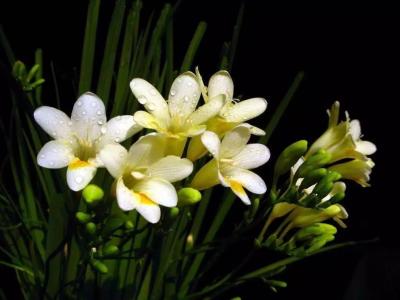
5. Fertilizer and water management: From planting until sprouting, the soil must be kept moist. After bud emergence, gradually reduce watering appropriately and keep the soil surface as dry as possible, so as to lower air humidity and prevent diseases. The time from planting to flowering is relatively short, and the organic fertilizer and compound fertilizer applied before planting can basically meet growth needs. However, if the plants grow weakly, at the 2~4 leaf stage, apply a top dressing of ammonium nitrate, urea, and potassium sulfate once more. At the beginning of flowering, use 0.2% potassium dihydrogen phosphate as a foliar fertilizer, but it is best to avoid top dressing before and after bud emergence.
6. Light management: During cultivation, appropriate shading is beneficial during the seedling stage and flowering stage. During the first leaf growth period, appropriate shading can lower soil temperature and promote root development. Before flower bud differentiation, giving a short-day treatment of about 10h is beneficial for promoting flower bud differentiation and increasing flower stem length, the number of flowers on the inflorescence, and the number of lateral spikes. After flower bud differentiation is complete, appropriately extending the photoperiod is beneficial for promoting good inflorescence development and earlier flowering. Although Freesia loves light, it should also avoid strong light exposure; under conditions of excessive light and relatively high temperature, a shade net with 70% light transmittance can be used for shading.
7. Netting: Freesia flower stems are relatively soft, and the inflorescence bends as it grows; when there are many flowers, the flower stems easily droop and lodge. At the 3~4 leaf stage of the plants, support frames and nets can begin to be set up, with the first layer of net placed about 25cm above the ground, and then 2~3 more layers of net added as the plants grow. Generally, the grid of the netting uses 10cm-20cm or 10cm-15cm squares.