Detailed Explanation of Snake Gourd Planting Methods and Technical Key Points
Snake gourd (Trichosanthes anguina) likes warmth and tolerates damp heat. It has fleshy roots and a well-developed root system. It can grow at temperatures of 15-40°C, with the most suitable temperature being 20-35°C. It can be cultivated in all types of soil. The whole growth period of snake gourd is about 180-200 days. It is a vining herbaceous plant with vigorous growth. The leaves are dark green, densely covered with fine hairs on both sides, palmately shaped, with radiating veins. Female flowers are solitary; male flowers are in racemes or compound racemes; the petals are fringed and lobed, with branches and curves. The fruit is long and strip-shaped, tapering at both ends, with the tail end often curved, 4-5 cm in transverse diameter and 2.5 m long. The young fruit has fine hairs; the flesh is 3-4 mm thick, soft and loose, with a fishy smell. The mature fruit turns orange-red. The seeds are earthy brown, with a rough surface and 2 parallel small grooves, with a 1000-seed weight of 200-250 grams.
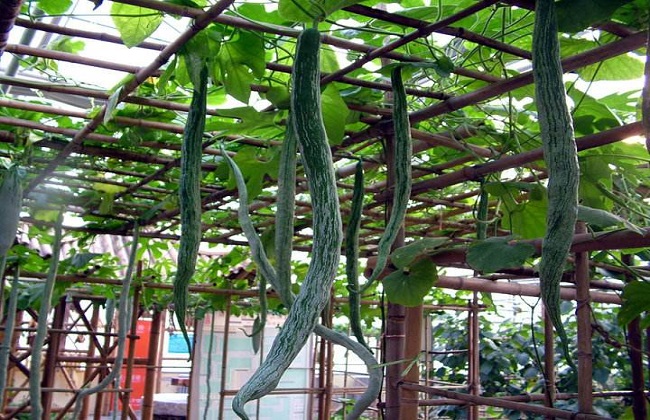
Planting time for snake gourd: North of the Yangtze River, sowing and seedling raising are generally done from March to April, and the growing period can be extended to October to November. It can also be cultivated as an autumn off-season crop. If sowing and seedling raising are done earlier, insulation facilities must be added to protect against cold and preserve the seedlings. Trellis cultivation is mostly used. The flat trellis form is the most common for trellis cultivation. Harvesting generally begins in May to June for the market, supplying young fruits to the market; they can generally be harvested about 10 days after flowering. Fully mature gourds need more than about 30 days, at which point they can be harvested for seed saving.
Planting Methods
1. Site selection and land preparation
Snake gourd does not have high requirements for land and has very strong adaptability. It is a vegetable that is very easy to grow, so it can be planted on a small scale or a large scale, and some people can even grow it on their own balcony. However, if you want high yields, then of course soil that is fertile and has sufficient moisture is best. During land preparation, apply base fertilizer well, and at the same time level and finely break up the soil as much as possible.
2. Sowing and seedling raising
Snake gourd seeds have a relatively thick seed coat, so the seeds must be treated before sowing. Generally, the seeds are first sun-dried for two to three days, then put into hot water for seed scalding. The water temperature should not be too high, about 45 to 55°C. The scalding time should not be too long, generally two to three minutes is appropriate. Then soak the scalded seeds in cool water for two to three days. After taking them out, place them in a relatively warm place for germination. Once the sprouts are fully out, they can be sown.
3. Transplanting and fertilizing
When the snake gourd seedlings grow three to five leaves, they should be transplanted, generally planting one seedling every 60 to 80 cm. Adjust the spacing of the plants according to the fertility of the soil; plant more densely in poorer soil and more sparsely in fertile land. After planting, fertilize once to help promote the growth of the gourd seedlings. A second fertilization should be carried out during flowering and fruiting to ensure the nutrients needed for fruiting.
4. Weeding and trellising
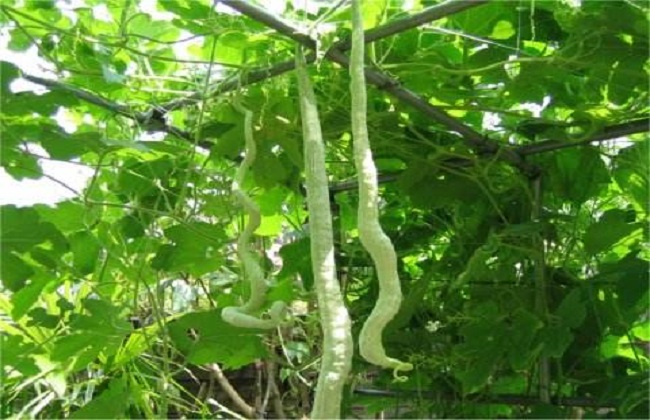
Weeding is a very necessary task to do before building the trellis, so that after the trellis is built, weeding will not expose the gourd roots above the soil surface and affect growth. The purpose of trellising is to increase yield. Snake gourd seedlings grow in a creeping pattern, so in order to make harvesting convenient and increase yield, trellising should be carried out when the seedlings grow to 50 cm, letting them grow along the trellis.
5. Prevention and harvesting
Snake gourd generally rarely develops diseases, but sometimes borers and the like may appear, so timely treatment is also necessary, especially one kind of borer that bites through the vines and causes the entire seedling to die, seriously affecting yield. When harvesting, be sure not to harvest too large or too late, otherwise it will not be fresh. Generally, harvesting can be done when the surface color of the snake gourd turns milky white.