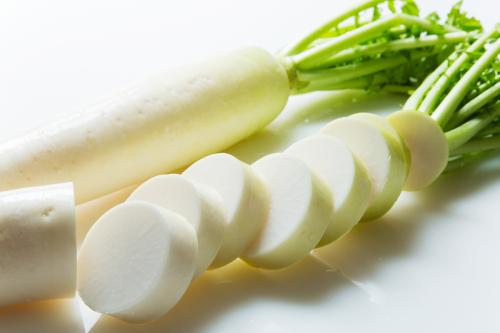
Radish (scientific name: Raphanus sativus L.), a biennial or annual herbaceous plant of the genus Raphanus in the Brassicaceae family, 20-100 cm tall, with a fleshy taproot that is oblong, spherical or conical, and an outer skin that is green, white or red; the stem is branched, hairless, and slightly covered with a powdery bloom. Racemes are terminal and axillary, flowers are white or pink, fruit stalks are 1-1.5 cm long, flowering period is April-May, and fruiting period is May-June.
Cultivation Techniques
Land Preparation and Fertilization
After the previous crop is harvested, deep plowing should be carried out as early as possible, with thorough freezing and sunning of the soil, then breaking up clods and raking level, and applying sufficient base fertilizer. Radish varieties should be selected according to soil conditions; for deep soil, large varieties with deep soil penetration can be arranged, and the plowing depth should be more than 33 cm; for shallow soil layers, medium and small varieties with shallow soil penetration can be selected, with a plowing depth of about 25 cm for medium varieties and about 15 cm for small varieties. The method of making beds varies with variety, soil quality, topography and local climate conditions. Medium and small radishes are mostly cultivated in flat beds in places with little rain and good drainage, while large radishes with deep roots and large leaves must be cultivated in high beds. In the Yangtze River Basin, whether large or small radishes, deep-furrow high beds are mostly used to facilitate drainage and irrigation. Generally, the bed height is 20-27 cm, the bed width is 1-2 m, and the furrow width is 40 cm.
Radish has a well-developed root system and requires sufficient base fertilizer. Before land preparation, apply 100 loads of decomposed farmyard manure such as pig and cow dung, 25 kg of superphosphate, and 50 kg of compound fertilizer, plow them into the soil, then rake level and make beds, so that the soil is loose, fine and uniform, and the bed surface is level.
Timely Thinning
After radish seedlings emerge, they grow rapidly, so thinning must be done in a timely manner. The principle is to thin early, thin in stages, and final thinning late. Early thinning, when the seedlings are small, will not damage the root hairs of the retained seedlings when pulling them out; late final thinning can reduce missing plants caused by damage from certain borers and the like compared with early final thinning. In production, thinning is generally done 2-3 times. Carry out the first thinning when the first true leaf unfolds, removing seedlings damaged by pests and diseases as well as weak seedlings, diseased seedlings, deformed seedlings, and seedlings that do not have the characteristics of the original variety. Carry out the second thinning when there are 2-3 true leaves. At the "large breaking of the belly" stage, select and retain one vigorous seedling with the characteristics of the original variety per hole, which is the final thinning, and remove the rest. The number of retained seedlings is 4000-5000 plants for medium and large varieties and 10,000 plants for small varieties.
Water and Fertilizer Management
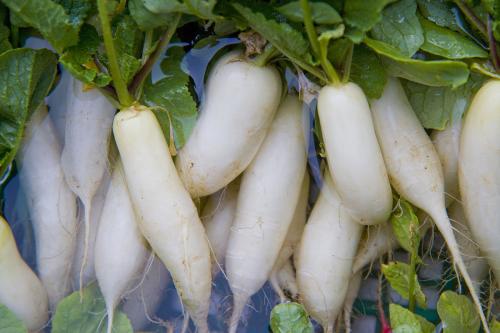
In water and fertilizer management, the following should be achieved: in the early stage, promote the vigorous growth of leaves and absorbing roots to lay the material foundation for the later expansion of the fleshy root. When vegetative growth reaches a certain level, it must be controlled to promote the timely transport of nutrients to the storage organ. During the rapid expansion period of the fleshy root, it is necessary to ensure that the leaves have a relatively long lifespan and strong vitality, so that they produce more nutrients and ensure the expansion of the fleshy root.
Radish has different water requirements at different growth stages. During the germination stage, there must be sufficient water, and the available soil water content should remain above 80%, so that germination is rapid and seedlings emerge uniformly. From the seedling stage to a period before "belly breaking," water should be applied sparingly to facilitate seedling hardening and encourage the root system to develop deeper into the soil layer. During the vigorous leaf growth stage, an appropriate amount of water should be applied to ensure leaf development. During the vigorous fleshy root growth stage, water should be supplied fully and evenly to keep the soil moist and prevent alternating drought and moisture. At this time, if the water supply is insufficient, it will not only affect the expansion of the fleshy root, but will also increase fibrous roots, make the texture coarse, and lead to sponginess. However, if there is too much soil moisture, drainage should be carried out in a timely manner to prevent the occurrence of root rot. As for watering time, in early spring when temperatures are low, it is best to water in the morning, and in the dog days it is best to water in the evening to lower the soil temperature.
Fertilization should be carried out according to the patterns of nutrient element requirements of radish during its growth period. Radishes with sufficient base fertilizer and a short growth period can be given less additional fertilizer; large varieties with a long growth period and high yield have a high fertilizer requirement, and in addition to sufficient base fertilizer, they also need additional fertilizer applied in stages. Generally, the timing and frequency of additional fertilization are: the first time when seedlings produce 2 true leaves, apply dilute human excrement and urine, applying it between rows for hole sowing and drill sowing, and broadcasting it over the entire area for broadcast sowing; the second time after the second thinning and intertillage, apply additional fertilizer at a concentration of 20%; at the "large breaking of the belly" stage, apply additional fertilizer once more with human excrement and urine at a concentration of 30%, and increase the application of 5 kg each of superphosphate and potassium sulfate per mu. For medium and small radishes, after three applications of additional fertilizer, the radish will expand rapidly, and no further additional fertilizer is needed. Large autumn and winter radishes also need an additional application of 7.5-20 kg of ammonium sulfate per mu at the "shoulder exposure" stage to meet the needs of vigorous root growth. When applying human excrement and urine and chemical fertilizers as additional fertilizer, avoid excessive concentration and being too close to the roots, so as to prevent root burning.