Bamboo willow is a plant of the genus Salix in the family Salicaceae. It is a tree with great growth potential. The bark is green and smooth when young. Apical dominance is obvious, axillary buds have strong sprouting ability, branching occurs early, and the angle between lateral branches and the main trunk is 30 to 45 degrees. The crown is tower-shaped with uniform branching. The leaves are lanceolate, simple and alternate, up to 15-22cm long and 3.5-6.2cm wide, with a long acuminate apex, a cuneate base, and obvious fine serrations along the margin; the upper surface of the leaf is green, the underside is grayish white, and the petiole is slightly red and relatively short. Bamboo willow is a new hybrid variety of willow. Bamboo willow has a wide range of uses and is an ideal tree species for industrial raw material forests, small- and medium-diameter timber cultivation, street trees, landscaping, and farmland shelterbelts. Bamboo willow is divided into different strains according to different adapted regions and characteristics. At present, only a few strains are preserved: Bamboo Willow No. 5, Bamboo Willow No. 7, and Bamboo Willow No. 3. After trials in many places, Bamboo Willow No. 3 has the widest adaptability and the best performance.
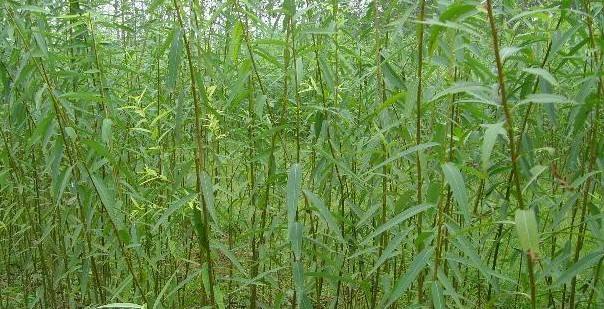
Cultivation Techniques
Light
Excellent fast-growing tree species generally have relatively high photosynthesis and photosynthetic efficiency in order to maintain rapid growth and a high cellulose content in the tree body. All branches of bamboo willow grow upward, the angle between lateral branches and the main trunk is small, and branching is uniform, making it more suitable for dense planting; its tree form has higher photosynthetic efficiency than other willows. It grows rapidly in areas with no less than 1400 hours of sunshine during the growing season.
Temperature
Warm climatic conditions are favorable for the fast growth of bamboo willow. Bamboo willow has a long growing season, and still has considerable growth in August and September. According to trial planting results in the north and south, temperature mainly has two effects:
a. Low-temperature tolerance: whether bamboo willow seedlings can safely overwinter does not depend on the extreme low temperature, but on lignification before leaf fall; the gradient from high temperature to low temperature before leaf fall must not be too large.
b. High-temperature tolerance: when the temperature in the south is above 35°C, if the day-night temperature difference is less than 10°C, heat dormancy may occur; during this period the growth of seedlings decreases, and when the day-night temperature difference is greater than 10°C, bamboo willow grows normally. Trials in Inner Mongolia and Ningxia have shown that bamboo willow can tolerate low temperatures of minus 30-35°C, but when new shoots or young trees are not yet lignified, some are prone to local frost damage. Cold resistance increases significantly in the second year, and its growth in high-cold regions is lower than in regions with temperatures more suitable for bamboo willow growth; in areas at minus 20°C, bamboo willow can all grow normally.
Water
In relatively dry areas after bamboo willow transplanting, timely irrigation should be carried out before bamboo willow buds and leaves sprout in order to promote bamboo willow sprouting. In summer in dry areas, timely irrigation should also be carried out for bamboo willow to ensure the water necessary for bamboo willow growth and improve the growth potential of bamboo willow. If the soil itself is relatively rich in water after transplanting, drainage treatment should be carried out in the forest area during continuous rainfall to avoid excessively high water levels affecting soil respiration and ultimately affecting the growth and development of bamboo willow. Bamboo willow also requires attention to water irrigation in winter to ensure an increased lignification rate of bamboo willow; winter irrigation is mainly carried out promptly after bamboo willow enters dormancy, so as to achieve the purpose of freezing the soil.
Soil
Soil fertility: bamboo willow prefers fertile land, and grows rapidly in plots with soil organic matter content of 2% to 10%.
Soil structure: bamboo willow grows fastest in sandy loam with 50% soil porosity, good aeration, and good water retention; sandy soil and clay soil are next.
Saline-alkali land: according to tests of different salinity and alkalinity in Dongying, Shandong, Dagang, Tianjin, and other places, bamboo willow can grow under conditions with a pH value below 8.5 and a salt content of 8‰. Under plots with the same salt content, the growth of bamboo willow depends on the content of nutrient elements in the plot. The salt content of saline-alkali land changes according to factors such as rainfall and season. For large-scale planting, soil composition testing must be carried out. For other poplar varieties, when the soil salt content is 3‰ and the pH value is above 8, survival rate and forest growth are affected.
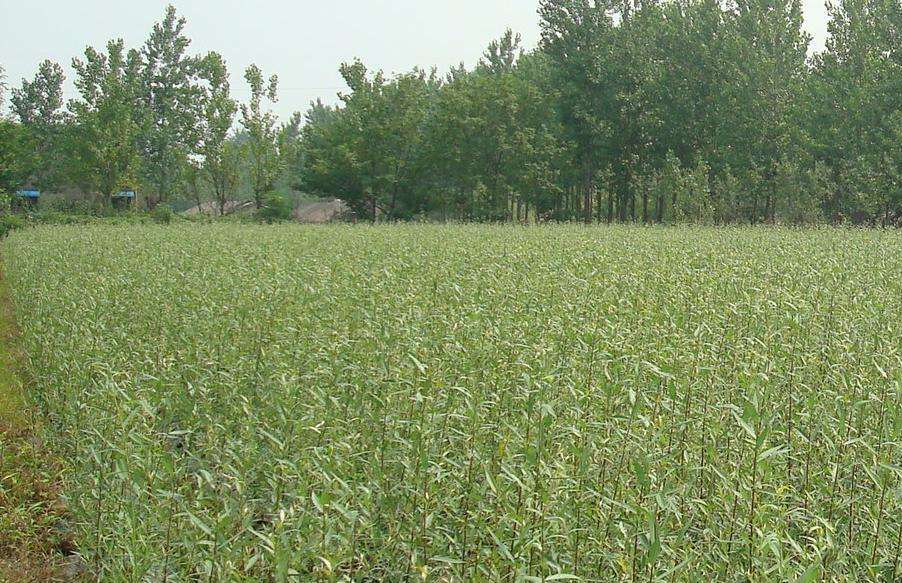
Pest and Disease Control
Pest and disease control is the matter that should be paid the most attention to in the process of bamboo willow afforestation. The main pests and diseases in the growth process of bamboo willow are cabbage caterpillars and willow blue leaf beetles. After discovering these two pests, decis can be used for control. In the process of pest and disease control, the selected pesticides should be changed frequently to prevent pests and diseases from developing resistance to the pesticides. Pest and disease control should focus on prevention, supplemented by integrated control, to ensure the normal and healthy growth of bamboo willow forests.