Sempervivum 'Guanyinlian' Planting Methods and Care Tips Explained in Detail
The Sempervivum 'Guanyinlian' of the Araceae family prefers partial shade and must never be exposed to strong direct sunlight. In a partially shaded environment, the leaves are fresh and glossy, with clear veins and a deep green color. If the light is too strong, the leaf color easily becomes dull, and sunscald may even occur, with rough leaf surfaces, grayish-white leaves, blurred veins, and sometimes scorched spots on the leaf surface; but if the light is too weak, it also easily causes leggy growth, with the plant growing thin and tending to lodge.
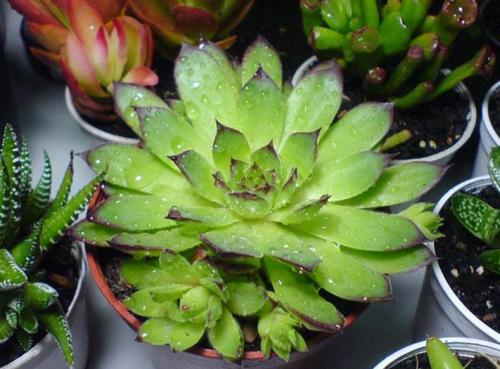
Cultivation methods and precautions for Sempervivum 'Guanyinlian'
1. Soil: The potting soil should be loose and fertile, with good drainage and aeration. You can use half leaf mold or peat soil and half coarse sand or vermiculite, mixed with a small amount of calcium-rich material such as bone meal, and use after mixing evenly. Since the soil is moist, newly planted specimens do not need too much water; keep it in a semi-dry state to help the root system recover.
2. Temperature: It likes a warm, moist, partially shaded growing environment. The optimum growing temperature is 20-30°C, and the overwintering temperature is 15°C. In winter, if the nighttime temperature is not lower than 5°C and the daytime temperature is above 15°C, the plant can continue to grow, and you can water normally and fertilize appropriately; if you control watering to make the plant go dormant, it can also tolerate low temperatures of 0°C. Sempervivum is not heat-tolerant; after May the plant's growth gradually stops and it enters its summer dormancy period. At home, it can be placed under a corridor or on the inner side of a balcony and other places without direct sunlight, with good ventilation and sheltered from rain, and watering should be controlled and fertilization stopped, to avoid plant rot caused by stuffiness, humidity, and waterlogged soil.
3. Light: During the high temperatures of summer and the cold of winter, the plant is in a dormant state. Its main growing period is in the relatively cool spring and autumn seasons. During the growing period it requires sufficient sunlight. If the light is insufficient, the plant shape will become loose and not compact, affecting its ornamental value, while plants grown in sufficient light have thick, plump leaves, a compact shape, and beautiful leaf color.
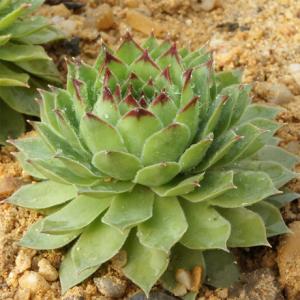
4. Watering: Master the principle of "do not water until dry, and water thoroughly when you do," avoiding long-term water accumulation to prevent root rot, but do not let it become too dry either, otherwise although the plant will not die, it will grow slowly, with dull leaf color and a lack of vitality. During the high-temperature period in summer, leaf water evaporation is high and water demand is greater. If water is lacking, the leaves easily wilt, so you must frequently spray water on the leaf surface while keeping the environment moist, but you must avoid water accumulation in the pot, otherwise it will cause root rot.
5. Fertilizing: Apply a decomposed dilute liquid fertilizer or a low-nitrogen, high-phosphorus-and-potassium compound fertilizer about once every 20 days. When fertilizing, do not splash the fertilizer solution onto the leaves. Fertilizing is generally done on a clear morning or evening, and a thorough watering should be given that evening or the next morning to dilute the residual fertilizer solution in the soil. In winter, place it indoors in a sunny spot. If the nighttime minimum temperature is around 10°C and there is a certain day-night temperature difference, you can water appropriately and fertilize as needed to keep the plant growing. If such a high temperature cannot be maintained, watering should be controlled, the potting soil kept dry, and fertilization stopped to make the plant go dormant; it can also tolerate low temperatures of 5°C, and some varieties can even tolerate low temperatures of 0°C.
6. Propagation: Sempervivum can be propagated during the growing season by cutting off the small offsets that sprout from the base (small rosette-shaped leaf discs) and rooting them in sandy soil. After inserting, keep them slightly moist; they will root in 2~3 weeks, and some small leaf discs already have roots underneath and can be potted directly. Leaf cuttings, although they can occasionally survive, have a very low success rate, so they are rarely used. If seeds can be collected, sowing can also be used for propagation; under conditions of around 20°C, they germinate in 10~15 days, and although the seedlings grow slowly, a large number of seedlings can be obtained at one time.
7. Repotting: Repot once every 1 to 2 years in spring or autumn. When repotting, prune the root system, cutting off dead roots or overly long old roots. The potting soil should be loose and fertile, with good drainage and aeration. You can use half leaf mold or peat soil and half coarse sand or vermiculite, mixed with a small amount of calcium-rich material such as bone meal, and use after mixing evenly. Since the soil is moist, newly planted specimens do not need too much water; keep it in a semi-dry state to help the root system recover.