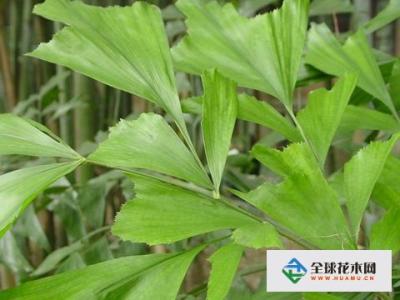
The Fish Tail Palm (scientific name: Caryota ochlandra Hance) is a plant of the palm family, genus Caryota. It is tree-like, 10-15 (-20) m tall, 15-35 cm in diameter, with a green stem covered in white felt-like hairs and ring-shaped leaf scars. The stem is upright and unbranched, and the leaves are large, bipinnately compound and fully divided, thick, leathery, large and stout, with irregular toothed notches on the upper part and drooping tips, resembling a fish tail. The inflorescence can be up to 3 m long, with flowers in clusters of 3, blooming in July, and the spadix droops, with small yellow flowers. The fruit is spherical and turns purplish-red when mature; contact between the fruit and its sap and the skin can cause itching.
Propagation methods:
Seed propagation: sow immediately after collecting the seeds, covering with soil about 2 times the seed diameter, keep moist, and seedlings can emerge in 2-3 months. During the seedling stage, air humidity should be increased and shade provided.
Division propagation: for large perennial plants with many tillers at the base, they can be divided into 2-3 clumps and replanted when repotting in spring.
Cultivation techniques:
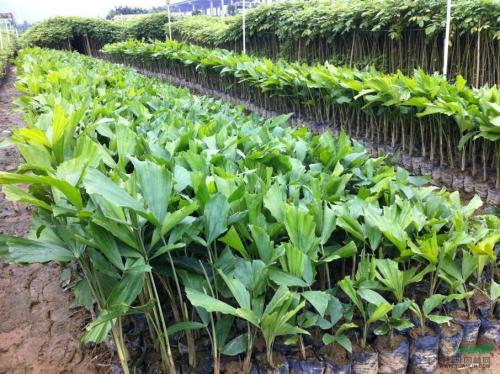
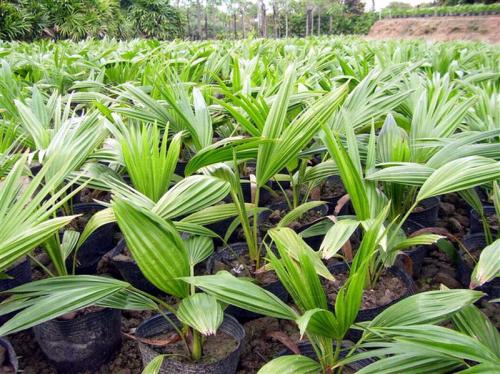
Seedling-grown Fish Tail Palms grow slowly, and the best potting effect is achieved when they are 2-3 years old and 1-2 m tall. The pot size is determined by the plant height. For a plant 1 m tall, choose a pot with a diameter of 30 cm; for a plant 1.5 m tall, choose a pot with a diameter of 40 cm; for a plant 2 m tall, choose a pot with a diameter of 50 cm. When planting, first place a 3 cm thick layer of coarse-grained soil or clean gravel at the bottom of the pot as a drainage layer, then fill with growing medium (a mix of 2 parts garden soil, 2 parts leaf mold, and 1 part sand) for planting.
Light
The suitable growth temperature for Fish Tail Palm is 15-25°C. In the tropical regions of southern China, it can be grown outdoors and overwinter outdoors. In northern China, where winter temperatures are low, it should be kept in a greenhouse for the winter; if the home has heating, it can overwinter indoors, with the temperature preferably kept above 10°C and with sufficient light, and the minimum temperature must not be lower than 5°C. If there is prolonged low temperature and insufficient light, the leaves will suffer cold damage and turn black. When outdoors in summer, use a 50%-70% shade net for shade, or place it in a spot with dappled shade under a large tree or in a shaded area. Under blazing sun or direct sunlight, the leaves will change color and wither.
Water and fertilizer
Add a small amount of decomposed cake fertilizer as a base fertilizer, apply a top dressing once every 15 days during the growing season, and stop fertilizing after the Start of Autumn. In a dry environment, the leaf surface becomes rough and loses its luster; during the growing season, water once every 2 days, and in summer water every day and spray water on the leaf surface.
Repotting
Fish Tail Palm grows relatively quickly and has a well-developed root system, so it should be repotted once every early spring. When repotting, cut off some old roots, prune the withered and yellow old leaves at the base of the plant, and replace some of the growing medium, which is beneficial for growth.
Uses:
Fish Tail Palm has unusual leaves, an upright stem, bright yellow flowers, and fruits like round beads in clusters; its tree form is elegant and full of tropical atmosphere. It is suitable for planting in gardens and courtyards for ornamental use, and can also be potted to decorate halls, entrance halls, display platforms, meeting venues, and so on.