Detailed Explanation of Black Rice Planting Methods and Technical Points
Black rice is a type of rice used both as medicine and food, and it belongs to the glutinous rice category. Black rice is a distinctive variety formed through long-term cultivation of the grass-family plant rice. The grain shape includes both indica and japonica types, and the grain quality is divided into glutinous and non-glutinous types. The brown rice is black or dark brown. Black rice has a jet-black appearance and is rich in nutrients, earning it the reputation of "black pearl" and "king of the world's rice." It is produced in many places in China, with representative varieties including Shaanxi black rice, Guizhou black glutinous rice, and Hunan black rice. Black rice is black or dark brown, rich in nutrients, and high in both food and medicinal value. Besides being used to make porridge, it can also be made into various nutritional foods and brewed into wine, and it has long enjoyed the reputation of "black pearl" and "king of the world's rice." The most representative is Shaanxi Yangxian black rice, which since ancient times has been known as "medicinal rice," "tribute rice," and "longevity rice."
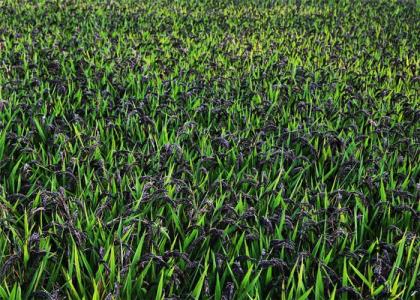
The main black rice planting techniques are as follows
(1) Sow early at the right time. Because black rice is a temperature-sensitive variety, it should be sown from March 10 to 15, which can extend its growth period and allow it to head, flower, and pollinate before the arrival of high temperatures in late July, helping to increase yield and grain quality.
(2) Dry seedling raising for strong seedlings with many tillers. Around the main field, choose a plot (block) of sandy loam field or dry land that is sheltered from the wind, faces the sun, and has convenient drainage and irrigation, and carry out film-covered dry seedling raising, sowing appropriately sparsely, with 4.5 kg sown per mu of seedling field and 1.5 kg of seed used per mu of main field.
(3) Improve transplanting quality. Carry out east-west oriented, wide-row narrow-plant, large-seedling transplanting with soil, and transplant enough basic seedlings per mu of main field, 300,000 to 320,000, so that they no longer tiller. The plant and row spacing for wide rows and narrow plants is generally 10 cm x 22 cm, which can increase ventilation and light penetration, favor robust growth, produce large panicles with many grains, and improve grain quality.
(4) Apply more phosphorus and potassium fertilizer, and apply little or no lime. According to soil survey data, the available potassium content in general soil is relatively low, and phosphorus content is also very low in some areas, so increasing the application of phosphorus and potassium fertilizer is an important measure to improve the grain quality of black rice. Phosphorus fertilizer is mainly used as a base fertilizer, potassium fertilizer is mainly applied as a top dressing combined with the first cultivation, with a small supplementary application at the booting stage, and both phosphorus and potassium fertilizers can be sprayed on the leaves before and after heading. If black rice absorbs too much calcium, the cooked rice will appear coarse and taste poor, so fields cultivating black rice should apply little or no lime.
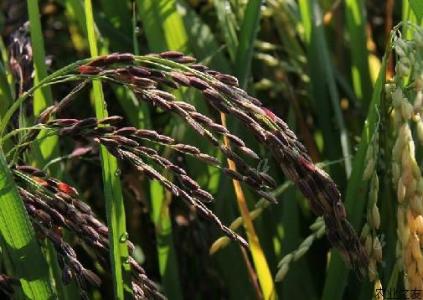
(5) Use as little pesticide as possible or none at all. Pesticide residues harm the health of humans, livestock, and poultry, and reduce the quality of black rice. Therefore, in pest and disease control, comprehensive control measures based mainly on agricultural control should be adopted, including selecting disease- and pest-resistant varieties, treating diseased rice straw, removing debris, shallow irrigation with field exposure, timely sun-drying of the field, completely removing barnyardgrass, and using traditional methods and local remedies to control pests and diseases, so as to achieve the goal of controlling and eliminating pests and diseases without pesticide residues.
(6) Do not cut off water too early in the later stage. Cutting off water too early during the maturity period of black rice not only increases the rate of empty grains and reduces the thousand-grain weight and yield, but also affects the quality of black rice. Generally, black rice should have its water cut off about 6 days before harvest.
(7) Harvest early at the right time. If black rice is harvested too late, the cooked rice will have no fragrance and the grains will be both coarse and hard, so it should be harvested when 85% of the rice grain is mature.
(8) Pay attention to improving the method of drying grain. If black rice is exposed to the scorching sun after harvest and rapidly dehydrated and dried, the broken rice rate during milling will increase. Therefore, at the beginning of drying, it can generally be spread 7 to 10 cm thick, and it should be turned frequently to prevent overly rapid dehydration. Special attention should be paid not to spread it on cement ground for sun-drying.
(9) Accelerate propagation and continuously purify and rejuvenate. Black rice varieties are very precious. In order to speed up breeding, seedlings can be raised strongly by sparse sowing. When the seedlings reach 7 to 8 tillers, the tillers can be separated one by one and transplanted as single plants, so that 100 grams of seed can plant 1 mu of main field. Before harvest, select 30 to 40 grains from the upper part of the main panicle (that is, seeds from the strongly hereditary part) that have the characteristics of this variety, large panicles with many grains, and strong resistance, to use as seed for the next generation's seed field or for the seed of a high-yield trial field, so as to continuously purify and rejuvenate, and improve yield and quality.