Detailed Explanation of Fuchsia Planting Methods and Techniques
Fuchsia (scientific name: Fuchsia hybrida hort. ex Sieb. et Voss ), also known as: lantern flower, hanging bell begonia. It is a perennial subshrub with erect stems. It grows 50-200 cm tall, 6-20 mm thick, much branched, covered with short pubescence and glandular hairs, gradually becoming hairless when old, with young branches tinged red. Leaves are opposite, ovate or narrowly ovate, 3-9 cm long, 2.5-5 cm wide. It prefers a cool and humid environment, fears high temperatures and strong light, and does best in fertile, loose, slightly acidic loam; the winter temperature should not be lower than 5°C.
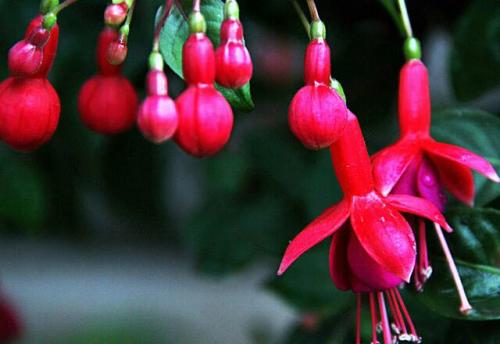
Cultivation Methods
Propagation Methods
Cuttage propagation is the main method. Apart from the hot summer, it can be done throughout the year, with spring cuttings rooting fastest.
In spring, do it from March to May; in autumn, from August to September. Select robust growing branches, each segment with 2-3 stem nodes, keep one pair of upper leaves, cut diagonally at the base near the node, immerse completely in a 0.1% potassium permanganate solution for 30 seconds, then stand upright with the leaves exposed and continue soaking the base for 30 minutes. After removal, rinse clean with water, then keep in clean water for 24-48 hours before inserting the cuttings, with a density such that the leaves do not shade each other. After the cuttings take root, transplant them as early as possible. Generally, the root length should not exceed 2 cm. First plant the cuttings in plain soil (made of 50% garden soil plus 50% river sand) in small pots to promote root growth. Plain soil causes little irritation to new tender roots, which helps survival. After planting, water thoroughly twice, arrange them closely in a shallow tray, and place in a semi-shaded spot for care.
Field Management
Light: It likes a semi-shaded environment, but light requirements vary by season. In winter, early spring and late autumn it needs full sun; in early summer and early autumn it needs half-day sun; in the hottest midsummer it should be shaded.
Temperature: The growing temperature for fuchsia is 10-28°C. In summer the temperature must not exceed 30°C; at 35°C large numbers wilt and die, so cooling measures should be taken in summer. In winter it requires ample sunlight, and the cultivation temperature must not be lower than 5°C, otherwise frost damage will occur, and insulation measures must be taken.
Humidity: Spray water on the leaves several times a day, sprinkle water on the ground, lower the temperature and increase air humidity.
Fertilizing: Because fuchsia grows fast and blooms many times, during the growing period apply light fertilizer frequently, about once every ten days with thin cake fertilizer or compound fertilizer. Before fertilizing, the potting soil should be on the dry side; after fertilizing, spray water once with a fine nozzle to avoid fertilizer water sticking to the leaves and causing rot.
Pest and Disease Control
Fusarium wilt and rust often occur. To control rust, spray with a 400-fold dilution of 20% carboxin EC; to control fusarium wilt, apply a 1000-fold dilution of 10% acetic acid solution (antimicrobial agent 401) into the soil.
Poor ventilation can also lead to damage from aphids, scale insects and whiteflies, which can be killed by spraying with a 1000-fold dilution of 40% omethoate EC.
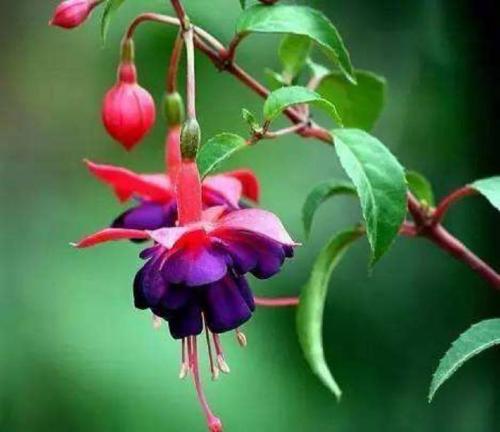
Cultivation Methods and Precautions for Fuchsia
1. Repotting and renewing the soil. Seedlings that have rooted from cuttings or grown from seed must go through several repottings from small pot to medium pot to large pot. The plant needs to be repotted once each year before sprouting in spring or autumn. The growing medium should be fertile, loose, well-draining potting soil, generally a uniform mix of leaf mold plus sandy loam plus decomposed organic fertilizer and phosphate fertilizer; no base fertilizer is needed, to avoid root rot.
2. Fertilizing. Because fuchsia grows fast and blooms many times, during the growing period apply light fertilizer frequently, about once every 10 days with thin cake fertilizer or compound fertilizer. During the flowering period, also apply a liquid fertilizer mainly of phosphorus and potassium once a month, but stop fertilizing in the hot season. Before fertilizing, the potting soil should be on the dry side; after fertilizing, spray water once with a fine nozzle to avoid fertilizer water sticking to the leaves and causing rot.
3. Temperature. The growing temperature for fuchsia is 10-28°C. In summer the temperature must not exceed 30°C, so cooling measures should be taken in summer. In winter it requires ample sunlight, and the cultivation temperature must not be lower than 5°C, otherwise frost damage will occur, and insulation measures must be taken. In addition, whether in winter or summer, pay attention to ventilation.
4. Watering. Water as soon as the soil is dry, and water thoroughly; avoid waterlogging. In summer, the potting soil is better kept on the dry side, but be sure to spray water on the leaves and the ground.
5. Pinching and pruning. Fuchsia branches are slender, weak and drooping, so pinching and shaping are needed to encourage branching, which can make the flowers abundant and colorful and prolong the flowering period.
6. Placement. To keep the fuchsia plant full and well-shaped, change its position frequently during the growing period so the plant receives even light and does not lean to one side and ruin its shape. However, during the flowering period it should be moved as little as possible, otherwise buds and flowers will drop.