Chinese mahogany (scientific name: Toona sinensis), also known as xiangchun buds, xiangzhuangtou, big red toon tree, chuntian and so on, is also called chunmiao in the Anhui region. Its root has two layers of bark, hence it is also called chunbaipi. It originated in China and is distributed across a wide area north and south of the Yangtze River, belonging to the Meliaceae family. It is a deciduous tree, dioecious, with even-pinnately compound leaves, paniculate inflorescences, bisexual white flowers, and oval capsule fruits with winged seeds; the seeds can be used for propagation. The tree is tall, and besides providing toon buds for eating, it is also a preferred tree species for landscaping. In ancient times, Chinese mahogany was called chun, and tree of heaven was called chu. The Chinese have long been accustomed to eating Chinese mahogany, and by the Han Dynasty it was already spread all across the country. Toon buds are rich in nutrients and have medicinal food value, mainly treating externally contracted wind-cold, rheumatic arthralgia, stomach pain, dysentery and so on.
Growing Techniques
Temperature, humidity and light
1. Temperature regulation
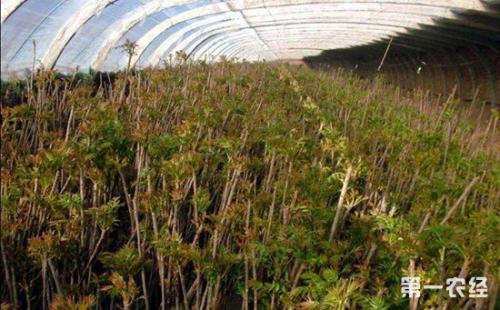
According to observations, when the greenhouse temperature is around 25°C, the tender buds can grow 3-4 cm in 24 hours; whereas at 15°C, they grow only 1 cm; when the greenhouse temperature exceeds 35°C, it affects the coloring and quality of the toon buds. The 10-15 days after covering with film is the seedling revival stage, and efforts should be made to raise the air temperature, which can be around 30°C during the day. After more than 1 month of natural light and temperature accumulation, once the buds sprout, the daytime temperature should be controlled at 25-30°C, and the nighttime temperature at 13-17°C; during the bud harvesting period, the air temperature is best at 18-25°C. Add straw mats and paper covers as needed to increase or maintain temperature.
2. Humidity regulation
For seedlings planted in the greenhouse, the root system has poor water absorption capacity, so a relatively high soil humidity and air humidity should be maintained in the early stage. After planting, water thoroughly, and thereafter water lightly as needed. The relative air humidity should be kept above 85%, and on sunny days, water should also be sprayed on the seedlings to prevent dehydration and drying out. After sprouting, the relative air humidity should be about 70%; if the humidity is too high, not only will sprouting be delayed, but the fragrance will also be greatly reduced, so ventilation should be provided in time to remove moisture.
3. Light regulation
Chinese mahogany likes light, so drip-free film should be used as much as possible. During the day, uncover the straw mats and paper covers in time, and also frequently clean debris off the film to increase light. If the light is too strong, appropriate grass covering can be used for shading.
4. Topping to promote branching
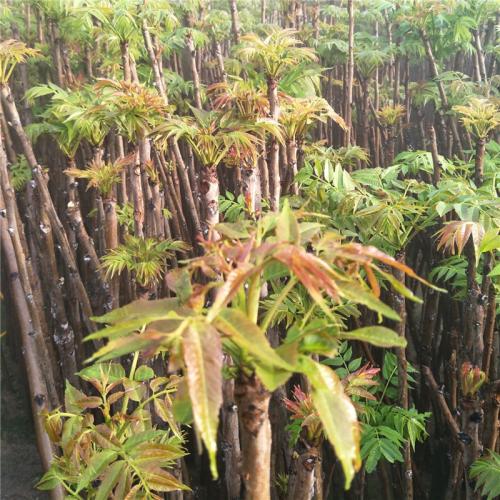
When harvesting the second crop of Chinese mahogany, remove the top at the same time to set the trunk (top at 40 cm from the ground). After setting the trunk, spray a 15% paclobutrazol solution at a concentration of 200-500 ppm to control apical dominance, promote rapid branch growth, and achieve dwarfed cultivation. After that, according to the development of the tree shape, top and prune branches in time to ensure that the canopy has many branches and produces many toon buds, achieving high yield and good quality.
5. Water and fertilizer management
Chinese mahogany is a fast-growing woody vegetable and does not need much water. Among fertilizers, it has a relatively high demand for potassium fertilizer. For every 300 sq m of greenhouse, the base fertilizer requires about 2500 kg of fully decomposed high-quality farmyard manure, 75-150 kg of plant ash or 3-6 kg of potassium dihydrogen phosphate, and 3-6 kg of diammonium carbonate. After each harvest, apply appropriate additional fertilizer and water according to soil fertility, the growth of the Chinese mahogany, and leaf color.
Putting on light-blocking film bags
After Grain Rain, when the ground temperature is above 18°C, the greenhouse film can be removed to let the saplings grow naturally. After that, although the saplings develop quickly, they are prone to aging. Black-red two-layer, two-color polyethylene film bags should be prepared early. When the toon buds grow to 5 cm, the light-blocking film bags can be put on. This can both increase yield and ensure that the toon buds do not age. When the toon buds grow to 15 cm, harvest them together with the bags, then remove the bags for sale. This kind of film bag can be used multiple times.
Medicinal Value
Chinese mahogany contains components such as calcium, phosphorus, potassium and sodium. It has effects such as tonifying deficiency, strengthening yang and securing essence, tonifying the kidney, nourishing hair and promoting hair growth, reducing inflammation, stopping bleeding and relieving pain, promoting qi circulation, regulating blood and strengthening the stomach. It is suitable for people with kidney yang deficiency, cold and painful waist and knees, nocturnal emission, impotence, and hair loss.
Chinese mahogany contains vitamin E and hormone-like substances, has anti-aging and yang-tonifying and yin-nourishing effects, and has a certain therapeutic effect on infertility, hence it has the good name of "fertility-promoting factor." Chinese mahogany is a famous seasonal delicacy and contains volatile aromatic organic compounds such as toonone, which can strengthen the spleen and appetite and increase appetite. The volatile odor of Chinese mahogany can penetrate the epidermis of roundworms, making it impossible for the roundworms to attach to the intestinal wall so that they are expelled from the body, and it can be used to treat roundworm disease. Chinese mahogany is rich in vitamin C, carotene and so on, helps strengthen the body's immune function, and has the effect of smoothing the skin, making it a good food for health care and beauty.
"Rihua Zi Bencao" points out that Chinese mahogany can "stop seminal discharge and bloody urine, warm the waist and knees, remove cold accumulations in the heart and chest, cold obstruction in the chest, abdominal masses and qi and abdominal pain, and eating it makes a person plump. For stroke and loss of voice, grind the juice and take it; for severe heart, spleen and stomach pain, grind it raw and take it; for snake and dog bites and malignant sores, pound and apply."
The inner bark of the tree bark and root bark (chunbaipi): bitter, astringent, cool. Clears heat, dries dampness, astringes the intestines, stops bleeding, kills parasites. Used for dysentery, diarrhea, painful urinary strangury, bloody stool, flooding and spotting, leukorrhea, rheumatic waist and leg pain. Leaves (chun leaves): bitter, neutral. Reduces inflammation, detoxifies, kills parasites. Used for hemorrhoids, dysentery. Fruit (Chinese mahogany seeds): pungent, bitter, warm. Dispels wind, disperses cold, relieves pain. Used for diarrhea, dysentery, stomach pain.