Detailed Explanation of Anthurium Planting Methods and Technical Points
Anthurium is a perennial evergreen herbaceous plant of the genus Anthurium in the family Araceae, class Monocotyledoneae. The stem nodes are short; the leaves grow from the base, are green, leathery, with entire margins, and are oblong-cordate or ovate-cordate in shape. The petioles are slender, and the spathe is held flat, leathery with a waxy sheen, orange-red or scarlet; the spadix is yellow, and it can bloom continuously throughout the year.
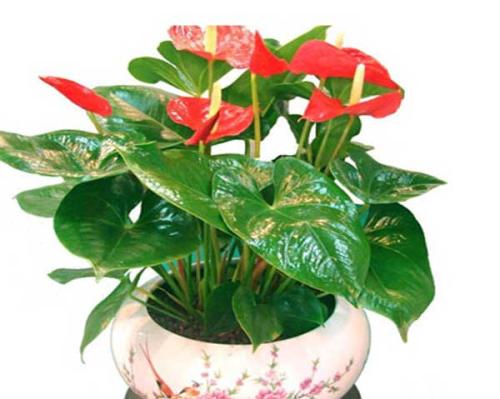
How to grow Anthurium:
1. Choosing soil: We can choose somewhat looser soil for Anthurium, because looser soil has better drainage and permeability and is very suitable for Anthurium to survive and develop well. It cannot be planted in soil containing salt and alkali. If it is ordinary soil, we can mix and prepare it ourselves, adding a little fermented okara from our own kitchen or kitchen waste with a high oil content, and we can also add some of our own poultry manure and naturally produced fertilizer, so that the soil will be very loose and also fertile.
2. Planting and cultivation: We can add some small gravel pieces to the bottom of the flower pot, which can effectively prevent the soil from clogging the drainage holes of the pot. During planting, we first put the selected soil into the flower pot, place the plant in the very center of the pot, and be sure to hold it upright, so that the root system of the Anthurium will naturally spread out and grow. Then add soil to bury the roots; it is enough to add soil until there are still two to three cm left below the pot rim. Finally, gently press the soil firm with your hands; after pressing, if the soil does not loosen when the pot is turned upside down, then it is fine.
3. Light: Anthurium cannot tolerate direct sunlight; it is suitable for growing in shade, and the best is dappled light cast down after the sun shines through trees. Especially in the very harsh summer sun, we had best shade 70 percent of the light for it. If Anthurium receives direct sunlight, its leaves will be scorched, the flower buds will turn brown, and the growth rate will also become slow. In the morning and evening, there is no need to shade the light, including on cloudy and rainy days as well.
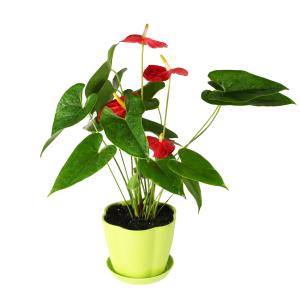
4. Watering: When we first start planting Anthurium, because its root system is not yet very developed and, moreover, is distributed very shallowly in the soil and has not yet obtained sufficient water, it is very easy for the roots to fail to keep up with nutrition. Therefore, after we plant Anthurium in a pot, it is best to water the flowers every day, two to three times, to ensure that the soil is moist. In the middle stage and the large-seedling stage, the growth rate of Anthurium will speed up, and the amount of water needed will also increase, so sufficient water must be maintained. In summer, watering once every two to three days is enough; at noon you can spray a little clean water on the leaves, which can also ensure the vitality and vigor of the leaves. In winter, we should water between 9 a.m. and 4 p.m., otherwise it is very easy to freeze and damage the roots. During the flowering period, note that the number of waterings should be appropriately reduced.
5. Fertilizing: Fertilizing depends on the season. In spring and autumn, fertilizing once a week is enough. If the air temperature is a little higher, then we fertilize once every two to three days. In summer, fertilize once every two days; when it is hot, do not forget to add one watering of clean water. In winter, we should fertilize less. Be sure not to use high-nitrogen fertilizer, and after each fertilizing it is best to water immediately, otherwise the fertilizer will very easily burn the plant's root system and stems and leaves.
6. Temperature: Anthurium is most suitable for growing in an environment of 20 to 30 degrees Celsius. If the temperature does not reach 10 degrees Celsius, Anthurium will at any time be frozen and suffer cold damage. But if the temperature reaches above 30 degrees Celsius, it will also cause the plant to grow too fast and consume too much nutrition, which will affect the overall quality of the plant. So we need to use a spray bottle to spray some water in the environment around the plant, to increase the humidity of the air and lower the surrounding temperature. 7. Pruning: If small thin shoots appear at the roots, we should prune them off in time, because those small thin shoots will compete for the plant's nutrients, causing poor development of the plant and making the overall plant shape very unsightly. Withering leaves and old flowers should also be pruned off in time.
Precautions for Anthurium:
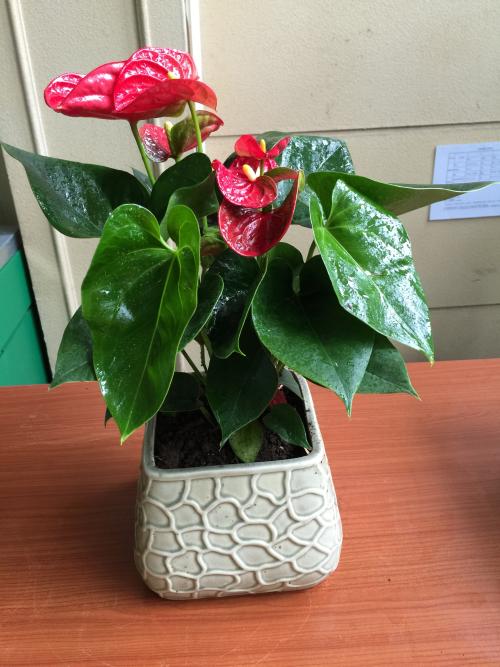
The main reason household Anthurium is not easy to grow is that it is prone to pests and diseases, so extra attention should be paid to this point. Generally there are red spider mites, nematodes, cabbage caterpillars, whiteflies, thrips, snails, and scale insects, among which red spider mites, nematodes, and cabbage caterpillars are especially the main ones. In addition, household Anthurium is especially sensitive to insecticides, so try not to use insecticides; when the pest problem is severe, they can be used at a reduced concentration.