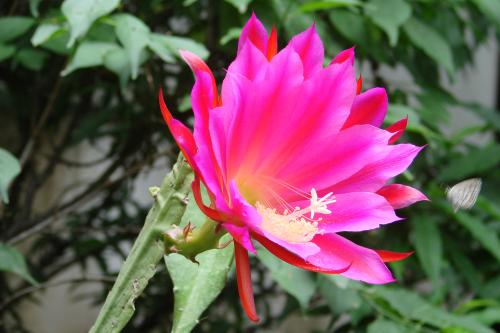
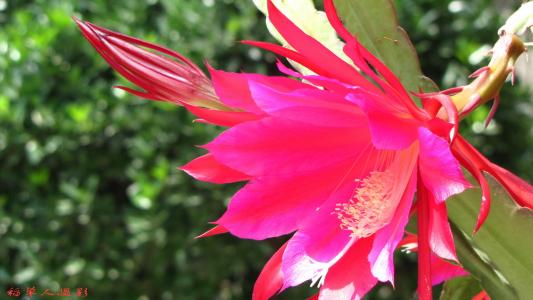
The orchid cactus (Nopalxochia ackermannii Kunth) is a perennial evergreen epiphytic plant in the cactus family. Its stems are flat and lance-shaped, resembling an arrow, and its flowers resemble water lilies, hence the name orchid cactus.
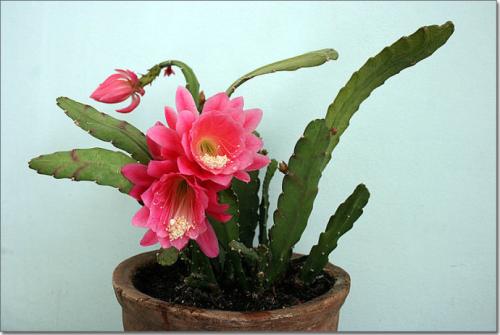
How to grow and care for the orchid cactus
Spring: During the orchid cactus's growing season, make sure it gets plenty of light and is fertilized in good time. Apply a nitrogen-and-phosphorus fertilizer once every 10-15 days to encourage strong, healthy growth of flowers and stems. Avoid waterlogging in the pot, which can cause root rot. From April onward, flower buds form along the edges of the upper half of the fleshy stems and gradually swell, bursting into bloom half a month later. If the plant is undernourished and weak at this time, it will not flower or will flower only sparsely. To prevent this, apply 1-2 extra doses of a fast-acting phosphorus fertilizer in advance. At the same time, remove excess side shoots and stem buds at the base.
Summer: During the period of vigorous growth, apply 1-2 top-dressings based mainly on nitrogen in good time. This both encourages new stems and leaves and helps the plant produce more buds and flowers the following spring. If you want to increase the number of stem segments, take advantage of this favorable period to keep buds. In the high heat of midsummer, the orchid cactus enters a semi-dormant period; place it in a cool, airy spot with partial shade, stop fertilizing, and do not water too much. Keep the potting soil slightly dry, and avoid too much shade, which can cause leggy growth and affect flowering.
Autumn: This is the second period of vigorous growth in the year. New leaves gradually age and mature, and care is basically the same as in spring and early summer, from May to June. Apply 2-3 top-dressings, mainly phosphorus and potassium fertilizers. Also increase the hours of light.
Winter: After Frost's Descent, when the weather turns cold, move the plant indoors to keep it warm. It can be placed in a sunny spot indoors, with the room temperature kept at 8°C. Stop fertilizing and restrict watering; it is best to keep the potting soil on the dry side, as too much moisture will cause the leaves to wilt, topple over, and rot at the roots. After spring, from mid-March to early April, as temperatures rise, gradually extend the time the window is opened for ventilation, to prepare the plant for being moved outdoors later.
Repot the orchid cactus with fresh soil once every 1-2 years; this can be done in either spring or autumn.
Care and Management
Soil
Potted orchid cacti need a fertile, loose, lime-rich sandy or loamy soil rich in organic matter. A potting mix can be made from 4 parts leaf mold, 2 parts peat, 2 parts rice-husk charcoal, plus an appropriate amount of bone meal. Before use, the potting mix is best sterilized with steam to reduce the risk from possible pests and eggs such as root-knot nematodes and root mealybugs, as well as various disease-causing bacteria, fungal spores, and fungal strains.
Potting
A purple-clay pot can be used; the size of the pot depends on the plant's shape and root system. It is best to place the plant in the pot so that the root crown sits slightly below the rim, and to use a shallow pot rather than a deep one whenever possible. Before potting, whether the pot is new or old, wash and disinfect it.
Planting
This is best done in early spring when growth begins, at temperatures above 15°C. When planting in summer, pay attention to ventilation and cooling; the temperature should not exceed 35%, otherwise the plant is prone to shriveling and mealybug damage. In mid-October, move it into a greenhouse, keeping the room temperature at around 15°C. In winter, keeping the indoor temperature above 5°C is enough for it to overwinter safely.
Fertilizer and Water Management
For the base fertilizer, generally use rotted poultry manure and bone meal, placed at the bottom of the pot or ground fine and mixed into the potting soil. For top-dressing, use rotted human manure or bean-cake fertilizer water and rotted fish fertilizer water alternately; when using them, they must be diluted with clean water. During the growing season, fertilize about once every half month. Apply 4-5 times in spring and 2-3 times in autumn; stop fertilizing during the high heat of midsummer. In late autumn, fertilizer should be applied sparingly, which helps the plant overwinter safely. Fertilize on a sunny morning or in the evening; during dormancy, do not fertilize newly potted plants, plants with damaged roots, or plants with wounds at the root crown.
The water used for watering should be neutral or slightly acidic; generally rainwater and unpolluted river or lake water can be used. Tap water is best left to stand for 2 days so the chlorine dissipates before use. From March to April, which is exactly when the orchid cactus is forming buds, water more; from May to July, the orchid cactus's flowering season, reduce watering, giving one thorough watering per week; after flowering, take even more care not to let the soil be too dry or too wet, and slightly dry is best; by mid-October around Frost's Descent, water thoroughly only when the soil has dried out, keeping it alternately dry and moist. From November to March of the following year is the dormant season; restrict watering and just keep the soil from becoming excessively dry.
Shaping and Pruning
1. Keeping buds on young plants
For plants that have survived from cuttings or grafting, remove all side buds that appear at the tip of the stem segments or at the leaf scars, forcing the plant to send up new shoots from the base of the stem segments instead. Among the shoots emerging from the base, keep the strong buds that are evenly spaced. Strong buds are purplish-red, grow quickly, and are flat and broad or three-angled. Remove thin, long, whip-like buds early so that nutrients are concentrated in the strong buds. If the stem segments growing from the retained strong buds point in an unsatisfactory direction, you can determine their direction of growth according to the space in the pot; since the newly emerging shoots are soft, you can roll stiff paper into a tube, rest one end against the inner rim of the pot, and use the other end to secure the new shoot in different positions.
2. Controlling height
When the stem segments of a potted orchid cactus grow to about 30cm, you can cut off the small red-rimmed ring at the tip edge of the stem segment, that is, the growing point, and the stem segment will stop growing taller. Treat every stem segment in the pot this way, and they will stay uniform in height. Since the stem segments no longer grow taller after the growing point is removed and are not allowed to produce side buds, the nutrients are concentrated in the retained stem segments, so they grow thick and plump. No support stakes are needed, and the plant's shape is upright and handsome, just like arrows stuck in the pot, a pleasure to look at.
3. Developing the plant's shape
Generally, a pot about 30cm in diameter only needs to keep 20-25 stem segments. If you want to increase the number of stem segments, you can keep 3-4 strong buds in each growing season. Do not keep too many, so as to ensure the retained buds get enough nutrients and grow to the desired height in one go. Stem segments that, because they sprouted too late or grew poorly and slowly, fail to reach the desired height in one go should simply be cut off and discarded, to prevent gourd-shaped stem segments from spoiling the plant's appearance. After the flowering period, cut off old, weak, and damaged branches.