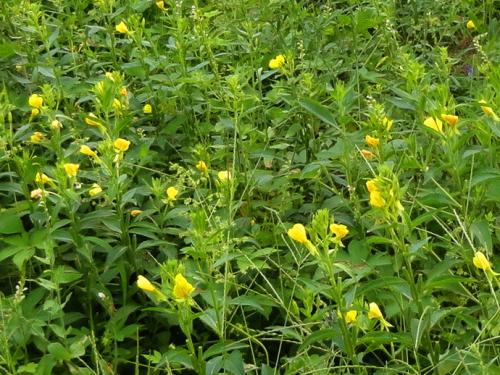
Evening primrose (scientific name: Oenothera biennis): a plant species in the genus Oenothera, family Onagraceae, order Myrtales. It has strong adaptability, is tolerant of acid and drought, and is not demanding about soil; it can generally grow in neutral, slightly alkaline or slightly acidic soil, and in well-drained, loose soil. In soil that is too wet, its roots are prone to disease. In the north it is an annual plant, and south of the Huaihe River it is a biennial plant. It is the most important nutritional medicine discovered this century. It can treat many diseases, regulate lipid substances in the blood, and has significant therapeutic effects on coronary artery infarction, atherosclerosis and cerebral thrombosis caused by high cholesterol and high blood lipids.
Propagation methods
Seed propagation
Propagate by seed. In the north, sow in spring; in areas south of the Huaihe River, sow in autumn or spring to raise seedlings. When sowing, the soil should be harrowed fine and level, the seeds scattered on the seedbed surface, then lightly raked with a rake and covered with a thin layer of soil. The seeds are small, so the soil must not be too thick, otherwise seed germination and growth will be affected. After sowing, the soil should be kept moist. About 10~15 days after sowing, the seeds can germinate and produce seedlings.
Sowing can be done in both spring and autumn. The autumn sowing period is from mid-October until before the ground freezes. If there is heavy winter snow, autumn sowing is better than spring sowing; if there is little winter snow, it easily causes missing seedlings and broken rows. Spring sowing can be done before wheat sowing, when the soil has thawed 2~3cm. Because the sowing rate is low, 60kg of diammonium per hectare is used to mix with the seed as a filler; if this is insufficient, a certain amount of dry sawdust or roasted wheat, rapeseed, etc. can also be added for sowing. Sowing depth is 1~2cm, and the soil should be pressed promptly after sowing. The seed rate per hectare is 6 kg, and the target stand per hectare is 400,000~500,000 plants. The sowing density must not be too low, otherwise there will be branching and the maturity period will be uneven.
Cutting technique
The branches used for cuttings are called cuttings. Usually in combination with pinching work, the thick, pest-free top shoots that are removed are used as cuttings, and the top shoots are used directly for cuttings.
The optimum temperature for rooting of cuttings is 18℃~25℃. Below 18℃, rooting of cuttings is difficult and slow; above 25℃, the cut surface of the cuttings is easily infected by pathogens and rots, and the higher the temperature, the greater the proportion of rot. When low temperatures are encountered after cutting, the main insulation measure is to wrap the flowerpot or container used for cuttings with film; when the temperature is too high after cutting, the main cooling measure is to shade the cuttings, blocking 50~80% of sunlight, and at the same time spraying the cuttings 3~5 times per day. On sunny days with higher temperatures, spray more often; on cloudy and rainy days with lower temperatures and higher humidity, spray less often or not at all.
After cutting, the relative air humidity must be maintained at 75~85%. Humidity can be increased by spraying the cuttings 1~3 times per day. On sunny days, the higher the temperature, the more often to spray; on cloudy and rainy days, the lower the temperature, the less often to spray or not to spray. However, excessive spraying makes the cuttings easily infected by pathogens and prone to rot, because many kinds of pathogens exist in water.
Light: cutting propagation cannot do without sunlight, but the stronger the light, the higher the temperature inside the cuttings, the more vigorous the transpiration of the cuttings, and the more water is consumed, which is not conducive to the survival of the cuttings. Therefore, after cutting, 50~80% of sunlight must be blocked. After the root system grows out, gradually remove the shade net: on sunny days, remove the shade net at 4:00 pm each day and cover it again before 9:00 am the next day.
Cultivation techniques
Site selection and land preparation:Evening primrose is vigorous by nature, cold-tolerant, drought-tolerant, tolerant of poor soil, fond of light, and averse to waterlogging. Choose fertile soil with good drainage, and bean stubble or melon crop stubble for planting; continuous cropping is possible. However, land with residues of herbicides such as chlorsulfuron, chlorimuron-ethyl, Pursuit and Command cannot be used to plant evening primrose. For land preparation, bean stubble and mixed stubble can be directly harrowed and ridged in autumn.
Transplanting and planting:When potting small seedlings, first place 2~3 cm thick coarse-grained substrate or expanded clay pellets at the bottom of the pot as a drainage layer, then sprinkle a layer of fully decomposed organic fertilizer as base fertilizer, about 1~2 cm thick, then cover with a layer of substrate about 1~2 cm thick, and then place the plant in, so as to separate the fertilizer from the root system and avoid burning the roots. For the substrate used in potting, one of the following can be chosen. Garden soil:cinder=3:1; or garden soil:medium-coarse river sand:sawdust (mushroom residue)=4:1:2; or one of paddy soil, pond mud, leaf mold. Or peat+perlite+expanded clay pellets=2 parts+2 parts+1 part; garden soil+cinder=3 parts+1 part; peat+cinder+expanded clay pellets=2 parts+2 parts+1 part; sawdust+vermiculite+medium-coarse river sand=2 parts+2 parts+1 part.
After potting, water thoroughly once and place in a slightly shaded environment for one week of care. When transplanting small seedlings, first dig the planting hole, sprinkle a layer of organic fertilizer at the bottom of the planting hole as bottom fertilizer (base fertilizer), about 4~6 cm thick, then cover with a layer of soil and place the seedling in, so as to separate the fertilizer from the root system and avoid burning the roots. After placing the seedling in, backfill the soil to cover the root system, press the soil firm with your foot, and water thoroughly once.
Field management:Before the second pair of true leaves unfolds, the seedlings are very similar to weed seedlings and easily confused, so intertillage and weeding cannot be carried out at this time; it can only be done after the second pair of true leaves has unfolded.
When the seedlings grow to 5~6 leaves, if there are many grassy weeds, haloxyfop and quizalofop can be sprayed to kill the weeds. During the growth period, 2 rounds of hoeing and 2 intertillages should be carried out; the hoeing and ridging must be finished before flowering, and the first round of hoeing and intertillage is carried out when the seedlings cover the ridge. In late July and early August, carry out 2 rounds of manual pulling of large weeds, so that there are no weeds in the field taller than the evening primrose plants.
Rot disease
For rot disease control, after onset the plant roots gradually discolour and rot, the leaves wilt and dry up, and then the whole plant dies. Control method: pour with 1% lime water, or 50% thiophanate-methyl 1500-fold solution, or 75% chlorothalonil 1000-fold solution.
Leaf spot disease
(1) Symptoms: This disease mainly damages leaves. After infection, the lesions on the leaves are round, light brown, 2~3 mm in diameter, with purplish red edges, brown centers, and densely covered with small black dots. When the disease is severe, it can cause the leaves to die.
(2) Causes: The pathogen is Septoria oenotherae Westd., belonging to Deuteromycotina, genus Septoria, a fungus. The pathogen overwinters in diseased residues as pycnidia and mycelium. In the following spring, after absorbing water, the pycnidia release conidia for primary infection. Field spread of the disease mainly relies on raindrop splash and airflow, and seed-borne infection causes long-distance spread. High temperature and high humidity, and continuous cloudy and rainy weather favour the disease. Poor cultivation management and weak plant growth make plants susceptible. The peak period of disease is the high-temperature and rainy season in July~August.
(3) Control methods:
① In autumn, thoroughly remove diseased and residual leaves from the field, burn them in a concentrated manner or bury them deeply, so as to reduce the amount of overwintering inoculum in the field.
② Before sowing, soak the seeds in 50% carbendazim or 50% mancozeb 500-fold solution for 30 minutes, dry them, and then sow.
③ In the early stage of disease, spray once with 50% mancozeb 500-fold solution or 50% dimethomorph 600-fold solution and other agents, with an interval of 10~15 days.
Copper-green chafer
(1) In the larval stage, this pest damages seedlings; in the adult stage during the flowering period, it damages petals.
(2) Control methods:
① Manual capture and killing;
② Mix roasted fragrant wheat bran with 90% crystalline trichlorfon 30-fold solution into poisoned bait to trap and kill;
③ Mix the bait directly with 50% phoxim emulsifiable concentrate at 1:1 and use it to trap and kill.
Evening primrose has an indeterminate inflorescence, and the fruits mature successively. Generally, when 3~4 pods at the bottom turn yellow and are about to split, it is the best harvest period. The specific time is mid-to-late September; if later, the early-maturing fruits will have dried and split. The seeds scatter on their own. Manual harvesting or swather harvesting can be used. After drying for 5~7 days, use a combine harvester to pick up the grain or thresh manually (by beating). After harvest, grade and clean the seeds with a grain cleaner, remove impurities, and after drying until the moisture content drops below 11%, bag them for storage or sale.