Sycamore Planting Methods and Key Technical Points
The sycamore (Platanus) is a tree in the family Platanaceae, and is the general name for about 7 species in the genus Platanaceae Platanus. It is distributed in eastern southern Europe, India and the Americas. Three species have been introduced and cultivated in China, for ornamental use and as street trees. The sycamore has a majestic tree form and dense branches and leaves, and is a world-famous excellent shade tree and street tree, known as the "king of street trees".
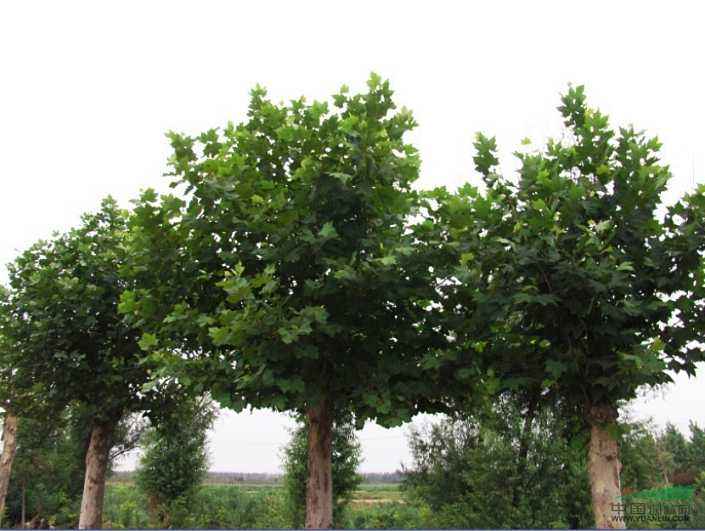
The method of raising sycamore seedlings by sowing is as follows:
The sycamore bears a head-shaped infructescence, which can generally be collected in December each year. Then we spread the collected sycamore seeds out to dry and store them indoors with ventilation and air permeability. By the spring of the following year, they can be sown. Before sowing the sycamore, the infructescence needs to be rubbed and broken up, and the attached yellowish-brown small fuzz can be sown together with it. The germination rate of sycamore seeds is relatively low, generally 10-20%, so when we propagate sycamore by sowing we need to scatter the seeds all over the seedbed.
For sycamore propagation by sowing, soil with good drainage should be selected, and the soil should not be too heavy in clay; this kind of soil is most suitable for raising seedlings. After sowing the sycamore, a sufficient base fertilizer should be applied, the soil should be plowed and harrowed carefully, the bed surface should be level, and drainage ditches should be opened around the seedbed.
Sycamore seeds can be evenly broadcast-sown in 2-3 rounds, then a thin layer of fine soil should be sifted over the seeds to cover them, and then it is enough to cover them with rice straw. If the soil is found to be dry before sowing the sycamore, it needs to be watered thoroughly, and then the bed should be made and sowing carried out, so as to keep the soil moist. Newly emerged seedlings have relatively weak resistance and need careful management. After the straw is removed from the sycamore seedlings, a shade shed should be set up in time; when the seedlings begin to lignify, the shade shed should then be dismantled.
After the sycamore seedlings unfold their leaves, they grow very quickly and their resistance gradually increases. At this time we should promptly strengthen the management of the sycamore nursery, often weed and loosen the soil around the sycamore seedlings, apply additional fertilizer, remove buds and prune branches, and prevent diseases and control pests.
When applying additional fertilizer to sycamore seedlings, care should be taken to apply it from light to concentrated and from little to much, so as to avoid burning the sycamore seedlings to death. To cultivate sycamore street tree seedlings, if the standard is not reached that year, they still need to be transplanted for 1-2 years to continue cultivating large seedlings.
When sycamore seedlings leave the nursery, the seedlings should be lifted well, carrying many lateral roots and fibrous roots. The sycamore is generally used for planting as a street tree; generally speaking, the row spacing is about 5 m. When cultivating the sycamore, points should be marked in advance, and after the positions are set, holes should be dug; the size of the holes depends on the sycamore seedling, generally 70 cm square and 30 cm deep. The key points of planting are the same as for general street trees.
The sycamore is mainly planted as a street tree. When cultivating the sycamore, intertillage, weeding, fertilizing and pruning are needed every year. Generally speaking, the intertillage depth for the sycamore is about 5-10 cm; in drought, attention should be paid to watering the sycamore and hilling up soil to retain moisture. Within 4-5 years after planting the sycamore, attention should be paid to shaping and pruning the sycamore. Newly planted seedlings generally have only a main branch and first-order lateral branches. From late autumn to early spring of the following year each year, sprouting shoots should be thinned out, the growth direction of branches should be controlled, and they should be encouraged to extend upward and outward continuously, increasing the shade area of the sycamore crown. Generally, the height of the sycamore crown can be controlled at a position lower than utility poles. Until it has 4-6 orders of lateral branches and the sycamore crown spread is about 5 m, the shaping work for the sycamore can be considered basically complete. But afterward, every year it is still necessary to prune out overlapping branches, drooping branches, outward-stretching branches, twiggy branches and diseased and pest-infested branches from the sycamore. When the sycamore is planted in rural areas, it need not be pruned into a cup shape; it is enough to let the main shoot of the sycamore grow upward.
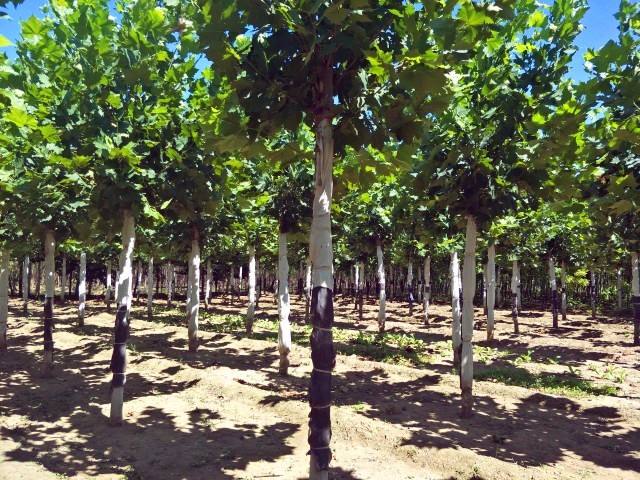
Pruning Techniques
1. Shaping and pruning in the nursery Shaping and pruning in the nursery must be carried out on the basis of reasonable close planting of seedlings. When cultivating large cup-shaped street tree seedlings, the planting spacing for cuttings is 60×60 cm. Choose fast-growing varieties of sycamore with few seed balls; in the same year the plant height can reach 2.5 to 3.5 m. After autumn or in early spring, finalize the seedlings according to the principle of "remove every other row, remove every other plant, keep the large and remove the small, keep the strong and remove the weak", so that the spacing of the retained seedlings basically reaches 1.2×1.2 m. The seedlings continue to grow in the second year; in winter, the trunk is headed, removing the tip at a height of 3.5 to 4.0 m, and cutting off the lateral branches on the trunk below the branching point. In the third year, after the seedlings sprout, select and retain 3 to 5 evenly distributed, robustly growing branches near the branching point that form an angle of about 45° with the trunk as the main branches, and cut off the rest in batches. In winter, the main branches are cut back leaving 50 to 80 cm, with the cut-eye bud kept on the side, as far as possible at the same horizontal level; after sprouting the following spring, 2 third-order lateral branches are selected and retained from each to grow obliquely, forming the shape of "3 strands, 6 forks, 12 branches". After 3 to 4 years of cultivation as above, the large seedlings have a breast-height diameter of more than 7 to 8 cm and have initially taken on a cup-shaped crown form, meeting the standard for street trees, and can leave the nursery.2. Shaping and pruning after planting After forest-form street trees are planted, pruning should continue within 4 to 5 years, with the same method as at the seedling stage, until the crown has 4 to 5 orders of lateral branches. Afterward, every year during the dormant period, the current year's branches are cut back, retaining 15 to 20 cm, called a small heading-back, so that the position of the sprouting shoots rises year by year; when the branch tips are about to touch the lines, they should be retrenched to lower the height, called a large heading-back. Small and large heading-back are carried out alternately, keeping the crown maintained at a certain height.
3. Shaping and pruning in other situations If the cup-shaped crown has not been formed when the seedlings leave the nursery and are planted, and the shape is to be created after planting, the planted seedlings can be headed at the ideal height, and after sprouting, 3 evenly distributed, robustly growing branches are retained as main branches, cut back in winter, and afterward the pruning method above is also followed.
If the road is not very wide and there are no wires passing above, an open-center crown can be used. After planting and heading, select and retain 4 to 6 main branches; after cutting back each winter, select and retain 1 branch growing slightly obliquely upward as the main branch extension branch, so that the crown rises year by year, and an elliptical crown form with a hollow interior can be formed. When pruning, strong branches should be pruned lightly and weak branches pruned heavily, so that the crown develops in a balanced way. In addition, besides being planted as a street tree, the sycamore can also be used as a shade tree or a specimen tree. When planted as a shade tree or specimen tree, a natural crown form is preferable.