Cassava Planting Methods and Key Cultivation Techniques
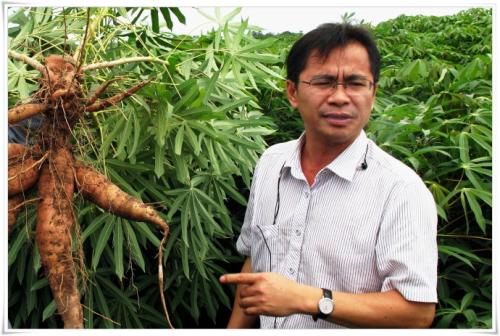
Cassava (scientific name: Manihot esculenta Crantz), an erect shrub, 1.5-3 m tall; storage roots cylindrical. Leaves papery, outline nearly circular, palmately parted almost to the base, lobes 3-7, oblanceolate to narrowly elliptic, apex acuminate; petiole 8-22 cm long, slightly peltate, with inconspicuous fine ridges; stipules triangular-lanceolate, entire or with 1-2 bristle-like fine lobes. Panicles terminal or axillary, bracts linear-lanceolate; calyx purplish red with a white powdery bloom; male flowers: calyx about 7 mm long, lobes long-ovate, nearly equal in size, inner surface hairy; stamens 6-7 mm long, anthers white-pubescent at the tip; female flowers: calyx about 10 mm long, lobes oblong-lanceolate, stigma recurved, fan-folded. Capsule ellipsoid, surface rough, with 6 narrow wavy longitudinal wings; seeds about 1 cm long, more or less trigonous, seed coat crustaceous, mottled, smooth. Flowering period September-November.
Planting Methods
(1) Site selection and land preparation
Cassava is highly adaptable; any land can be used as long as it is not excessively barren, not too gravelly, and does not accumulate water.
(2) Planting material
1. Variety selection. Commonly used varieties include South China 205, South China 124, Bread Cassava, South China 8002, etc.
2. Seed stem selection. It is advisable to select fully mature main stems that are thick and have closely spaced nodes, solid pith rich in moisture, intact bud points, undamaged bark and buds, and free of pests and diseases as planting material.
(3) Planting methods
The main planting methods for cassava are flat placement and oblique insertion. When planting, cut the seed stems with a sharp knife; the cutting length is preferably 15-20 cm, placed flat or inserted obliquely into the hole, and covered with a thin layer of soil. Density depends on soil fertility; generally 800-1000 plants per mu is suitable. Planting spacing is generally 1 x 0.8 (m) and 0.8 x 0.8 (m).
(4) Field management
1. Replanting. To ensure a full stand, begin replanting 20 days after planting and complete within 30 days.
2. Thinning. Generally thinning is carried out after full emergence, when seedlings are 15-20 cm tall, leaving 1-2 seedlings per hole.
3. Intertillage and weeding. Generally, the first intertillage and weeding is carried out 30-40 days after planting when seedlings are 15-20 cm tall, and the second intertillage and weeding can be carried out 60-70 days after planting. At 90-100 days after planting, combine the third intertillage and loosening of the soil with topdressing of tuber-promoting fertilizer.
4. Fertilization: The principle of fertilization is to apply sufficient basal fertilizer, carry out reasonable topdressing, and combine nitrogen, phosphorus, and potassium.
Basal fertilizer: apply 25 kg of ternary compound fertilizer per mu, and 400-500 kg of farmyard manure; topdress 2-3 times, divided into seedling-strengthening fertilizer, tuber-setting fertilizer, and tuber-strengthening fertilizer. Seedling-strengthening fertilizer is mainly nitrogen, applied within 30-40 days after planting, with 10 kg of urea and 5-7.5 kg of potassium chloride per mu, to promote early and rapid growth of the cassava seedlings; tuber-setting fertilizer is mainly potassium with appropriate nitrogen, applied 60-90 days after planting, with 5-7.5 kg of urea and 7.5-10 kg of potassium chloride per mu, to promote storage root formation and ensure the number of tubers per plant; if the soil is barren, tuber-strengthening fertilizer should be applied 90-120 days after planting, with 5-7.5 kg each of urea and potassium chloride per mu, to promote storage root enlargement and starch accumulation.
5. Pest and disease control. In our area, cassava has fewer pests and diseases, and the damage is relatively light. A common pest is the cassava red mite. Damage by this pest worsens in dry climates. It can be controlled by spraying with acaricides.