Detailed Explanation of Peach Tree Planting Methods and Technical Key Points
Peach (scientific name: Amygdalus persica L.): a plant of the genus Amygdalus in the Rosaceae family. Deciduous small tree; leaves are narrowly elliptic to lanceolate, 15 cm long, 4 cm wide, with a long and slender pointed tip, finely toothed margins, dark green and glossy, with nectaries at the leaf base; bark is dark gray, developing cracks with age; flowers are solitary, ranging from light to deep pink or red, sometimes white, with short stalks, 4 cm in diameter, blooming in early spring; nearly spherical drupe, with a fuzzy surface, fleshy and edible, orange-yellow with a reddish blush, 7.5 cm in diameter, containing a stone with deep pitting and grooves, enclosing a white seed.
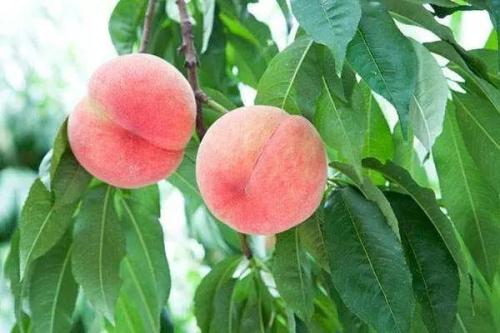
How are peach trees planted?
1. Generally, peach trees are planted at 500-840 trees per hectare. Planting can be done from after leaf fall to before bud break.
2. A peach orchard must not be continuously cropped, otherwise young trees will grow noticeably weaker, leaves will lose their green color, new roots will turn brown and branch excessively, and trunks and branches will exude gum.
3. The potassium content in peach fruit is 3.2 times that of nitrogen; increasing potassium fertilizer results in larger fruit and higher yield.
4. A peach orchard needs frequent cultivation and weeding to keep the soil loose, and timely drainage to prevent waterlogging and root rot.
5. After peach trees are planted, proper pruning is also very good; generally many people like to train peach trees into a natural open-center shape.
Soil Management of Peach Trees
1. Deep plowing: In peach orchards with heavy clay soil, to improve the soil, deep plowing is carried out between the rows to a depth of about 60 cm, combined with the application of organic fertilizer. Sandy gravel peach orchards are also deep plowed, removing gravel and replacing the soil, combined with the application of organic fertilizer. Deep plowing plays a good role in achieving high yields year after year.
2. Autumn plowing: Carried out before and after leaf fall combined with the application of organic fertilizer, to a depth of 20-30 cm.
3. Intercropping: Intercrops in peach orchards can include beans, melons, strawberries, peanuts, etc. Green manures such as hairy vetch and alfalfa can also be planted. No matter what crop is planted, sufficient tree should be left, and timely fertilization, irrigation, and cultivation and weeding should be carried out.
Transplanting of Peach Trees
1. Before understanding peach tree planting, let us understand its seedling preparation. Peach trees are mainly propagated by grafting, but can also be propagated by sowing, cuttings, and layering. For seedlings used as rootstock, when the seedling height is 25-30 cm, the growing tip is pinched off to thicken the seedling; by late summer and early autumn, it can reach the thickness required for the rootstock at grafting time.
2. Transplanting is best done in early spring or after leaf fall in autumn. Small seedlings can be transplanted bare-root or dipped in mud slurry, while large seedlings need to be transplanted with a soil ball. Large seedling cultivation requires shaping and pruning to form a framework. Peach trees are generally trained into a natural cup-shaped canopy and a natural open-center canopy.
Main Disease Control Measures for Peach Trees
1. Strengthen peach orchard management, enhance tree vigor, pay attention to drainage, increase the application of organic fertilizer, avoid excessive application of nitrogen fertilizer, increase the application of phosphorus and potassium fertilizers, improve ventilation and light conditions in the peach orchard, prune reasonably, cut off diseased branches, remove fallen leaves, dead branches, mummified fruit, and fallen fruit on the ground, and burn or bury them deeply in a centralized manner.
2. Before peach buds break, spray once with 5 degrees Baumé lime sulfur mixture, or 45% lime sulfur crystalline 30-fold solution, or 1:1:100 Bordeaux mixture. Starting 10 days after flower drop, spray "ethylicin" 1500-2000-fold solution, or 72% agricultural streptomycin soluble powder 3000-fold plus Dacotech M-45 wettable powder 600-800-fold solution, alternating every 10 days with 12.5% cyproconazole 1500-fold solution or 70% thiophanate-methyl 600-fold solution, spraying 2-3 times. Depending on disease occurrence, pesticide can also be sprayed promptly at the early stage of disease to control the condition and reduce damage.
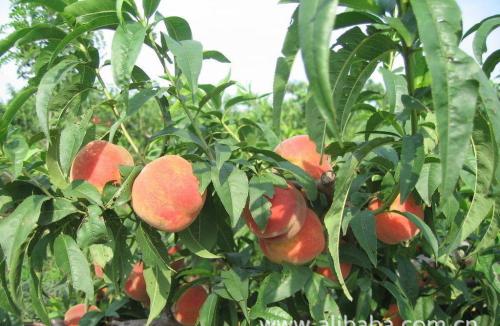
Flower and Fruit Thinning of Peach Trees
A heavy fruit set affects tree growth and development, weakens tree vigor, makes fruit small and lowers quality, and affects the quantity and quality of flower bud differentiation. Therefore, under the premise of integrated management, reasonable flower and fruit thinning is one of the important measures for high, stable, and high-quality peach yields.
1. Flower thinning: Manual flower thinning is generally carried out at the bud stage and flowering stage. The method of flower thinning is to first thin the flowers at the base of the fruiting branch, keep the flowers in the middle and upper parts, and in the middle and upper parts thin the double flowers and keep single flowers. All flowers on the should be thinned entirely.
2. Fruit thinning: Usually carried out after the second fruit drop when fruit set is relatively stable, and completed when pit hardening begins. When fruit set is excessive, the first fruit thinning is carried out 1 week after flower drop, leaving about 3 times the final fruit load. Early-maturing varieties can be thinned appropriately earlier, and late-maturing varieties can be thinned appropriately later. The fruit load should be determined according to the yield in past years, the current year's growth vigor, and fruit set conditions. Generally, on long fruiting branches, leave 1 large fruit, 2 medium fruit, and 4 small fruit. On medium fruiting branches, leave 1 large fruit, 1 medium fruit, and 2 small fruit. On short branches, leave no large fruit or 2. Leave no fruit on.
Pruning of Peach Trees During the Fruiting Period
Pruning in this period is, first, to control the canopy and prevent canopy closure, and second, to maintain the fruiting capacity of branch groups and ensure high and stable yields.
1. Summer pruning.
In addition to measures such as twisting shoots, thinning branches, and twisting branches, when the canopy reaches the predetermined size, compress and thin the upper branch groups so that the upper branch groups are as small and sparse as possible and light conditions in the lower part are improved; when canopies meet, cut back the branch tips so that a 100 cm interval is maintained between rows, and thin the upper branch groups to solve the light problem.
2. Winter pruning.
Pruning of the main branch tips. When the predetermined height has not been reached, continue to leave a single head and let it extend; after reaching the height, cut back to the rear short branch, and after new long branches grow out, let them extend again. This alternation of extending and cutting back, on the one hand, maintains the canopy within a certain range, and on the other hand, always maintains single-head extension and a form that is small at the top and large at the bottom.
3. Maintenance and renewal of branch groups.
If there is space, large and medium branch groups can continue to be left to extend; otherwise, alternate extending and cutting back to maintain fruiting. Small branch groups can alternate extending and cutting back to maintain fruiting. Large and medium branch groups should be kept in a braided form and not allowed to branch repeatedly. When large and medium branch groups fail to produce long fruiting branches after cutting back, they should be cut back more severely to the last branching point of the branch group, causing it to produce strong new shoots; after summer twisting, let them extend again into new branch groups and continue fruiting, thereby achieving the purpose of renewal.
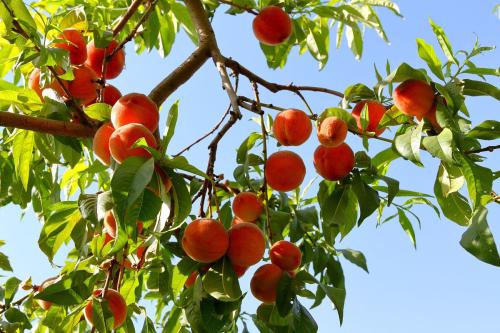
Training Techniques for Peach Trees
1. Trunk determination. After grafted peach saplings are planted, cut and determine the trunk at 60-70 cm above the ground, leaving 20 cm below the cut (7-10 healthy, plump leaf buds) as the training zone (the so-called training zone is the section of trunk selected for leaving main branches when determining the trunk, located below the cut and above the main trunk), and cultivate 3 main branches within the zone. After bud break, all buds below the training zone are removed.
2. Cultivating main branches. After grafted saplings have their trunks determined, when the current-year new shoots grow to 50 cm, begin selecting and leaving main branches. We can cut off the central branch and use the current-year new shoots or current-year secondary shoots sprouting on the main trunk to select those with suitable distance and orientation as main branches, cutting off the central branch above the third main branch. In August-September, use the branch-bending method to open the angle of the main branches.
3. Select and leave side branches on the main branches. Generally, 3 to 4 side branches are selected and left on each main branch (the so-called side branches are the permanent scaffold branches borne on the main branches). With some shaping and pruning techniques, completing the above steps is sufficient.