Verbena Planting Methods and Care Tips Explained in Detail
Verbena is an annual herbaceous flower with graceful form, rich flower colors and brilliant hues; when in full bloom it looks like a sea of flowers, making people linger unwilling to leave. Verbena plants are low and dense, with abundant, brightly colored flowers; the flowering portion is corymb-like, and flower colors include white, red, blue, snow-blue (lavender-blue), pink and so on. The flowering period is from May to November, and it is very robust. It can be used as flower bed and flower border material, and is suitable for potted display or for arranging flower stands and flower borders. It can also be grown as pot flowers and planted on a large scale in garden gaps and tree beds. Common cultivated species in the same genus include Canadian verbena, red-leaf verbena, fine-leaf verbena and so on. The whole plant can be used as medicine and has the effect of clearing heat and cooling the blood.
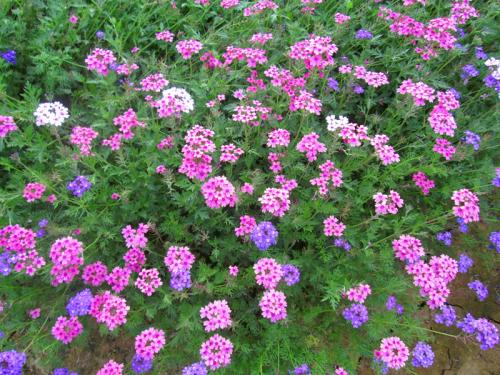
Growth Habits
It likes a warm and humid climate, likes sun, is not drought-tolerant, and has no strict requirements for soil, but in loose, fertile, relatively moist neutral soil it can root at every node, grow robustly and bloom profusely. In warmer microclimates in Shanghai it can overwinter outdoors.
Cultivation Techniques for Verbena
Verbena has clustered blossoms and bright colors. It is an important herbaceous flower for flower beds in summer and autumn, and is also suitable for potted display. It is native to Brazil, Peru, Uruguay and other places. It likes sunny, warm and humid environmental conditions, is not tolerant of shade, not drought-tolerant, and not very tolerant of severe cold. It has no strict requirements for soil, but in loose, fertile, relatively moist soil it grows robustly and blooms abundantly with bright colors.
In the north it is usually propagated by sowing or cuttings; in warm southern regions it overwinters outdoors as a perennial, and can be propagated by division in early spring. Sowing can be done in spring or autumn, often mainly in spring; in early spring, seedlings are raised by sowing in pots in a greenhouse, and transplanted in mid-May. Flower seedlings sown in autumn need to be moved into a low-temperature greenhouse or a sunny cold frame for protection to overwinter, and in early April of the following year they can be planted outdoors or potted to make them bloom earlier. Cuttings are carried out from April to July. Cut healthy branches as cuttings; after inserting them, manage them under light shade, paying attention to heat preservation and moisture retention; at 15°C to 20°C they root in about two weeks. After they survive, pinch them in a timely manner so that the plant form is low and neat, for arranging flower beds or potting.
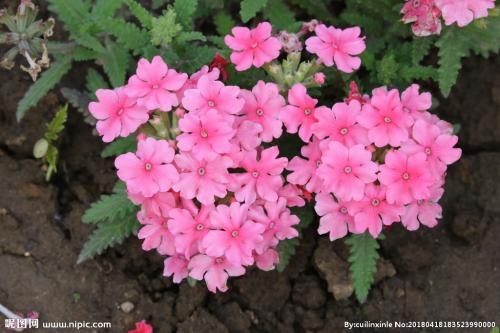
Verbena is tolerant of high temperatures and can bloom normally even in hot summers. The cultivation site requires sufficient light; only sufficient light can make the plant form full and the flowers abundant and brightly colored. If light is insufficient, the plant tends to grow leggy, with fewer flowers and a sparse plant form. For open-field cultivation, planting should be done when the plants are relatively small, because after they grow larger the stems are slender and sparse, and after transplanting the "recovery from transplanting" is very slow, and the stems and leaves easily turn yellow, affecting the ornamental effect. When planting, an appropriate amount of base fertilizer should be applied.
During the growth period of verbena, apply liquid fertilizer 1 to 2 times a month according to growth vigor, but nitrogen fertilizer should not be applied too heavily, otherwise it will lead to vigorous growth of branches and leaves and few or even no flowers. When the weather is dry and hot, water in a timely manner; during high-temperature periods, watering should be sufficient. For potted dwarf varieties, use loose, fertile, highly permeable culture soil, and place a small amount of decomposed cake fertilizer powder or finely crushed hoof pieces at the bottom of the pot as base fertilizer. In the peak growth season, apply a compound liquid fertilizer once every 1 to 2 weeks, and always keep the potting soil and the surrounding environment moist. When the seedlings are 10 cm tall, pinch them to promote side branches, shape them accordingly, and keep the plant form compact and full with abundant, brightly colored flowers. After flowering, promptly cut off the spent flowers, which can prolong the flowering period.