Japanese Maple Planting Methods and Technical Key Points
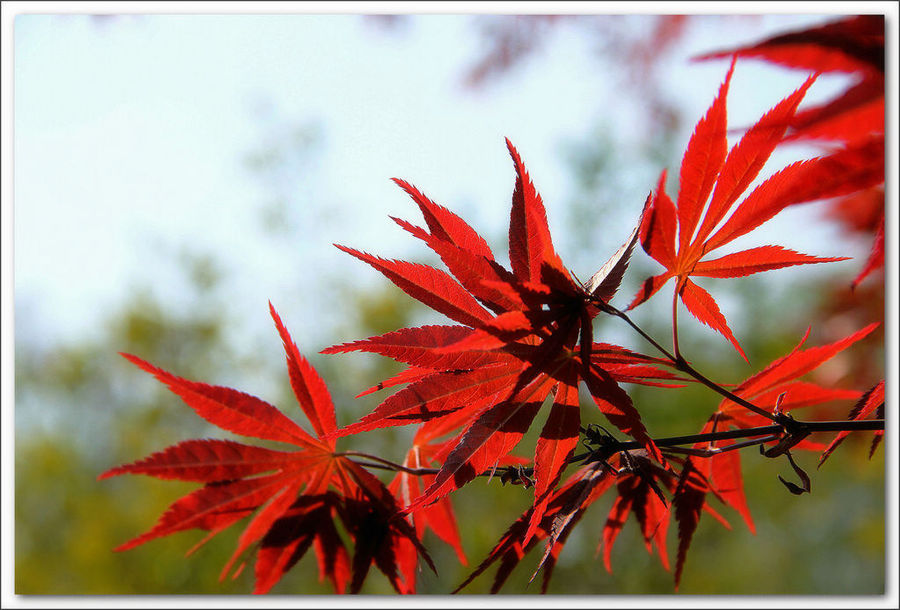
Japanese maple (scientific name: Acer palmatum Thunb.) is a deciduous small tree in the Aceraceae family, genus Acer; the crown is umbrella-shaped. The bark is smooth. The bark is dark gray. The twigs are purple or pale purple-green, and the old branches are pale gray-purple. The leaves are nearly round, with a heart-shaped or nearly heart-shaped base, palmately lobed, usually with 7 deep lobes, densely set with sharp serrations. It flowers after the leaves emerge; the flowers are purple, polygamous, with male flowers and bisexual flowers on the same plant; the inflorescence is a corymb. The sepals are ovate-lanceolate; the petals are elliptic or obovate. Young fruit is purplish-red, turning brownish-yellow when mature; the nutlet is spherical, with prominent veins, and the two wings form an obtuse angle. The flowering and fruiting period is from May to September.
-
Propagation methods:
Generally, seed sowing is used for propagation, and grafting can also be used. After the samaras mature in October, sow them immediately after collection, or store them in moist sand stratification and sow again the following spring. Drill sowing with a row spacing of about 20 cm, cover with soil about 1 cm thick, and cover with rice straw. They germinate and emerge in late March, and the straw should be removed promptly.
To prevent scorching by intense sunlight, build a shade shed in July and August, water to prevent drought, and apply additional dilute, fully decomposed cake fertilizer water to promote the growth of the seedlings. The seedling nursery advises that current-year seedlings can reach 30-40 cm tall, and after staying in the bed for another year they can be transplanted separately. Ornamental varieties such as red maple and laceleaf maple are usually propagated by grafting, carried out before bud break in spring, using 2-3 year old Japanese maple seedlings as rootstock. Cut grafting or side grafting should be done several centimeters above the ground. After the graft takes, growth is relatively slow, so management should be strengthened. If single-bud side grafting is carried out in summer, the survival rate is relatively high and the finished plants are also faster. Wild Japanese maples are mostly tree-like and not suitable for making bonsai; wild seedlings under the forest can be dug up and potted, and can be shaped into beautiful ornamental bonsai
-
Potting process
Pot selection: Japanese maple is suitable for a relatively shallow oval or rectangular glazed ceramic pot; among these, for the red-leaved varieties, colors such as grayish-white, light blue, light green, and light yellow are suitable, and black also has a very good effect. For green-leaved types, colors such as purple and red can be chosen.Soil: Japanese maple likes fertilizer and moisture, and is suitable for fertile, loose, and moist slightly acidic soil or neutral soil. For potting, humus-rich mountain soil or leaf mold can be used.Planting: This can be done in March in spring or after leaf fall in autumn. When planting, take care to spread the roots out and do not let them curl up in the pot soil. For precious varieties, management should be strengthened after planting, keeping the pot soil moist and placing it in a shaded place, then moving it to a ventilated and light-transmitting place once growth is vigorous.
-
Pruning management
Processing: Japanese maple is mostly shaped by combining binding and pruning. For binding, palm fiber is suitable, and it must be removed promptly, otherwise it easily cuts into the branches. If metal wire is used for binding, even more care must be taken to prevent it from cutting into the branches. Binding processing is best carried out during the plum rain period or after leaf fall. The large branches of Japanese maple can be bound, while the small branches are better pruned; generally leave 1-2 nodes on each branch and cut off the front end, so that the two side branches that grow form a forked shape, and then prune in the same way in sequence, finally forming the crown.
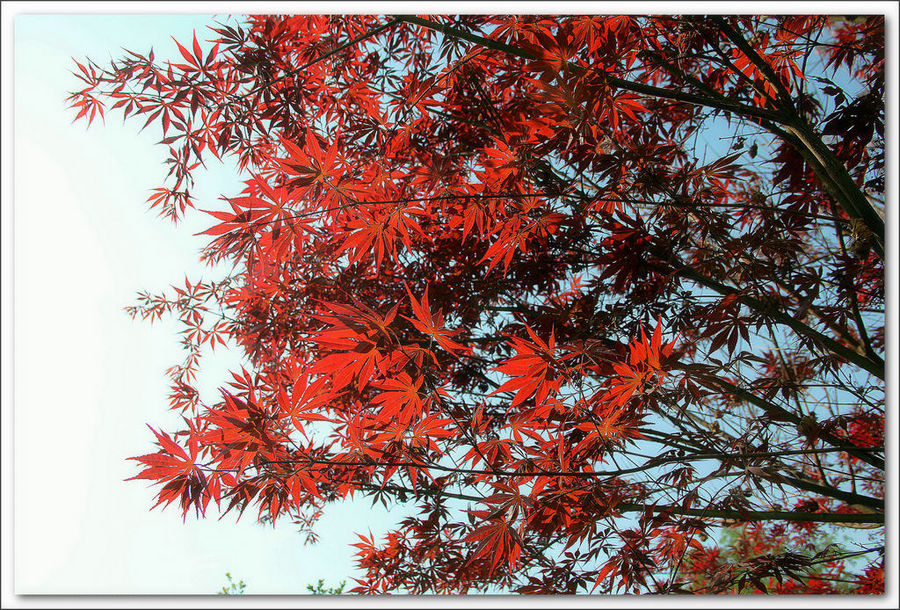
Tree shape: Japanese maple is suitable for making group plantings or forest-style arrangements. As a single planting, it can be made into tree forms such as slanting trunk style and curved trunk style. The leaf shape is elegant, and the red color is vivid and varied, making it quite beautiful.
When making a group planting style, attention must be paid to handling the primary and secondary, sparse and dense, high and low, and near and far aspects. One may refer to the layout of group-planted golden larch, with the difference being that golden larch is mostly straight-trunked, while Japanese maple often has curves, so when group planting, attention must also be paid to the direction and degree of trunk curvature, so as to achieve unity and harmony
- Pest and disease control
Prevention should be given priority; spray hymexazol or dimethomorph or Aimiao emulsifiable concentrate + ningnanmycin + abamectin + beta-cyhalothrin or chlorpyrifos or acetamiprid + organosilicon at 3000 times solution; when there is no disease, apply once every 15-20 days, and when the disease is severe, apply once every 5-7 days. Note to alternate medications.
Common insect pests of Japanese maple include white grubs, mole crickets, scarab beetles, stinging caterpillars, aphids, longhorn beetles, heart borers, black worms, and Asian longhorn beetles, etc.
Control of white grubs, mole crickets, etc. Underground pests such as white grubs and mole crickets gnaw the roots and stems of seedlings, causing the seedlings to wither and die. A 1000 times solution of 50% phoxim emulsifiable concentrate or 48% Lorsban emulsifiable concentrate can be used, mixed with fine soil and spread or poured at the roots.
Control of scarab beetles, stinging caterpillars, aphids, etc. Pests that eat branches and leaves, such as scarab beetles, stinging caterpillars, aphids, and red spiders, often feed on red maple leaves, causing poor growth of the seedlings; abamectin, Bukuai, or omethoate at 800-1000 times can be used for spraying.