Detailed Guide to the Planting Methods and Daily Care Techniques of the Agave
The Agave, also known as the Nuleishen, is a perennial herbaceous succulent plant with a short stature, leaves clustered at the base and arranged in a rosette. The leaves are obovate-spatulate, 20-25 cm long and 9-11 cm wide, narrower at the base, thick, grayish-white or pale bluish-green, with dark brown spines on the leaf tips and margins, and the leaf margins have backward-facing serrations. No petiole. The plant readily produces offsets around itself that grow close together. The inflorescence is 3 m tall, with flowers about 5 cm in diameter, yellow-green, native to Mexico. It has been introduced to China and is cultivated in all regions.
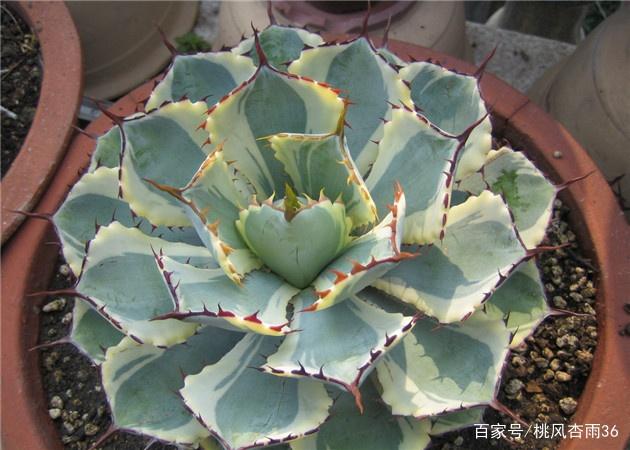
Planting methods:
The Agave, like other succulents, generally relies on leaves for propagation. If you want to grow more pots of Agave, you only need to pick a leaf from the Agave after the weather warms up in spring. After the wound has dried, simply insert the leaf slightly into relatively moist sandy soil. In the meantime, as long as the sandy soil is kept moist and direct sunlight is avoided, the Agave will slowly begin to take root.
The Agave does not grow as fast as other succulents. The Agave grows slowly, so when taking cuttings, its rooting speed is also slower than that of other succulents. Therefore, when taking Agave cuttings, do not be impatient. After inserting the Agave leaves, you can place it in a relatively shady place and let it slowly take root. During the planting process, when you notice the soil is dry, you can spray a little water on the sandy soil; it is best not to water it directly. While the Agave is rooting, try not to frequently turn over its leaves. When the Agave grows some aerial roots, you can place it in the sunlight to receive sun exposure. This will speed up the Agave's rooting. Once the Agave's root system is more or less developed, you can continue normal daily care.
In the daily care of the Agave, the Agave actually likes a dry environment. So when watering the Agave, you do not need to water it often. When you find that the soil in the pot is almost dry, you can water it. Although the Agave prefers dryness, that does not mean it does not need watering. Once the Agave lacks water, its leaves will turn yellow or even shrink and wither. So when watering, water thoroughly after the soil has dried out. If you cannot get the rhythm right, you can water once after an interval of about ten days following a thorough watering. In summer, when temperatures are higher and water evaporates faster, it is best to water the Agave once every 3 to 5 days. In winter, reduce the frequency of watering. Generally in winter the Agave has low water requirements; watering once within 20 to 30 days is enough. Reducing the frequency of watering in winter can better ensure the soil stays dry, allowing the Agave to overwinter better.
If the soil is changed every year, the Agave does not need any fertilizer. But when changing the soil, you must make sure the soil has enough nutrients. Below, Xiaofeng will tell everyone how to change the soil for the Agave in spring. When changing the soil, we can buy succulent soil from the market or mix it ourselves. When mixing, you can use sandy soil with good drainage as the main component. A mixture of 3 parts rotted leaf mold, 3 parts sandy soil and 3 parts ordinary soil plus bone meal or shell powder can serve as the base soil in the pot. When changing the soil, you can cut off part of the Agave's root system. This can make the Agave's root system more vigorous. When trimming the roots, you can give priority to cutting off dead roots and longer roots, and then cut off part of the old roots. There is no need to cut off too many roots; just reaching one third is enough.