Bottle gourd (Lagenaria siceraria), also known as calabash, is an annual vining herbaceous plant of the genus Lagenaria in the Cucurbitaceae family. The young fruit of bottle gourd has a mild flavor and a tender, delicate quality, making it suitable for boiling. In some areas around Hebei, "hulu gua" refers specifically to zucchini, while "huzi" is used to refer specifically to bottle gourd. In ancient China, its mature, dried fruit shell was used as a container and also for medicinal purposes. Bottle gourd is a medicinal gourd vegetable that can reduce swelling and nourish the skin. It has been cultivated in China since ancient times; the young fruit is edible, but once old it cannot be eaten, and it is a dish commonly eaten in summer among the people. Compared with other fruits and vegetables, its nutritional value is relatively low. The edible part is the young fruit. Bottle gourd has a fine, tender, soft quality with a slight sweetness, and after peeling it can be eaten entirely. It can be stir-fried or stewed in soup. Bottle gourd is cultivated throughout northern and southern China, commonly in the south, and in recent years the north has also begun introducing and cultivating it.
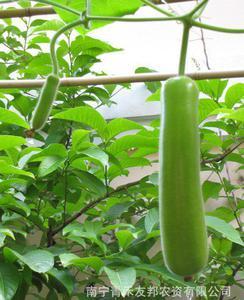
Planting methods
The seed coat is relatively thick, so germination is relatively slow. To make the main vine produce side vines and female flowers early, once the main vine has grown 4-6 nodes, the terminal bud of the main vine can be removed. Plant hormones can also be used to promote early female flowers on the main vine and earlier fruiting. Bottle gourd has relatively high requirements for fertilizer and water, so sufficient base fertilizer must be applied, along with multiple topdressings of quick-acting nitrogen fertilizer. It is not tolerant of waterlogging or drought; in rainy areas, attention should be paid to drainage, and in drought, timely irrigation is needed. Cultivation season: bottle gourd is generally sown in spring and harvested in summer. When cultivated in protected structures, it can be appropriately advanced or delayed.
Planting method
Bottle gourd can be directly sown in the open field before the last frost, or raised as seedlings in a protected structure and then transplanted. Before sowing, the seeds need treatment. They must be soaked for 24-48 hours and then sown; the seeding rate is 250 grams per mu. The management of bottle gourd seedlings is the same as that of spring cucumbers. The cucumber seedling-raising technique can be referenced.
Sowing and seedling raising
Use a hotbed to raise seedlings. Sow from late February to early March, with a seeding rate of 3.75 kg per hm2 (0.25 kg per 667 m2). Before sowing, soak the seeds in 55°C warm water for 15 min, then place them under a constant temperature of 25-30°C to promote germination; after the sprouts emerge uniformly, sow them into nutrient pots. During the seedling stage, keep warm and prevent cold damage, provide ventilation and light, and keep the soil moisture appropriate. The seedling age is about 30-35 d. About 10 d before transplanting, carry out low-temperature hardening of the seedlings.
Land preparation and fertilization
Apply sufficient base fertilizer: 30000-45000 kg of decomposed organic fertilizer per hm2 (2000-3000 kg per 667 m2), 15000-22500 kg of human feces and urine (1000-1500 kg per 667 m2), or 1500-1875 kg of cake fertilizer (100-125 kg per 667 m2), and 300-400 kg of superphosphate (20-30 kg per 667 m2). About 10 d before transplanting, make beds with a bed height of 20-25 cm, a bed width of 100 cm, and a ditch width of 50 cm, then lay plastic film and wait for planting.
For transplanting, the plant spacing is 0.67 m; dig holes and plant a single seedling, then water to settle the roots. Before plowing, use paraquat to control weeds once; after the land is prepared, spray butachlor once, and only then carry out transplanting.
Plant adjustment: bottle gourd can be cultivated with or without trellising. For ground crawling without trellising, vines need to be pressed to prevent wind damage; for trellising, when the seedlings grow to 30 cm tall, use 2-3 m long bamboo poles to set up an A-frame trellis, crossing at about 1.3 m. To facilitate side vines climbing and manual tying of vines in layers, 2-3 horizontal bars are needed. As the seedlings grow, tie the vines to the trellis several times and distribute them evenly. Bottle gourd mainly sets fruit on secondary and tertiary vines, so plant adjustment should be carried out, often with 2-3 pinching treatments to promote the development of secondary and tertiary vines. If sprayed twice, the number of continuously borne nodes is greater, and the occurrence of male flowers is greatly reduced.
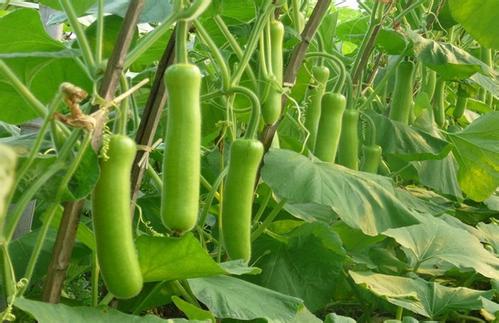
Fertilizer and water management
Bottle gourd has weaker growth vigor than other cucurbits, a short growth period, and concentrated fruiting; in addition to base fertilizer, topdressing and irrigation are also needed. Topdressing should be light and frequent. Apply fertilizer once each after transplanting survival and after pinching, and during the fruit enlargement period. After harvest begins, topdress 1-2 times in stages to promote the growth of later-maturing fruits. Bottle gourd needs relatively more water, so it should be watered in a timely manner; during the fruiting period, in dry weather it can be watered once every 1-2 days, but if there is a lot of rain, drainage should be timely to prevent waterlogging.
Topdressing should be based on soil fertility and combined with watering. Generally, 6 days after transplanting, apply 15 kg of bean bran infusion, 1.5 kg of biological phosphorus, and 1.5 kg of biological potassium per 667 square meters, mixed with manure water and poured on; apply once every 7-10 days. After planting, 10-15 days later, insert poles and set up the trellis. Prune branches and remove side shoots, pinch the growing tips. Remove old leaves and adjust the space to provide ventilation and light. When the plant has 4-6 true leaves, spray the foliage twice with 1.5-6 ethephon, which can promote earlier formation and increase the number of female flowers and raise yield.
Harvest
Timely harvesting can improve fruit quality and promote continued fruit set on the upper part and the growth of subsequent fruits; this is an important measure for early-maturing, high-yield cultivation. When the fuzz on the young gourd has basically fallen off and the skin color has become lighter, it is at the suitable harvest stage. Generally, the harvest time for the first batch of gourds is 15-20 days after flowering, and for the peak fruiting period it is 10-12 days after flowering. Harvesting the fruit too old affects its edible value.
Fruit: In autumn, pick fruits that have matured but whose outer skin has not yet become woody, and use them after peeling. Seeds: In autumn, collect mature fruits, take out the seeds, wash them, and dry them in the sun.
Fruit shell: In late autumn and early winter, collect old mature fruits, cut them open, remove the pulp and seeds, break them into pieces, and dry them in the sun. Stems, leaves, flowers, tendrils: Harvest in summer and autumn, and dry in the sun.