Detailed Explanation of Tomato Planting Methods and Key Technical Points
The tomato is a perennial herbaceous plant of the genus Solanum, subgenus Tomato, in the nightshade family, also known as the tomato or foreign persimmon. The character "" in "" (tomato) is sometimes mistakenly written with the grass radical as "". It originated in Central and South America, is commonly cultivated throughout China, and is produced in greater quantities in summer and autumn. It is now widely grown worldwide as an edible vegetable and fruit, and is generally considered a nutritious food.
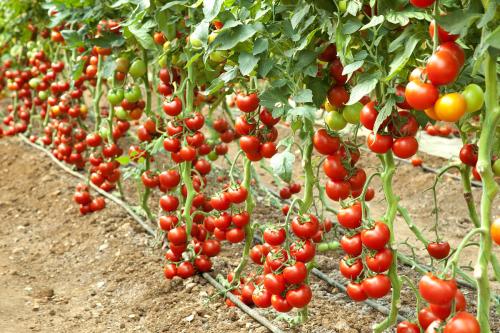
Pollution-free Cultivation Technology for Early Spring Greenhouse Tomatoes
The cropping arrangement for early spring greenhouse tomatoes mainly involves sowing and raising seedlings in winter and producing in early spring; the technical difficulty and risk are low, and the yield and economic benefit are relatively high, making it one of the main cultivation forms of greenhouse tomato production in Bozhou at present.
1 Variety Selection
There are many varieties suitable for tomato production in this crop. Such as L402, Zhongza No. 7, 8, and 9, American Big Red, Sunshine 903, Shanghai 903, and Ruby No. 2.
Generally, mid-to-late maturing varieties are the main choice, with early and mid-to-late maturing varieties intercropped.
2 Cultivating Disease-free Strong Seedlings
The sowing period for early spring greenhouse tomatoes varies by region. Generally, in the Bozhou area, sowing and seedling raising in the greenhouse take place from the end of December to the beginning of January of the following year. Seedlings are separated when they have two true leaves and one heart leaf; the seedling age is 60-70 days, and they are transplanted when the seedlings are 20-25 cm tall, have 7-9 leaves, and generally show large buds.
3 Transplanting
3.1 Land preparation and fertilization: Clear away dead branches and fallen leaves from around the area, deep-plow and prepare the land 15-20 days in advance, plowing 30-40 cm deep to sun the ridges; especially for greenhouses where the previous crop was leafy vegetables, deeper plowing is even more necessary, and the greenhouse and soil should be disinfected as described above. In conjunction with land preparation, apply 5000 kg of fully decomposed organic fertilizer per mu. Tomato seedlings and early growth stages have ***high phosphorus uptake, so 10-15 kg of superphosphate can be piled and fermented together with organic fertilizer. Base fertilizer is not better the more the better; too much fertilizer will cause excessive vegetative growth, and instead lead to late flowering, slow fruit growth, and more deformed fruit.
3.2 Transplanting: Use small raised ridges with plastic film mulching cultivation in the greenhouse. For plastic film mulching, use double ridges covered with one sheet of film or cover a 1-meter-wide high bed, with a bed surface width of 70 cm, open a 20-25 cm wide small ditch in the middle of the bed, apply base fertilizer in the ditch, and apply 5000-8000 kg of high-quality organic fertilizer or decomposed biogas slurry per mu. If superphosphate is not used, add 15 kg of diammonium phosphate or 30 kg of compound fertilizer, level it with a rake, then pat it into a concave ditch with a shovel for dark irrigation in the small ditch under the film. If conditions permit, plastic soft hose drip irrigation equipment can be installed under the film, with very good results.
The temperature indicators for transplanting early spring greenhouse tomatoes are: when the 10 cm soil temperature is stably above 8 degrees and the ***low air temperature is above 10°C, the transplanting period in the Bozhou area is in mid-February. Usually early maturing varieties use plastic-mulched bed planting, with about 5500 plants per mu; mid-maturing varieties use film-covered ridge planting, with about 4000 plants per mu, and row-to-plant spacing of 45 cm × (27-40) cm. After transplanting, water thoroughly with transplanting water, but do not flood-irrigate with open water; attention should be paid to sealing the film openings well to prevent soil compaction.
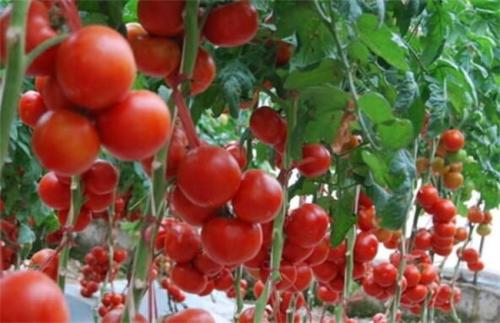
Pollution-free Cultivation Technology for Late Autumn Greenhouse Tomatoes
Late autumn greenhouse tomatoes mainly address the off-season problem in the tomato market in late autumn and early winter. In the early growth stage of this tomato crop, high temperature and drought occur, and viral disease is relatively severe; in the later stage, light decreases and temperature drops, affecting fruit enlargement and coloring. The key to cultivation technology is selecting disease-resistant varieties and cultivating disease-free strong seedlings. After transplanting, prevent high temperature and strong light in the early stage, and pay attention to preventing aphids, so as to avoid excessive growth and viral disease; seize the period in the middle when temperature and light conditions are ***most suitable to complete fruit set of 3-4 trusses and promote their enlargement; strengthen insulation in the later stage to avoid freezing damage.
1 Selecting Excellent Disease-resistant Varieties
Select varieties that are heat-tolerant, cold-tolerant, disease-resistant, high-yielding, large-fruited, thick-skinned, storage- and transport-tolerant, and highly adaptable, such as Maofen 802, L402, Zhongza No. 8 and 9, and Jiafen No. 15, etc.
2 Cultivating Disease-free Strong Seedlings
It is required to cultivate virus-free robust seedlings under relatively high temperature. In the Bozhou area, sowing from late June to early July is appropriate; sowing earlier or later results in very obvious differences in yield and benefit. Management during this seedling-raising period mainly prevents viral disease and excessive seedling growth caused by high temperature and drought. If seedlings show a tendency to excessive growth, spray with 0.05%-1% chlormequat; after spraying, prevent drought, and water in the morning and evening.
3 Transplanting
Before transplanting, cover the lighting surface of the greenhouse with anti-drip film, roll up the front bottom edge about 1 meter high, open ventilation openings at the rear, and cover the greenhouse film with a shade net or straw curtain on top to form a cool shed.
In conjunction with land preparation, apply 5000 kg of decomposed fertilizer, high-quality farmyard manure, or decomposed biogas slurry per mu, deep-plow and level, open transplanting ditches at 50 cm row spacing, and apply 40 kg of diammonium phosphate per mu in the ditches.
The day before transplanting, water the seedbed heavily; when transplanting, cut blocks while planting seedlings; the transplanting depth should mainly bury the original roots, and never lay large seedlings horizontally; plant spacing is 30 cm, with about 4000 plants per mu, and water heavily after earthing up.
Current Market Situation
International Market
Price Fluctuations