Planting Methods and Technical Key Points for Scutellaria indica
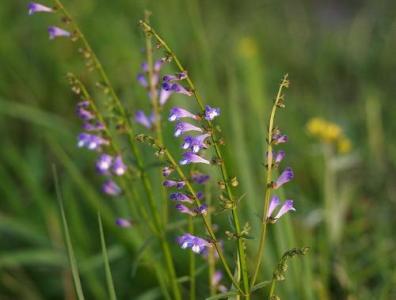
Scutellaria indica (scientific name: Scutellaria indica L.) is a perennial herbaceous plant of the genus Scutellaria in the Lamiaceae family; the rhizome is short, the stems are ascending and erect, four-angled, usually dark purple, the leaves are herbaceous to nearly firm-papery, cordate-ovate or orbicular-ovate to elliptic, with a blunt or rounded apex, densely and neatly rounded-toothed margins, both surfaces sparsely pubescent or strigose, and the leaf stalks are flat above and convex beneath, densely covered with fine soft hairs. Racemose inflorescence; flowers opposite, both pedicels and rachis covered with fine soft hairs; ovate, with rounded teeth on the margins, entire, sessile, the calyx covered with stiff hairs and fine soft hairs, the scutellum erect at fruiting time, the corolla blue-purple, the limb bilabiate, the upper lip helmet-shaped, the middle lobe of the lower lip rounded-ovate, the disc thick and fleshy, the ovary stalk short and smooth; the style slender. Mature nutlets chestnut-colored or dark brown; flowering and fruiting from February to June.
Planting Methods
It prefers a warm and humid climate and is best cultivated in loose, fertile loam or sandy loam with good drainage.
[Land preparation]: Scutellaria indica has strong adaptability and can be sown in all regions. Before sowing, plow the land once and apply sufficient base fertilizer; fertilizer rates: 15000 kg/ha of decomposed farmyard manure, 375 kg/ha of compound fertilizer or cake fertilizer. Make beds 120 cm wide, rake them level, work the soil fine, spray once with herbicide, and they are ready for planting. Scutellaria indica is propagated by seed and can be sown in spring, summer, and autumn. Generally, sowing is done from late March to early July. The sowing rate is 3.25-4.5 kg per hectare. There are two methods of sowing: raising seedlings for transplanting and direct sowing in the field.
[Raising seedlings for transplanting]: Prepare a seedbed 120 cm wide, apply sufficient base fertilizer, work the soil fine, and rake it level. The sowing rate is 0.0125 kg per square meter. Before sowing, mix every 0.025 kg of seed with 2.5 kg of fine moist soil, stir repeatedly until evenly mixed, then sow evenly into the seedbed, do not cover with soil, then cover with straw or plastic film, and water once a day or every other day to keep the soil moist; seedlings emerge in 7-14 days. If most seedlings have emerged, remove the covering and continue spraying water until all seedlings have emerged. When the seedlings reach 5 cm in height, they can be transplanted to the field, 1 plant per hole, with plant and row spacing of 20 cm each. After transplanting, water several times to preserve soil moisture.
In the prepared field, sow in drills with a row spacing of 30 cm. When sowing, scatter the seeds evenly into the drill holes, then lightly cover with loose fine fertile soil or plant ash, with a thickness not exceeding 0.5 cm. After sowing, the soil must be kept absolutely moist for half a month. To ensure that all directly sown seeds in the field germinate, it is generally best to sow during warm weather with continuous rain.
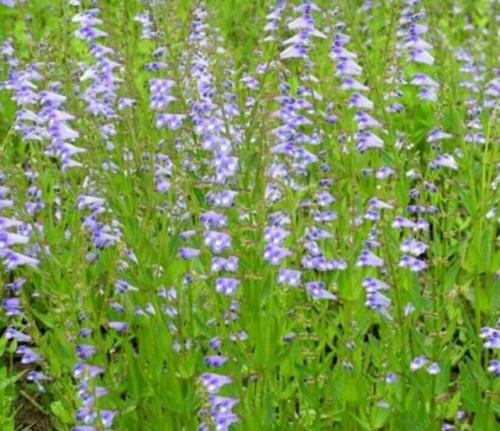
[Cultivation, weeding, and topdressing]: For seed-propagated plants, carry out the first cultivation, weeding, and topdressing after thinning; use 15000 kg/ha of light human and livestock manure water. From the second year on, carry out 3-4 successive rounds, once in early March during the branching stage and once each after harvest in May, July, and September; after each cultivation, apply 22500-30000 kg/ha of human and livestock manure water each time, and some ammonium sulfate may also be applied appropriately. Generally, after 3-4 consecutive years of cultivation, because the root crowns age and their sprouting ability weakens, the root crowns must be renewed or the field must be resown.
[Pest and disease control]: Scutellaria indica has no notable diseases throughout its growing period. However, aphids and cabbage black worms easily occur during the second flowering period. For aphids, 300 times diluted dimethoate can be used with an equal amount of edible vinegar for control; for black worms, 50% dichlorvos diluted 1000 times can be sprayed for control.